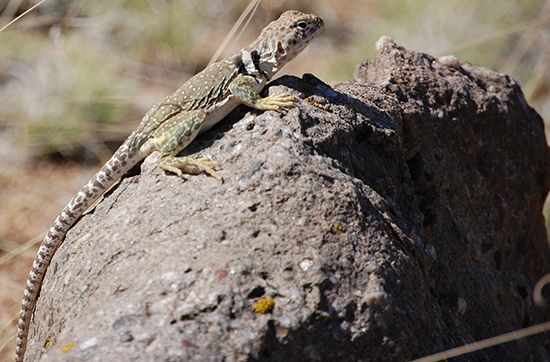
Collared Lizard
Collared lizards (genus Crotaphytus) are known for several distinct behaviors and characteristics:
What are some interesting behaviors or habits unique to collared lizards?
Collared lizards (genus Crotaphytus) are known for several distinct behaviors and characteristics:
- Bipedal Locomotion: These lizards are notably active and nimble; they frequently lift their front legs off the ground to run exclusively on their hind legs.1
- Coloration Dynamics: Their appearance is not static. Collared lizards exhibit color changes influenced by temperature, light intensity, and the season. During the breeding season, they undergo hormonal shifts that result in seasonal color changes, with males typically displaying much brighter hues—ranging from cobalt blue and green to tan, brown, and gray—than females.1
- The “Mountain Boomer” Myth: In the eastern portion of their range, they are often called “mountain boomers.” This name originated from early pioneers who mistakenly attributed loud noises heard on rocky hillsides to these lizards.1
- Dietary Habits: They are active predators that feed on large insects and even other lizards.1
How do collared lizards differ from other lizard species in their family?
Collared lizards (genus Crotaphytus) belong to the family Crotaphytidae, a group that also includes the leopard lizard (genus Gambelia). While these two genera share the same family, they exhibit distinct characteristics and behaviors that set them apart from other lizard species and each other:24
- Locomotion: Both collared and leopard lizards are notable for their ability to run bipedally, using only their hind limbs to achieve high speeds across open habitats when disturbed. This behavior is a specialized form of movement that distinguishes them from many other lizards that rely on a standard quadrupedal, sprawled gait.54
- Physical Traits: Collared lizards are characterized by their relatively massive heads and vibrant, variable coloration, which shifts based on temperature, light intensity, and reproductive status. In contrast, leopard lizards are often described as large and spotted, with specific species like the long-nosed leopard lizard inhabiting arid and semi-arid regions.24
- Diet and Behavior: Both groups are active predators that feed on large insects and other lizards. However, leopard lizards are also known to consume seeds and flowers, and they notably exhibit no signs of parental care after laying their eggs.24
Where are collared lizards typically found in the wild?
Collared lizards (genus Crotaphytus) are primarily found in the hilly regions of the central United States and northeastern Mexico. Their range extends westward to the Great Basin.2
These lizards are typically associated with rocky hillsides, which provide the terrain necessary for their active, nimble lifestyle.2
What is the mating and reproductive cycle of collared lizards?
The mating and reproductive cycle of the collared lizard (Crotaphytus) is characterized by seasonal hormonal shifts and specific egg-laying behaviors.
- Seasonal Changes: As the breeding season approaches, collared lizards undergo hormonal changes that result in seasonal color variations. Males, which are typically larger than females, exhibit vibrant colors ranging from green and cobalt blue to tan, brown, and gray, while females are generally less brightly colored.2
- Breeding and Egg Deposition: The breeding season for these lizards concludes in June. Following this period, females produce clutches consisting of 2 to 11 leathery-shelled eggs. These eggs are deposited directly into the ground.2
- General Reproductive Context: Like other reptiles, collared lizards utilize internal fertilization. While many reptiles exhibit diverse nesting strategies, collared lizards are oviparous (egg-laying) and, consistent with most lizard species, do not provide parental care once the eggs have been laid.289
Sources
- lizard - Locomotion and limb adaptations — Encyclopædia Britannica
- collared lizard — Encyclopædia Britannica
- collared lizard — Merriam-Webster
- reptile - Walking and crawling — Encyclopædia Britannica
- leopard lizard — Encyclopædia Britannica
- crotaphytus — Merriam-Webster
- heteropteran - Annotated classification — Encyclopædia Britannica
- reptile - Embryonic development and parental care — Encyclopædia Britannica
- reptile: Top Questions — Encyclopædia Britannica
- reptile - Life cycle and life history — Encyclopædia Britannica
Published on · 3 min read