Ligurian Sea
The Ligurian Sea is an arm of the Mediterranean Sea that indents the northwestern coast of Italy. It is situated between the Italian regions of Liguria and…
What is Ligurian Sea?
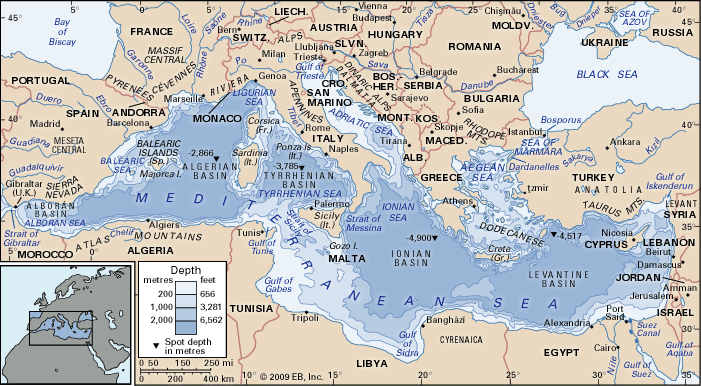
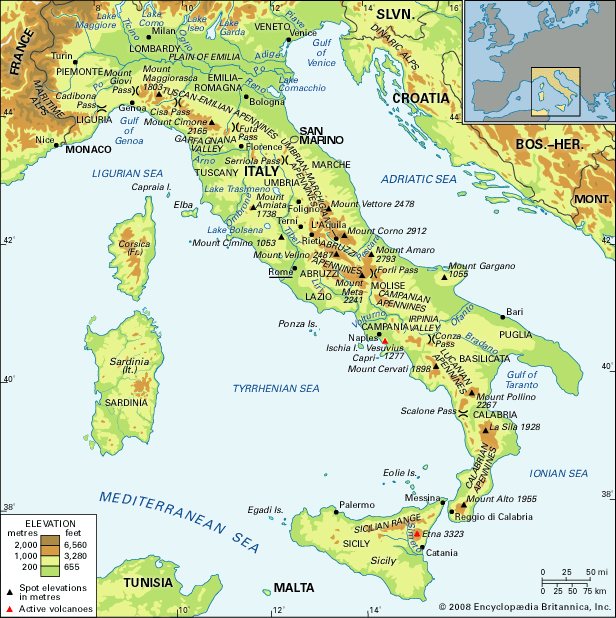
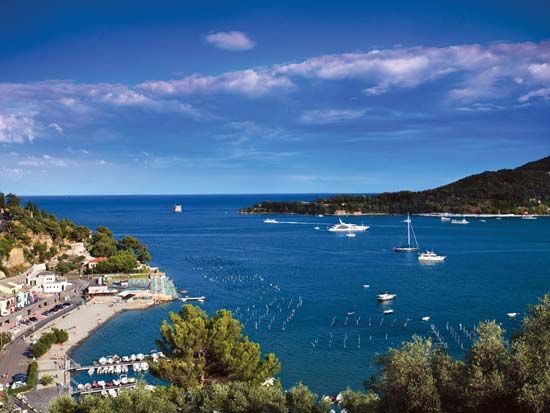
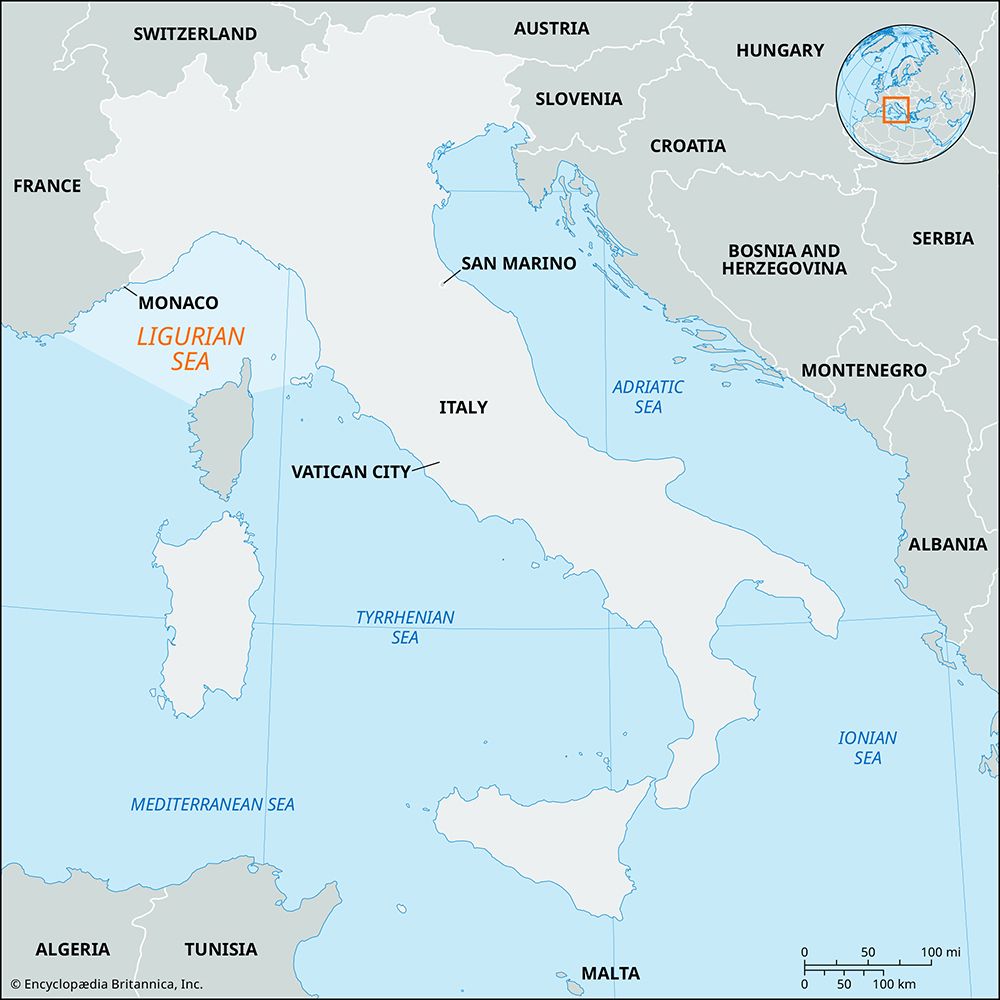
The Ligurian Sea is an arm of the Mediterranean Sea that indents the northwestern coast of Italy. It is situated between the Italian regions of Liguria and Tuscany to the north and east, and the French island of Corsica to the south.1
The sea reaches depths exceeding 9,300 feet (2,850 meters) northwest of Corsica and receives water from numerous rivers originating in the Apennines. In the north, it contains the Gulf of Genoa, and it connects to the Tyrrhenian Sea in the southeast via the Tuscan Archipelago. The region is historically significant, with the adjacent Ligurian coast serving as a major maritime and commercial hub centered around the city of Genoa.12
What is the history of the Republic of Genoa?
The Republic of Genoa evolved from an independent commune formed before 1100 into a formidable maritime power that dominated Mediterranean trade during the 12th and 13th centuries. Governed initially by elected consuls, the state functioned as a business enterprise managed by influential families such as the Doria, Spinola, Grimaldi, and Fieschi.3
Rise and Expansion
Genoa’s power grew through its naval strength and commercial networks, which extended across the Mediterranean and into the Black Sea following the 1261 Treaty of Ninfeo. The city established self-governing colonies, including Kaffa in the Crimea and Pera near Constantinople. Its political zenith was marked by a decisive naval victory over Pisa in 1284.3
Decline and Transformation
During the 14th and 15th centuries, internal political strife and costly wars weakened the Republic. Intense rivalry with Venice culminated in the Peace of Turin (1381), which significantly diminished Genoese influence in the East. After periods of foreign domination, Andrea Doria restored order in 1528, aligning Genoa with the Spanish Empire. The Republic eventually lost its remaining overseas territories, including Corsica, before being transformed into the Ligurian Republic under French pressure in 1797 and later annexed by the French Empire.34
How do the Apennine Mountains influence the climate of the Italian Riviera?
The Apennine Mountains play a crucial role in shaping the climate of the Italian Riviera, acting as a protective barrier that shields the coastal region from cold northern winds.56
By blocking these frigid air masses, the mountains help maintain the Riviera’s exceptionally mild winters and contribute to a climate characterized by significant sunshine throughout the year. This shelter is a primary reason why the region is able to support the growth of delicate plants—such as palms, mimosa, and pomegranates—and sustain a thriving agricultural sector that produces flowers, olives, and wine grapes.67
In addition to this protective effect, the local climate is influenced by the area’s exposure to the noonday sun and the moderating presence of the Ligurian Sea, which brings prevailing southwesterly winds. While the entire Riviera benefits from this topography, there are variations in precipitation; the eastern section (Riviera di Levante) generally experiences more rainfall than the western section (Riviera di Ponente) due to the specific orientation and influence of the mountain range.567
What are the other major seas that make up the Mediterranean?
The Mediterranean Sea is a vast, interconnected body of water that is geographically divided into several distinct seas and basins. These include:
- Alborán Sea: Located at the westernmost extremity of the Mediterranean, situated between Spain and Morocco, just east of the Strait of Gibraltar.1011
- Tyrrhenian Sea: Part of the western Mediterranean, this sea lies between the Italian peninsula and the islands of Sardinia and Corsica.11
- Adriatic Sea: Positioned to the northwest of the main eastern Mediterranean body, it is bounded by Italy to the west and by Slovenia, Croatia, Bosnia and Herzegovina, Montenegro, and Albania to the east.11
- Ionian Sea: Located south of Italy, Albania, and Greece, this area contains the deepest point in the Mediterranean.11
- Aegean Sea: Situated north of Crete and bounded by Greece to the west and north, and Turkey to the east.11
Additionally, the Sea of Marmara is often considered part of the Mediterranean system, serving as a vital connection to the Black Sea.10
Sources
- Ligurian Sea — Encyclopædia Britannica
- Liguria — Encyclopædia Britannica
- Genoa - History — Encyclopædia Britannica
- Venice - Struggle for naval supremacy — Encyclopædia Britannica
- Apennine Range - Climate of the Apennine Range — Encyclopædia Britannica
- Italy - Climate of Italy — Encyclopædia Britannica
- Apennine Range — Encyclopædia Britannica
- Mediterranean Sea - Climate — Encyclopædia Britannica
- Riviera — Encyclopædia Britannica
- Mediterranean Sea — Encyclopædia Britannica
- Mediterranean Sea - Physiography — Encyclopædia Britannica
- Mediterranean Sea - Natural divisions — Encyclopædia Britannica
Published on · 3 min read