Locust
A locust is a member of the family Acrididae, a group of short-horned grasshoppers known for their ability to transition from a solitary, harmless state into…
What is locust?
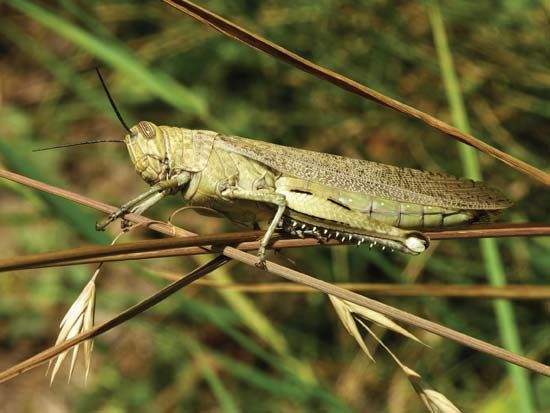
A locust is a member of the family Acrididae, a group of short-horned grasshoppers known for their ability to transition from a solitary, harmless state into a gregarious, migratory phase. While the term is sometimes used broadly to describe various grasshoppers or even cicadas, true locusts are defined by their capacity to form massive, destructive swarms when environmental conditions force them into dense populations.12
This physiological shift is known as phase theory. When crowded, locusts change in appearance, behavior, and metabolism, becoming restless and highly active. These swarms can travel thousands of miles, often aided by winds, and are capable of devastating crops across entire regions. Because these swarms are difficult to control once they develop, management strategies often focus on destroying egg masses or applying insecticides to breeding grounds.12
What is the difference between the solitary and gregarious phases of a locust?
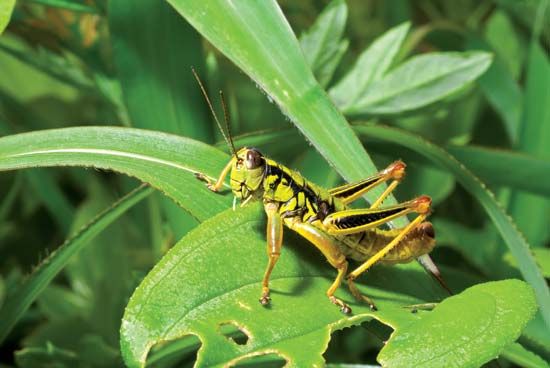
According to phase theory, locusts exist in two distinct states—solitary and gregarious—which differ significantly in appearance, behavior, and physiology.1
Key Differences
Feature
Solitary Phase
Gregarious Phase
Behavior
Sluggish; does not collect in groups.
Active, nervous, and restless; gathers in large swarms.
Coloration
Matches surroundings to provide camouflage.
Fixed pattern of black and yellow or orange.
Physiology
Low metabolic and oxygen-intake rates.
High metabolic and oxygen-intake rates.
Morphology
Shorter wings, longer legs, and a narrower pronotum.
Longer wings, broader shoulders, and a saddle-shaped pronotum.
The Transition
The solitary phase is considered the normal state of the species. The transition to the gregarious phase is a physiological response to environmental stress, typically triggered by crowding when populations are forced into small, habitable areas during unfavorable seasons. This process is mediated by hormonal changes; for instance, crowding exposes individuals to male secretions that accelerate reproductive maturation, leading to a population explosion. These phases are reversible: if a gregarious-phase locust matures in isolation, its offspring will revert to the solitary type.13
How do scientists control or stop a locust plague?
Controlling a locust plague is exceptionally difficult once a swarm has fully developed, making early intervention critical. Because swarms are highly mobile and vast, management strategies focus on both preventing the transition to the gregarious phase and mitigating the impact of existing swarms.1
Effective control measures include:
- Targeting Breeding Grounds: Scientists and agricultural authorities monitor and apply insecticides to known breeding areas to disrupt the population before swarms can form.1
- Destroying Egg Masses: Locating and destroying the eggs laid by invading swarms prevents the next generation from emerging.1
- Mechanical Barriers: For nymphs (the flightless stage), digging trenches can trap them, or “hopperdozers”—wheeled screens—can be used to knock them into troughs filled with water and kerosene.1
- Aerial Application: Aircraft are frequently used to spray insecticides directly onto swarms and breeding sites to cover large, inaccessible areas efficiently.1
- Insecticidal Baits: Using poisoned baits can help reduce local populations in specific agricultural zones.1
Are cicadas and locusts the same type of insect?
No, cicadas and locusts are not the same type of insect; they belong to entirely different biological orders and have distinct life cycles and behaviors.
- Locusts are members of the family Acrididae within the order Orthoptera. They are essentially a type of short-horned grasshopper capable of undergoing a dramatic physiological transformation. Under specific environmental conditions, they shift from a solitary, sluggish phase to a gregarious, migratory phase, forming massive, destructive swarms that can travel long distances.4
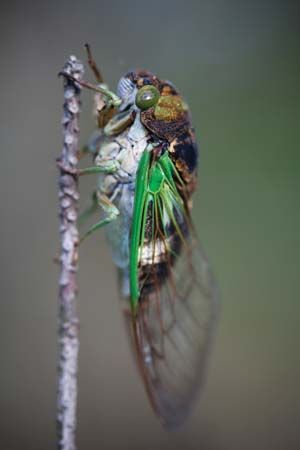
- Cicadas belong to the family Cicadidae within the order Hemiptera. They are sound-producing insects known for their loud, rhythmic songs and long underground larval stages. Unlike locusts, they do not form migratory swarms, though they may emerge in large numbers periodically.51
The confusion often arises because of the term “17-year locust,” which is an erroneous common name frequently applied to the periodical cicada. While both insects are sometimes referred to as “locusts” in colloquial language, they are biologically unrelated.145
Sources
- locust — Encyclopædia Britannica
- insect - Damage to growing crops — Encyclopædia Britannica
- Orthoptera - Hormones — Encyclopædia Britannica
- Did you know? — Merriam-Webster
- cicada — Encyclopædia Britannica
Published on · 3 min read