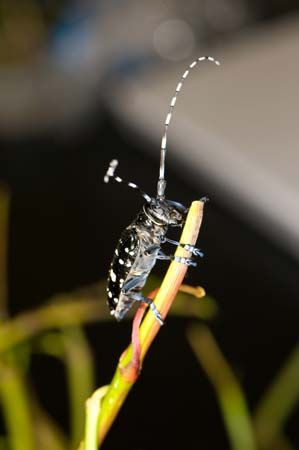
Long-horned Beetle
Long-horned beetles, belonging to the family Cerambycidae, are primarily distinguished by their extremely long antennae, which are often longer than their…
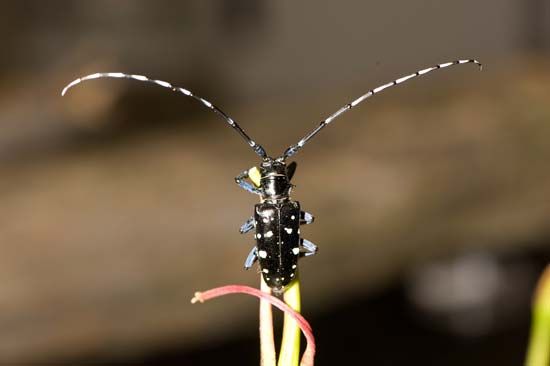
What are the distinguishing physical characteristics of long-horned beetles?
Long-horned beetles, belonging to the family Cerambycidae, are primarily distinguished by their extremely long antennae, which are often longer than their own bodies.123
Key physical characteristics include:
- Size: Adults range from 2 to 152 mm in length, though their total length can double or triple when the antennae are included.2
- Body Form: They are diverse in structure, ranging from slender to medium or large in size. Some species exhibit specialized features, such as the toothlike, expanded margins of the prothorax found in Prioninae or the ridges on the wing covers of certain cerambycids.12
- Coloration and Mimicry: Many species utilize coloration to mimic other insects, such as wasps or ants, to deter predators. Others possess cryptic coloration that allows them to resemble natural elements like moss or lichen.2
- Larval Appearance: The larvae are often referred to as “roundheaded borers” because the front portion of their plump bodies is expanded, giving them a rounded appearance.2
What are some natural predators of long-horned beetles?
Long-horned beetles (family Cerambycidae) are generally well-armored, which provides them with a degree of protection against many potential enemies. However, they still face threats from various predators and parasites throughout their life cycle.4
Parasites
Parasitism is a significant pressure for long-horned beetles, particularly during their larval stage. Various species of wasps act as parasitoids by laying their eggs directly on or inside the beetle larvae. These parasitic larvae then feed on the host, often leading to the death of the beetle. Researchers are currently investigating these natural enemies, including specific fungi and nematodes, as potential tools for biological control against invasive species like the Asian longhorned beetle.456
Predators
While some predators avoid certain beetles due to their tough exterior or potential distastefulness, long-horned beetles are still hunted by a variety of animals, including:
- Birds: Many insectivorous birds, such as swifts, prey on beetles.4
- Mammals: Insect-eating mammals, including bats, are known predators.4
- Other Animals: Reptiles, frogs, and various predatory insects also consume beetles.4
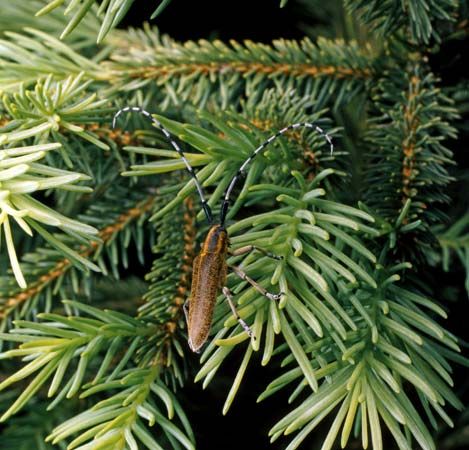
Where are long-horned beetles typically found, and what habitats do they prefer?
Long-horned beetles (family Cerambycidae) are found throughout the world, though they are most numerous in tropical regions. As a group, they occupy a wide variety of environments, but their distribution is closely tied to their specific host plants.8
Preferred Habitats
Because most species are wood-boring, their primary habitats are areas with abundant woody vegetation, including:
- Forests and Woodlands: They are commonly found in forests where they inhabit living, dead, or decaying trees, stumps, and logs.98
- Trees and Woody Plants: Different species are specialized to infest specific hosts, ranging from timber and pulpwood trees to fruit trees, landscape trees, and woody ornamental plants. Some species also inhabit large herbs, stems, or even the roots of plants.89
- Specific Microhabitats: Larvae often develop deep within the heartwood or under the bark of trees, while adults are frequently found on the surface of bark, on flowers, or near damaged trees where they feed on plant juices.98
While many species are solitary, they are widely distributed across diverse climates, excluding extreme environments like Antarctica or high-altitude mountaintops.10
What role do long-horned beetles play in forest ecosystems?
Long-horned beetles (family Cerambycidae) play a complex role in forest ecosystems, primarily as wood-boring insects. Their ecological impact is defined by their feeding habits, which influence both the health and the structural composition of forests.92
Ecological Contributions and Impacts
- Wood Decomposition: By boring into dead or decaying trees, stumps, and logs, long-horned beetle larvae facilitate the breakdown of woody material. This process is a vital part of nutrient cycling, as it helps return organic matter to the soil.92
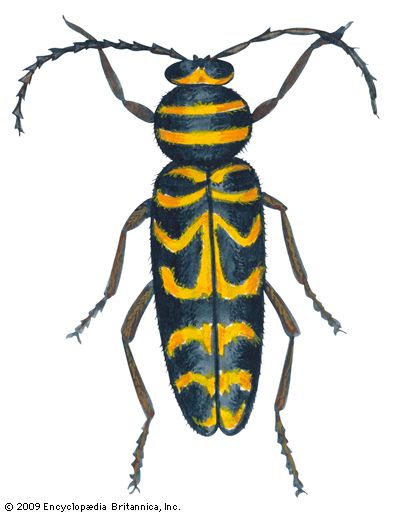
- Tree Health and Mortality: While many species focus on dead or dying wood, some long-horned beetles attack living trees. By boring into stems, trunks, and roots, they can weaken trees, making them more susceptible to other stressors, such as fungal infections. For example, the locust borer creates tunnels that allow damaging fungi to enter the tree.122
- Forest Dynamics: In natural settings, these beetles are part of the forest’s inherent check-and-balance systems. However, when invasive species—such as the Asian longhorned beetle—are introduced to new environments, they can cause significant damage to hardwood trees, often leading to widespread tree mortality because local natural controls may be absent.1113
We could dive deeper into how foresters manage these populations through sanitation and biological control methods.
Sources
- Coleoptera - Size range and diversity of structure — Encyclopædia Britannica
- long-horned beetle — Encyclopædia Britannica
- long-horned beetle — Merriam-Webster
- Coleoptera - Beetles as prey — Encyclopædia Britannica
- Asian longhorned beetle — Encyclopædia Britannica
- ground beetle — Encyclopædia Britannica
- Hymenoptera - Solitary forms — Encyclopædia Britannica
- Coleoptera - Distribution and abundance — Encyclopædia Britannica
- Coleoptera - Feeding habits and habitats — Encyclopædia Britannica
- Taiga - Insects — Encyclopædia Britannica
- Asian longhorned beetle: Top Questions — Encyclopædia Britannica
- Coleoptera - As plant feeders — Encyclopædia Britannica
- forestry - Insect and disease control — Encyclopædia Britannica
- Coleoptera - Special ecological relationships — Encyclopædia Britannica
Published on · 4 min read