Main Range
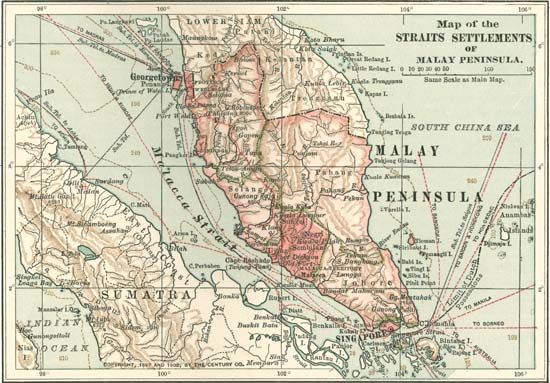
The Main Range is the most prominent mountain group on the Malay Peninsula, located in West Malaysia.
What is Main Range?
The Main Range is the most prominent mountain group on the Malay Peninsula, located in West Malaysia.1
This heavily forested mountain range is composed primarily of granite and extends southward for 300 miles (480 km) from the Thai border. Elevations throughout the range are generally at least 3,000 feet (900 m), with several peaks exceeding 7,000 feet (2,100 m), including its high point, Mount Korbu (7,162 feet [2,183 m]). The range serves as a vital watershed, giving rise to the Perak and Pahang river systems, and its western flanks are home to significant alluvial tin fields. While the range diminishes in elevation near Negeri Sembilan, it features eastward extensions that include Mount Tahan, the highest peak on the peninsula.1
It is important to note that while the term “main range” is sometimes used descriptively for other geographical features, the specific name “Main Range” refers to this Malaysian mountain system.1
How do mountain ranges influence local river systems?
Mountain ranges exert a profound influence on local river systems by acting as physical barriers, water sources, and structural guides for drainage patterns.
Watersheds and Drainage Divides
Mountain ranges often serve as drainage divides, which are elevated regions that separate adjacent drainage basins. For example, the Continental Divide in North America dictates whether water flows toward the Atlantic or Pacific oceans. Similarly, the Virunga Mountains act as a continental-scale divide between the Nile and Congo river basins.45
Structural Control and River Evolution
The relationship between mountains and rivers is often complex. In some cases, rivers are older than the mountains they traverse; as ranges uplift slowly, these rivers maintain their courses by cutting deep transverse gorges through the rising rock. This process creates distinct drainage patterns, such as:6
- Consequent drainage: Streams that follow the initial slope of the land, such as those found in young mountain systems.5
- Radial systems: Streams that radiate outward from a central high point, common in volcanic mountains like Mount Elgon.5
Glacial Influence
Mountains also influence rivers through glaciers, which act as critical water sources at high elevations. Glacial activity can significantly alter river sediment loads, leading to the formation of river terraces when rivers entrench into valley fills composed of glacial outwash.67
What is the difference between a mountain range and a plateau?
The primary difference between a mountain range and a plateau lies in their topography and relief.
Key Differences
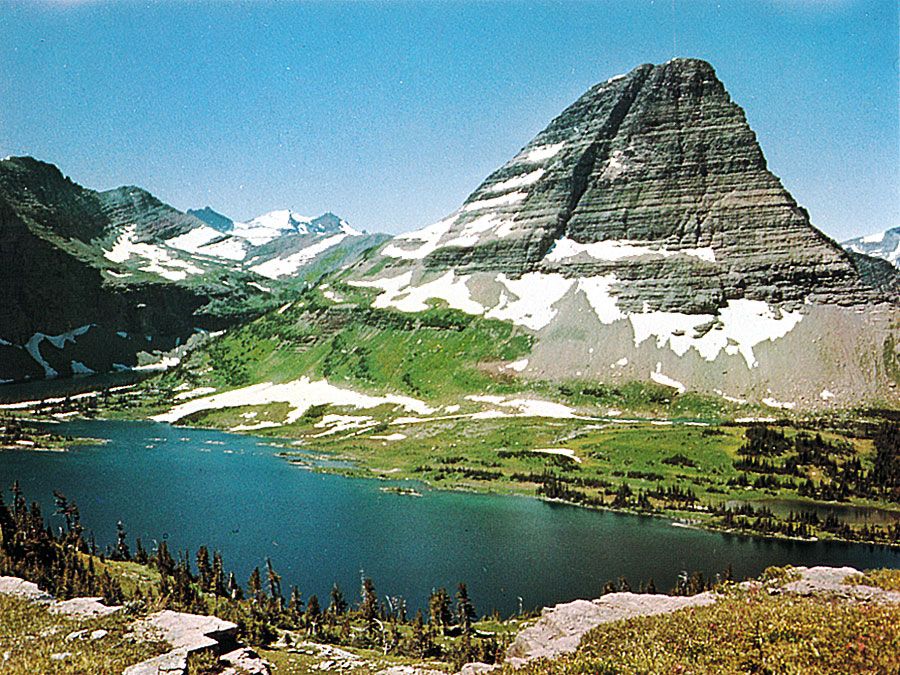
- Topography: Mountains are characterized by prominent, steep slopes, confined summit areas, and significant local relief. In contrast, a plateau is an extensive area of upland defined by its remarkably flat surface and low relative relief, even when situated at high altitudes.910
- Structure: Mountains typically occur in elongated chains or belts connected by ridges and separated by valleys. Plateaus are often bounded by steep escarpments on all sides, though they can sometimes be enclosed by mountains.910
- Relationship: These features are not mutually exclusive. Plateaus can exist within mountain belts, such as the Altiplano located within the Andes. Conversely, some plateaus are formed by processes distinct from those that created neighboring mountain ranges.910
Formative Processes
Both landforms are often created by similar tectonic processes, including volcanism, crustal shortening, and thermal expansion. For example, plateaus formed by crustal shortening are essentially mountain ranges buried in their own debris, where flat valleys have filled with sediment.11
Why are mountain ranges often significant for mining and agriculture?
Mountain ranges are significant for mining and agriculture primarily due to the tectonic processes that form them, which concentrate valuable resources and influence local environments.
Significance for Mining
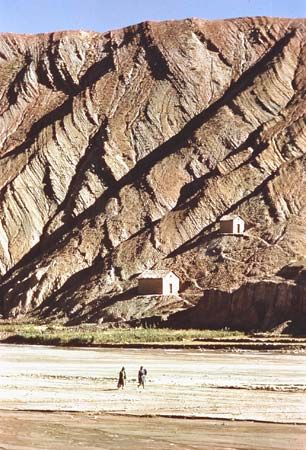
Mountain ranges are often rich in mineral deposits because their formation involves intense geological activity. The folding, faulting, and volcanism that create mountains frequently bring deep-seated materials to the surface or concentrate ores through igneous intrusions. For example, the Western Cordilleran region is highly productive because of the immense igneous bodies that underlie its structures, hosting significant deposits of gold, silver, copper, lead, and zinc. Similarly, crystalline rocks—metamorphic and igneous formations that solidify deep within the Earth—are often exposed in mountain belts, providing access to valuable metallic ores that would otherwise remain buried.1415
Significance for Agriculture
While the provided data focuses heavily on the geological and economic aspects of mining, mountain ranges influence agriculture by creating diverse topographical zones. The variation in elevation and the presence of valleys—often formed by the erosion of weaker rock between resistant ridges—create distinct microclimates and soil conditions. These valleys can serve as fertile areas for cultivation, benefiting from the runoff and sediment transport originating from the higher, more resistant mountain peaks.15
Sources
- Main Range — Encyclopædia Britannica
- Snowy Mountains — Encyclopædia Britannica
- Great Dividing Range — Encyclopædia Britannica
- Himalayas - Drainage of the Himalayas — Encyclopædia Britannica
- East African mountains - Drainage of the East African mountains — Encyclopædia Britannica
- valley - Geomorphic characteristics — Encyclopædia Britannica
- river - Origin of river terraces — Encyclopædia Britannica
- Continental Divide — Encyclopædia Britannica
- plateau — Encyclopædia Britannica
- plateau — Merriam-Webster
- plateau - Formative processes — Encyclopædia Britannica
- mountain - Residual mountain ranges and thermally uplifted belts — Encyclopædia Britannica
- mountain — Encyclopædia Britannica
- mountain - Geomorphic characteristics — Encyclopædia Britannica
- North America - The marginal mountains — Encyclopædia Britannica
- geology - Mineral deposits — Encyclopædia Britannica
- mountain - Tectonic processes that produce high elevations — Encyclopædia Britannica
- mountain - Heating and thermal expansion — Encyclopædia Britannica
Published on · 3 min read