Manihiki Atoll
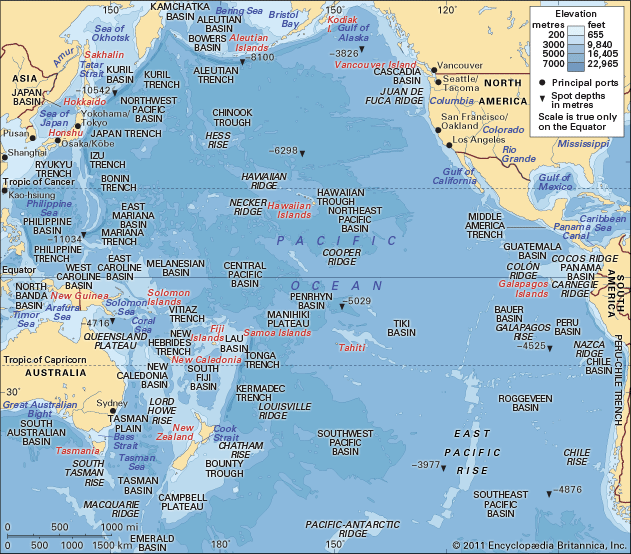
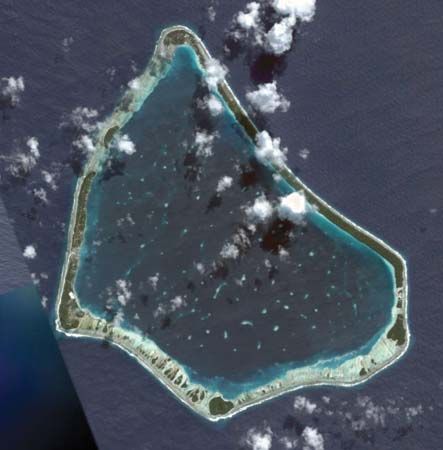
Manihiki Atoll is a coral atoll located in the northern Cook Islands, a self-governing state in free association with New Zealand in the South Pacific Ocean.…
What is Manihiki Atoll?
Manihiki Atoll is a coral atoll located in the northern Cook Islands, a self-governing state in free association with New Zealand in the South Pacific Ocean. Measuring approximately 2.5 miles (4 km) across, the atoll consists of dozens of small islets, with Tauhunu and Tukao serving as the two primary locations.1
Inhabited by Polynesian people for centuries, the atoll was discovered by U.S. mariners in 1822 and later became a British protectorate in 1888 before being annexed by New Zealand in 1901. Today, the local economy is primarily driven by fishing and the cultivation of oysters for black pearls. Although the lack of a direct passage into the lagoon complicates the export of copra and pearl shell, the atoll remains a significant part of the region’s geography.1
How are coral atolls formed?
Coral atolls are primarily formed through the gradual subsidence of volcanic islands, a process first proposed by Charles Darwin in 1842.34
The Subsidence Theory
The development of an atoll typically follows these stages:
- Fringing Reef: Coral begins growing in shallow waters around a volcanic island.34
- Barrier Reef: As the volcanic island slowly subsides or the sea level rises, the reef continues to grow upward and outward, creating a lagoon between the reef and the shoreline.34
- Atoll: Eventually, the volcanic cone becomes completely submerged, leaving only the ring-shaped reef structure at the surface, which encloses a central lagoon.34
Alternative Factors
While Darwin’s subsidence model remains fundamental, modern science incorporates additional factors:
- Sea Level Changes: Fluctuations in sea level, particularly following the melting of ice sheets during the Pleistocene Epoch, have significantly influenced the upward growth of many reefs.34
- Plate Tectonics: The ocean floor subsides as it spreads from oceanic ridges, explaining the progression from barrier reefs to atolls in mid-ocean chains.3
- Erosion: Some annular reefs form when uplifted limestone islands undergo subaerial erosion, creating a saucer-shaped interior that becomes a lagoon upon subsequent submergence.3
What are the unique characteristics of Polynesian culture?
Polynesian culture is defined by a profound mastery of the Pacific Ocean environment and a complex social structure deeply rooted in tradition and genealogy.5
Key Characteristics
- Maritime Mastery: Polynesians were exceptional navigators and shipbuilders. This expertise extended beyond technology, influencing their social organization, religion, and survival strategies in a challenging environment.5
- Social Hierarchy and Kinship: Society was typically organized through hierarchical lineages. Many groups utilized a ramage system, where prestige was determined by proximity to a senior line of descent traced back to the gods. Others, such as in Samoa, used a descent-line system focused on titles.6
- Connection to the Supernatural: The supernatural was viewed as a continuum of reality rather than a separate sphere. Creation myths and genealogies fixed individuals within a specific social and cosmic order.5
- Cultural Conservatism: Despite vast geographic separation, traditional cultures shared remarkable similarities in material goods, kinship terms, and art motifs, reflecting a deep reverence for the past.5
- Oral Traditions: Genealogies, legends, and chants were vital for preserving history and identity. While colonial disruption suppressed many practices, there has been a significant modern revival of oral literature, navigation, and Polynesian languages.578
How are cultured black pearls harvested?
Cultured pearls, including those that may appear black, are produced by intentionally introducing a foreign object into a mollusk to stimulate the secretion of nacre.1112
The harvesting process generally follows these steps:
- Implantation: Once pearl oysters reach a specific size, they are implanted with a tiny, polished sphere of mother-of-pearl. This bead acts as a stimulant for the mollusk to coat the object in layers of nacre.11
- Maturation: The implanted oysters are suspended in wire nets from floating rafts or otherwise contained in a controlled environment. They are tended by divers for two to three years while the pearl forms.11
- Monitoring and Harvest: The readiness of the pearls is often determined using X-ray technology to ensure the nacre coating is sufficient.11
The final color of the pearl, which can range from white to black, is influenced by the specific species of the oyster and its environment.1213
Sources
- Manihiki Atoll — Encyclopædia Britannica
- Manihiki — Merriam-Webster
- coral reef - Origin and development of reefs — Encyclopædia Britannica
- atoll — Encyclopædia Britannica
- Polynesian culture - Traditional Polynesia — Encyclopædia Britannica
- Polynesian culture - Contemporary Polynesia — Encyclopædia Britannica
- Polynesian culture - Kinship and social hierarchy — Encyclopædia Britannica
- Samoa - The arts — Encyclopædia Britannica
- French Polynesia - Cultural life — Encyclopædia Britannica
- Oceanic literature - Polynesia and Micronesia — Encyclopædia Britannica
- cultured pearl — Encyclopædia Britannica
- How do oysters make pearls? — Encyclopædia Britannica
- pearl — Encyclopædia Britannica
Published on · 3 min read