Marajó Island
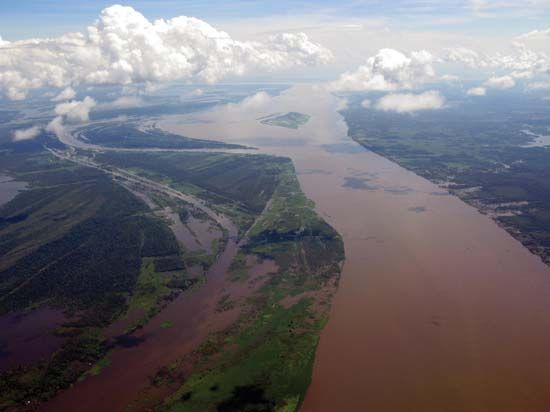
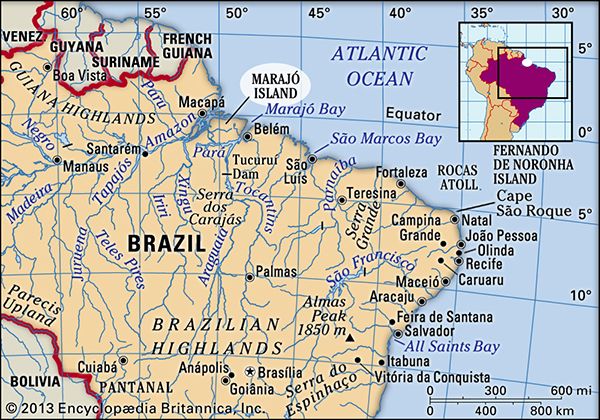
Marajó Island, located in the Amazon River delta in the Brazilian state of Pará, is the world’s largest fluvial island, formed by sediments deposited by…
What are the unique geographical features of Marajó Island?
Marajó Island, located in the Amazon River delta in the Brazilian state of Pará, is the world’s largest fluvial island, formed by sediments deposited by river flow.1
Key geographical features include:
- Hydrology and Terrain: The island is separated from the mainland to the south by the Pará River, an estuary. Numerous narrow channels known as furos direct portions of the Amazon’s water around the island.1
- Seasonal Flooding: Approximately half of the island’s landmass is submerged during the annual rainy season.1
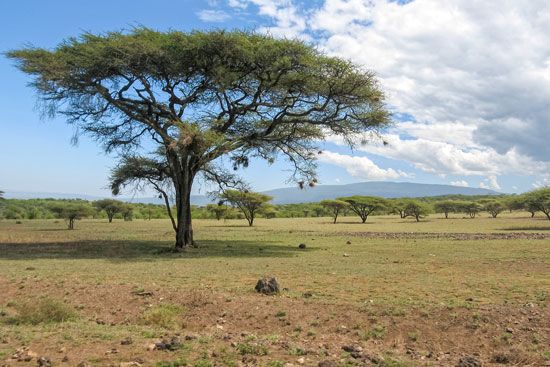
- Vegetation: The eastern portion of the island is characterized by savanna landscapes, which are also found in other parts of the Amazon basin in other parts of the Amazon basin.12
- Archaeological Significance: The eastern savanna region is notable for containing numerous archaeological mounds that are rich in elaborate polychrome pottery.1
- Land Use: The island’s savanna supports the grazing of cattle and water buffalo.1
How does the Amazon River influence the ecology of Marajó Island?
The Amazon River plays a fundamental role in shaping the ecology and physical environment of Marajó Island. As the world’s largest fluvial island, its very existence is a direct result of the river’s influence, having been formed by the massive accumulation of sediments deposited by the stream’s flow.1
The river’s impact on the island’s ecology is characterized by several key factors:
- Hydrological Dynamics: While the main flow of the Amazon passes to the north, a complex network of narrow channels known as furos directs portions of the river’s water into the Pará River estuary, which bounds the island to the south.14
- Seasonal Flooding: The island’s ecology is heavily dictated by the annual rainy season, during which approximately half of its landmass is submerged. This periodic inundation creates a dynamic environment that influences the island’s vegetation and land use.1
- Savanna Landscapes: Unlike the dense tropical rainforest found in much of the Amazon basin, the eastern portion of Marajó is dominated by savanna ecosystems. These grassy plains are well-suited for grazing, supporting the island’s population of cattle and water buffalo.15
How has tourism developed on Marajó Island, and what attractions does it offer?
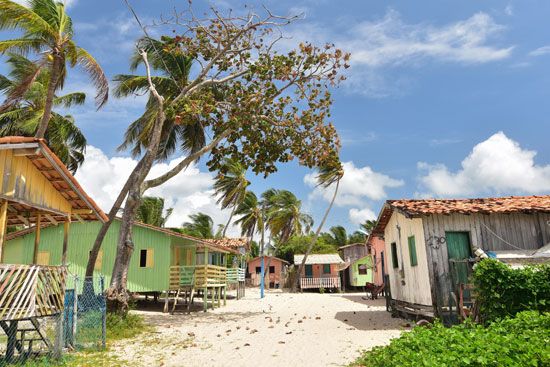
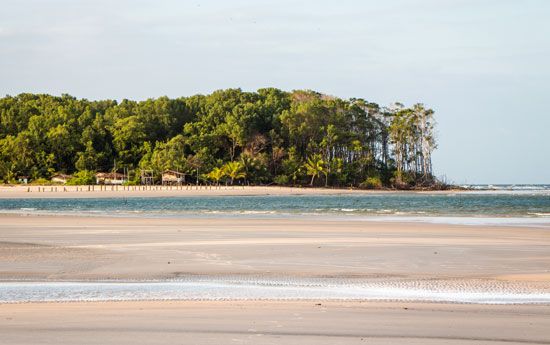
Tourism on Marajó Island is centered primarily around the town of Soure, which serves as a key destination for visitors. Located on the island’s Atlantic coast, Soure has developed into a modern town and beach resort, providing a gateway for those exploring the region. Access to the island is facilitated by regular ferry service connecting it to Belém, the capital of the state of Pará.1
Attractions on the island include:
- Coastal Recreation: Soure is well-known for its beach resort facilities, offering visitors access to the Atlantic coastline.1
- Cultural and Archaeological Heritage: The eastern savanna region is home to numerous archaeological mounds. These sites are historically significant for their deposits of elaborate, ancient polychrome pottery.1
- Unique Local Experiences: The island’s landscape, which supports the grazing of water buffalo, offers a distinct cultural experience unique to this part of the Amazon River delta.1
What is the cultural significance of Marajó Island, particularly in terms of its archaeological history?
Marajó Island holds profound cultural and archaeological significance as one of the few areas in Brazil where extensive archaeological research has been conducted. The island is renowned for its numerous archaeological mounds, which contain evidence of a remarkably advanced civilization that flourished in the Amazon lowlands, potentially as early as 1000 CE.17
The most notable cultural contribution from this region is the Marajoara pottery style. This unique artistic tradition is characterized by:
- Complex Techniques: It incorporates a sophisticated combination of modeling, painting, and low-relief surface carving.1
- Distinctive Aesthetics: The style features strong geometric patterns that appear to be unique to the island, showing little influence on or from surrounding cultures.1
Despite its importance, the island’s prehistory remains partially obscured. The challenging environment—marked by dense vegetation and seasonal flooding—has hindered complete excavation, leaving a significant gap in the historical record between early human presence in the region and the rise of the Marajoara civilization.71
Sources
- Marajó Island — Encyclopædia Britannica
- Amazon River - Hydrology of the Amazon River — Encyclopædia Britannica
- Amazon River - Landforms and drainage patterns — Encyclopædia Britannica
- Amazon River - Plant life — Encyclopædia Britannica
- Amazon River - Physiography of the river course — Encyclopædia Britannica
- list of islands - Brazil — Encyclopædia Britannica
- Native American art - Brazil — Encyclopædia Britannica
Published on · 3 min read