Water Buffalo
The water buffalo (Bubalus bubalis) is a large, oxlike mammal belonging to the Bovidae family. Both wild and domestic forms typically feature a gray to black…
What are the physical characteristics of water buffaloes?
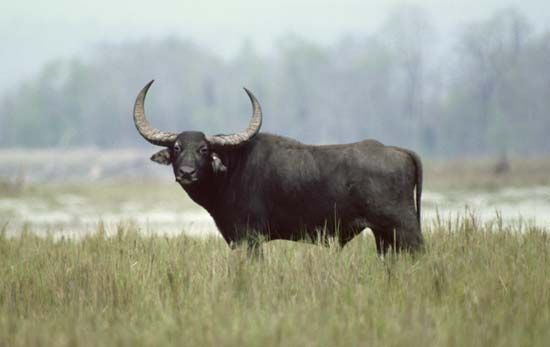
The water buffalo (Bubalus bubalis) is a large, oxlike mammal belonging to the Bovidae family. Both wild and domestic forms typically feature a gray to black coat, often accented with off-white “socks” and one or two white chevrons on the neck.1
Key physical characteristics include:
- Horns: Both sexes possess horns that curve backward in a crescent shape. These are the longest among cattle, with record lengths reaching nearly 2 meters (6.6 feet). Domesticated forms may have shorter or absent horns.12
- Size: Wild water buffalo are massive, reaching up to 3 meters (10 feet) in length and 2 meters in height, with weights up to 1,200 kg (2,600 pounds). Females are generally about two-thirds the size of males.1
- Adaptations: They possess large, splayed hooves with two flexible joints (fetlock and pastern) that facilitate movement through deep mud.1
- Distinguishing Features: Unlike bison, water buffalo lack a shoulder hump and are beardless.2
Where are water buffaloes primarily found in the wild?
Wild water buffalo (Bubalus bubalis) are primarily found in Southeast Asian swamps and forests. Their remaining populations are extremely limited, with only a few dozen herds persisting in areas ranging from east-central India to Thailand.
These animals rely on these wetland environments to feed on grass and sedges, and they spend much of their day wallowing in water or mud to regulate their body temperature and protect themselves from insects. Unfortunately, the survival of these wild populations is increasingly threatened by habitat loss and the risk of interbreeding with feral domestic water buffalo.
How have water buffaloes been domesticated and used by humans?
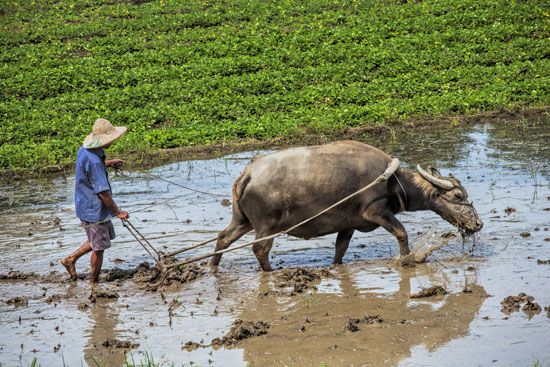
Domesticated water buffalo (Bubalus bubalis) have been integral to human society for millennia, serving as essential partners in agriculture and sources of nutrition. Known as the “living tractor of the East,” they are considered one of the world’s most important draft animals, particularly in tropical Asia.15
Humans have utilized them in two primary ways based on their subspecies:
- River Buffalo: Primarily selected for milk production, this type is valued for milk with a high butterfat content (approximately 8 percent). They have been present in India since at least 2500 BCE and in Mesopotamia by 1000 BCE.1
- Swamp Buffalo: These are predominantly used as draft animals to assist in the cultivation of rice paddies throughout Southeast Asia. Their physical strength and ability to navigate deep mud make them uniquely suited for this labor.15
Beyond their work in fields, these animals provide manure as a valuable agricultural resource and serve as a source of food and other products at the end of their working lives.5
What are the main differences between Asian water buffaloes and African water buffaloes?
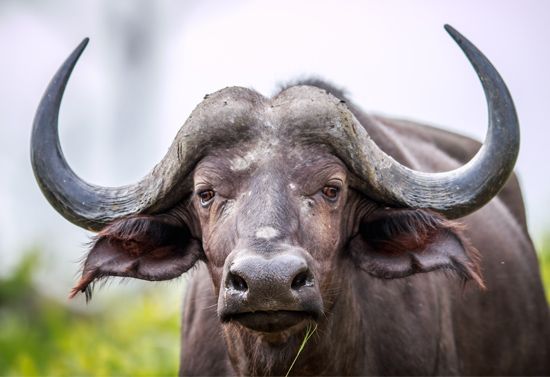
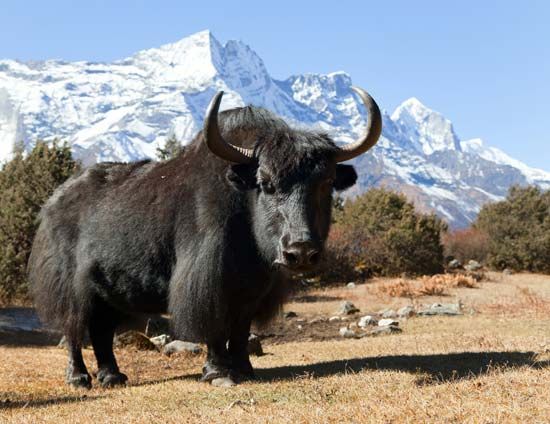
It is a common misconception to group Asian water buffalo and African Cape buffalo together as the same type of animal. In reality, they are distinct species that diverged from yaks and bison approximately three million years ago.1
The primary differences between them include:
- Scientific Classification: The water buffalo (Bubalus bubalis) belongs to the Bubalus genus and is native to South Asia. The Cape buffalo (Syncerus caffer) belongs to the Syncerus genus and is indigenous to Africa.12
- Physical Characteristics: Water buffalo are known for their massive, crescent-shaped horns that can reach lengths of nearly 2 meters (6.6 feet). While both animals lack the shoulder humps found on bison, they differ in their adaptation to their environments; water buffalo possess large, splayed hooves and flexible joints to navigate deep mud in swamps.12
- Habitat and Behavior: Water buffalo are semi-aquatic, spending much of their time wallowing in water to regulate body temperature. Cape buffalo are not specialized for these same aquatic environments.1
Sources
- Water buffalo — Encyclopædia Britannica
- What’s the Difference Between Bison and Buffalo? — Encyclopædia Britannica
- Livestock farming - Buffalo — Encyclopædia Britannica
- Cape buffalo — Encyclopædia Britannica
- Draft animal — Encyclopædia Britannica
- water buffalo — Merriam-Webster
- Asia - Animal resources — Encyclopædia Britannica
Published on · 3 min read