Massasauga
The massasauga (Sistrurus catenatus) is a small, venomous rattlesnake belonging to the family Viperidae. Typically measuring 45 to 75 cm (18 to 30 inches) in…
What is massasauga?
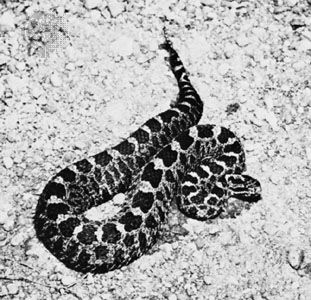
The massasauga (Sistrurus catenatus) is a small, venomous rattlesnake belonging to the family Viperidae. Typically measuring 45 to 75 cm (18 to 30 inches) in length, this species is found in various habitats, including prairies, swamps, and woodlands, ranging from the Great Lakes region to Arizona.1
Physically, the massasauga may appear entirely black or display a gray or tan coloration with rows of dark spots along its back and sides. It is a member of the genus Sistrurus, which is considered more primitive than the Crotalus genus and is distinguished by having nine large scales on the upper surface of its head.12
Generally secretive and unaggressive, the massasauga is a live-bearing snake that primarily feeds on frogs, lizards, and rodents. While its bite is painful, it is rarely fatal.1
How do pit vipers use their heat-sensing pits to hunt?
Pit vipers utilize specialized heat-sensing organs to hunt, which are located in deep pits on either side of the head, positioned between the nostril and the eye. These organs function as infrared receptors, allowing the snake to detect the thermal radiation emitted by warm-blooded prey.34
The structure of the pit consists of two chambers separated by a thin membrane that is densely supplied with nerves and blood vessels. Because these pits are located on both sides of the head, they provide a form of binocular vision that enables the snake to “see” heat images and accurately gauge the distance and position of its target.34
While the snake may initially identify the presence of prey through ground vibrations, smell, or sight, the pit organs serve a critical role in the final stages of the hunt. They allow the snake to confirm the identity of the prey and precisely aim its strike, even in total darkness, by detecting temperature differences as small as 0.6 °C (1.1 °F).3
What is the difference between the genus Sistrurus and Crotalus?
The genera Sistrurus and Crotalus both belong to the subfamily Crotalinae, commonly known as pit vipers, and are both types of rattlesnakes. While they share many characteristics, such as the presence of heat-sensing pit organs and a rattle composed of horny, hollow segments, they are distinguished by specific physical traits.
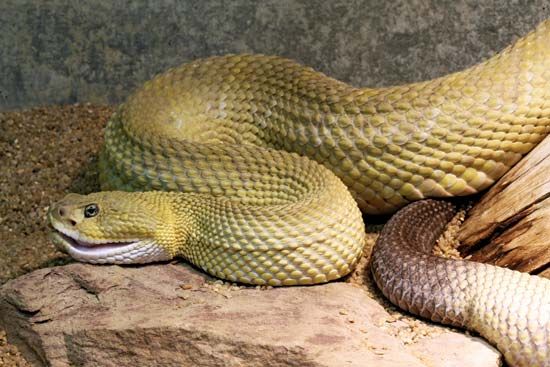
The genus Sistrurus is often considered more primitive than Crotalus. A primary physical distinction is that members of the Sistrurus genus, such as the massasauga, possess nine large, symmetrical scales on the upper surface of the head. In contrast, members of the Crotalus genus, such as the Mexican west coast rattlesnake, typically have numerous small, irregular scales on the top of the head. Additionally, Sistrurus species are generally smaller in size compared to many of the larger, stouter species found within the Crotalus genus.
Why do rattlesnakes have rattles on their tails?
Rattlesnakes possess a rattle on their tail primarily as a warning device. This structure is composed of loose, dry, horny, and hollow segments. When a rattlesnake feels threatened, it rapidly vibrates the tip of its tail, causing these segments to strike against one another and produce a distinct buzzing sound.62
The development of the rattle begins at birth with a single “button” on the end of the tail. Each time the snake sheds its skin, a new segment is added to the rattle. Once a snake has acquired at least three segments, it is capable of producing the characteristic buzzing sound of an adult. While the sound serves as a warning to potential threats, it is important to note that the number of rattle segments cannot be used to determine the age of the snake, as rattlesnakes typically shed their skin three or four times per year.67
Sources
- massasauga — Encyclopædia Britannica
- rattlesnake — Encyclopædia Britannica
- reptile - Chemoreception — Encyclopædia Britannica
- viper — Encyclopædia Britannica
- Mexican west coast rattlesnake — Encyclopædia Britannica
- reptile - Avoidance and noise — Encyclopædia Britannica
- black-tailed rattlesnake — Encyclopædia Britannica
Published on · 3 min read