Merganser
Mergansers are a group of long-bodied, crested diving ducks belonging to the genus Mergus (within the tribe Mergini). While the provided information does not…
How many species of mergansers are there, and what are their main differences?
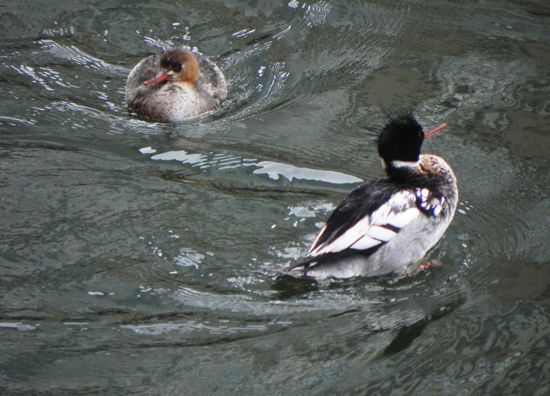
Mergansers are a group of long-bodied, crested diving ducks belonging to the genus Mergus (within the tribe Mergini). While the provided information does not specify an exact total count of species, it highlights several distinct members of the group, which are characterized by narrow, tooth-edged bills designed for catching fish.1
Key species and their differences include:
- Common Merganser (Goosander, M. merganser): Mallard-sized; males lack a noticeable crest. They typically nest in hollow trees in northern regions.1
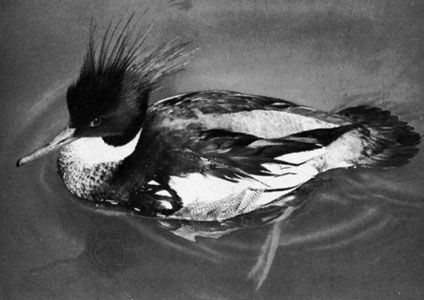
- Red-breasted Merganser (M. serrator): Somewhat smaller than the common merganser and distinct for its ground-nesting habit.1
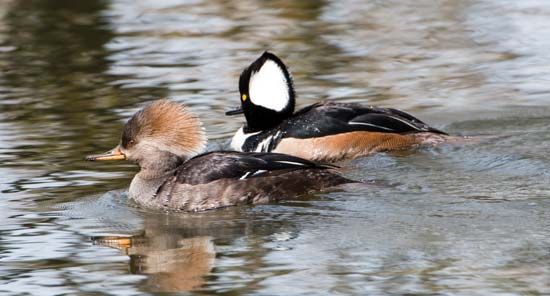
- Hooded Merganser (Lophodytes cucullatus): A small, tree-nesting species found in temperate North American woodland waterways, differing significantly in appearance from other members.1
- Smew (M. albellus): A small, compact merganser with a short bill, breeding in northern regions from Scandinavia to Siberia.1
- Brazilian Merganser (M. octosetaceus): Noted as a rare species, distinct from the others which primarily inhabit northern regions.1
What are some interesting behaviors or social structures observed in merganser flocks?
Mergansers exhibit several fascinating behaviors and social structures, many of which are characteristic of the broader waterfowl family. Because they are gregarious, they rely on well-developed social signals to maintain group cohesion and manage interactions within their flocks.1
Social Displays and Communication
Mergansers are known for their elaborate male courtship displays, which serve to attract mates and prevent interbreeding with closely related species. These displays often involve:1
- Ritualized Movements: Males may perform bowing motions while emitting dovelike coos, flag their heads from side to side, or execute a “head-throw-kick,” where they jerk their heads back toward their tails and kick up a spurt of water.1
- Signal Integration: Many social signals are derived from maintenance activities, such as preening or wing-stretching, which have become ritualized over time to convey information during threat or sexual encounters.1
- Vocalizations: While their vocal range is relatively simple compared to songbirds, mergansers use various coos and whistles to facilitate social contact and maintain flock unity.1
Flock Dynamics
Like many other waterfowl, mergansers are gregarious, especially during migration. They often signal their intention to take flight through specific movements, such as head-shaking or chin-lifting, ensuring the group departs together. While they may display individualistic tendencies at other times, they often form cohesive groups during migratory journeys, sometimes adopting the characteristic “V” formation to save energy by flying in the wake of others.13
How do mergansers’ diving abilities compare to other duck species?
Mergansers are classified as diving ducks, a group specifically adapted for underwater foraging rather than the “tipping up” behavior seen in dabbling ducks like mallards.18
Compared to other duck species, mergansers and pochards share distinct anatomical features that facilitate their diving lifestyle:
- Body Positioning: Their legs are positioned far back on the body, which makes them excellent swimmers but results in an awkward, upright waddling gait when on land.19
- Locomotion: Like other diving ducks, they submerge by arching their bodies and propelling themselves forward with both feet in a smooth arc. Once underwater, they scull their legs together for propulsion, sometimes using their wings for steering.9
- Diving Depth and Duration: While some species, such as the long-tailed duck, have been recorded at exceptional depths, most diving ducks typically forage at depths of less than 6 meters (20 feet). They generally remain submerged for under 30 seconds, though they are physiologically capable of longer dives.9
Where are mergansers typically found, and what are their preferred habitats?
Mergansers are primarily found in northern regions, inhabiting a variety of freshwater environments across the globe. While they are classified within the sea duck tribe, they are essentially freshwater birds that favor specific aquatic settings based on their species.1
Preferred Habitats and Distribution
- Lakes and Rivers: Larger species, such as the common merganser (or goosander), are most frequently observed on the open reaches of lakes and rivers. They often breed in north temperate to subarctic regions and migrate to more southerly rivers during the winter.1
- Woodland Waterways: The hooded merganser, native to temperate North America, prefers smaller, sheltered woodland waterways rather than large open lakes.1
- Diverse Geographic Ranges: The smew breeds across a vast range from Scandinavia to Siberia and south to Turkestan, wintering on lakes and streams as far south as the Mediterranean and Central Asia. In contrast, the rare Brazilian merganser is a notable exception to the group’s northern distribution.1
- Nesting Sites: Habitat preference is also dictated by nesting needs; species like the common and hooded mergansers typically nest in hollow trees, while the red-breasted merganser is a ground-nesting bird.1
Sources
- Merganser — Encyclopædia Britannica
- Anseriform - Behaviour — Encyclopædia Britannica
- Reproductive behaviour - Courtship — Encyclopædia Britannica
- Animal social behavior - Social interactions involving sex — Encyclopædia Britannica
- Animal social behavior - Social interactions involving the costs and benefits of parental care — Encyclopædia Britannica
- Reproductive behaviour - Parental care — Encyclopædia Britannica
- Migration - Modes of migration — Encyclopædia Britannica
- What do ducks eat? — Encyclopædia Britannica
- Diving duck — Encyclopædia Britannica
- Anseriform - Locomotion — Encyclopædia Britannica
Published on · 4 min read