Mesosaurus
Mesosaurus likely fed on small crustaceans and other similar prey.
What did Mesosaurus likely eat, and how do we know about its diet?
Mesosaurus likely fed on small crustaceans and other similar prey.1
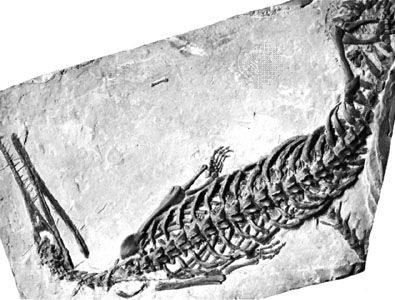
Paleontologists infer this diet primarily from the animal’s physical anatomy. Mesosaurus possessed long, narrow jaws filled with numerous long, thin, and pointed teeth, which were well-suited for capturing small aquatic organisms as the creature undulated through the water.1
What adaptations did Mesosaurus have for its aquatic lifestyle?
Mesosaurus possessed several specialized adaptations that allowed it to thrive in a freshwater aquatic environment during the Early Permian Period:
- Locomotion: The animal was elongated and slim, utilizing lateral undulations of its body and tail to propel itself through the water, a method similar to that used by many fish and other aquatic reptiles.15
- Feeding Anatomy: It featured a long, narrow skull and jaws lined with numerous thin, pointed teeth, which were highly effective for capturing small crustaceans and other prey.1
- Diving Capabilities: Mesosaurus had large, banana-shaped ribs, which are believed to have reinforced its ribcage to withstand the pressure changes associated with diving.1
- Aquatic Specialization: The creature was so well-adapted to life in lakes and ponds that it likely seldom, if ever, ventured onto land. Its inability to traverse open, saline oceans served as significant evidence for the theory of continental drift.1
What is the significance of Mesosaurus fossils in paleontology and geological studies?
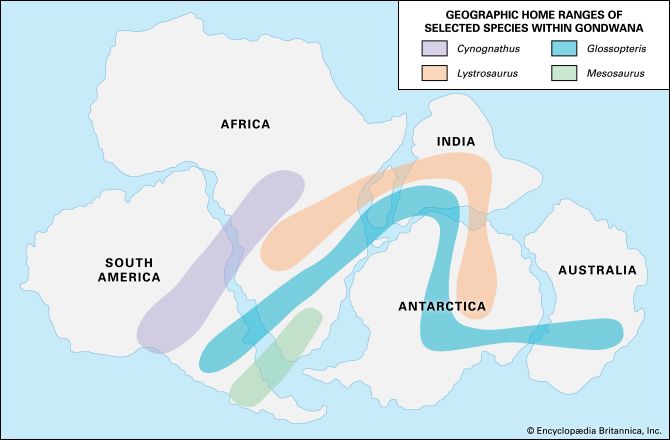
The fossils of Mesosaurus hold immense significance in the history of science, serving as one of the earliest and most compelling pieces of evidence for the theory of continental drift.1
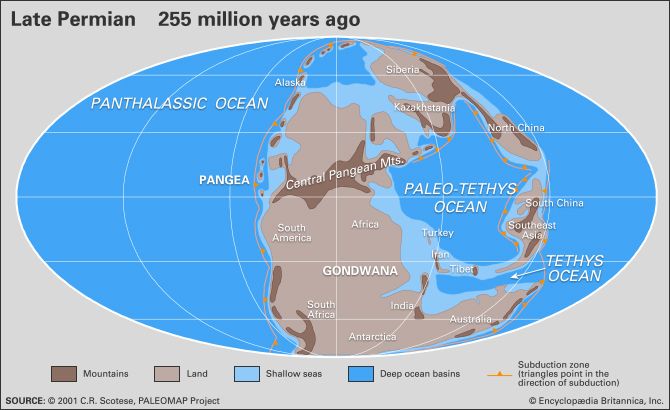
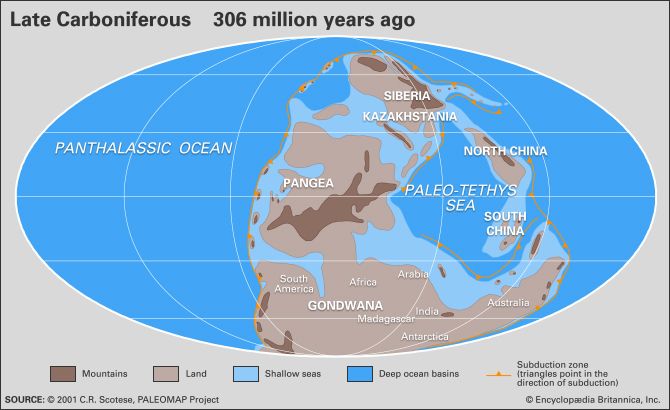
Found in the Early Permian Period rock strata of both South Africa and South America, these fossils presented a geological puzzle. Because Mesosaurus was a small, freshwater-dwelling reptile, it was biologically incapable of traversing the vast, saline expanse of the open ocean. Its presence on two continents separated by the Atlantic Ocean strongly suggested that these landmasses were once physically connected as part of the ancient supercontinent Gondwana.18
This paleontological evidence, alongside similar findings like the distribution of the seed fern Glossopteris, helped geologists like Alfred Wegener and Alexander Du Toit argue that the Earth’s continents were not stationary. These observations eventually contributed to the modern understanding of plate tectonics, which confirmed that ocean basins are dynamic and that continents have shifted positions over millions of years.8
What other animals lived alongside Mesosaurus during its time?
During the Early Permian Period, the environment in which Mesosaurus lived was part of a rapidly evolving world. While Mesosaurus occupied freshwater lakes and ponds, the broader Permian landscape supported a diverse array of life that was adapting to changing climates and the formation of the supercontinent Pangea.
Key groups of organisms that lived during this time include:
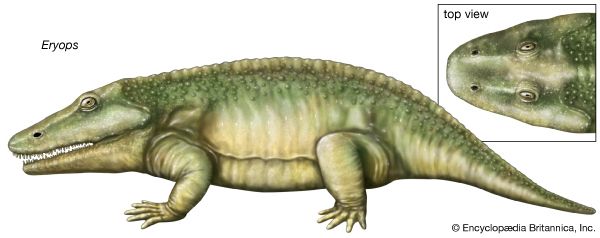
- Amphibians: Many groups of amphibians and anthracosaurs that originated in the Carboniferous Period persisted into the early part of the Permian. These included various lineages that were generally small and aquatic, though some, such as the large, stout-bodied Eryops, were strong-limbed terrestrial animals.
- Early Reptiles: The Permian saw the emergence of several important reptile lineages, including those that would eventually give rise to mammals in the Mesozoic Era. As the climate became increasingly arid, these amniotes became progressively more abundant and diverse.
- Insects: Insects underwent rapid evolution during this period, diversifying into at least 23 orders as they followed plants into new habitats and formed specialized ecological associations.
- Flora: The landscape was dominated by ferns, seed ferns, and lycophytes in swampy areas, with early coniferophytes appearing as the climate shifted toward drier conditions.
Sources
- Mesosaurus — Encyclopædia Britannica
- dinosaur - The plant eaters — Encyclopædia Britannica
- dinosaur - The flesh eaters — Encyclopædia Britannica
- Triassic Period - Fishes and marine reptiles — Encyclopædia Britannica
- reptile - Swimming — Encyclopædia Britannica
- mosasaur — Encyclopædia Britannica
- mesosaur — Merriam-Webster
- Gondwana — Encyclopædia Britannica
- Permian Period - Marine and terrestrial life — Encyclopædia Britannica
- Permian Period - The Permian environment — Encyclopædia Britannica
- A Journey Through Time Since the Precambrian - Permian Period: 298.9 million to 252.2 million years ago — Encyclopædia Britannica
- amphibian - Evolution and classification — Encyclopædia Britannica
Published on · 3 min read