Mid-Indian Ridge
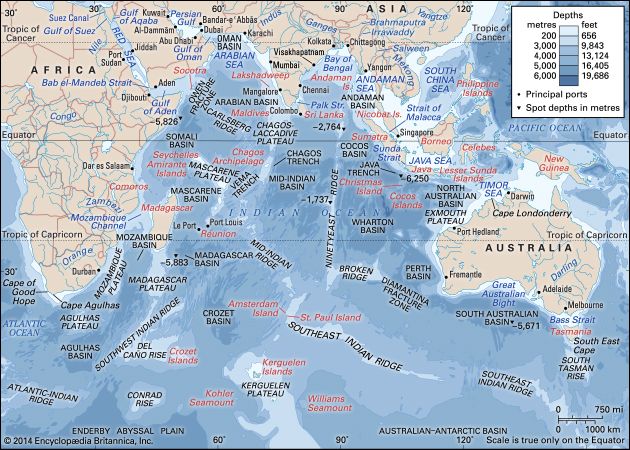
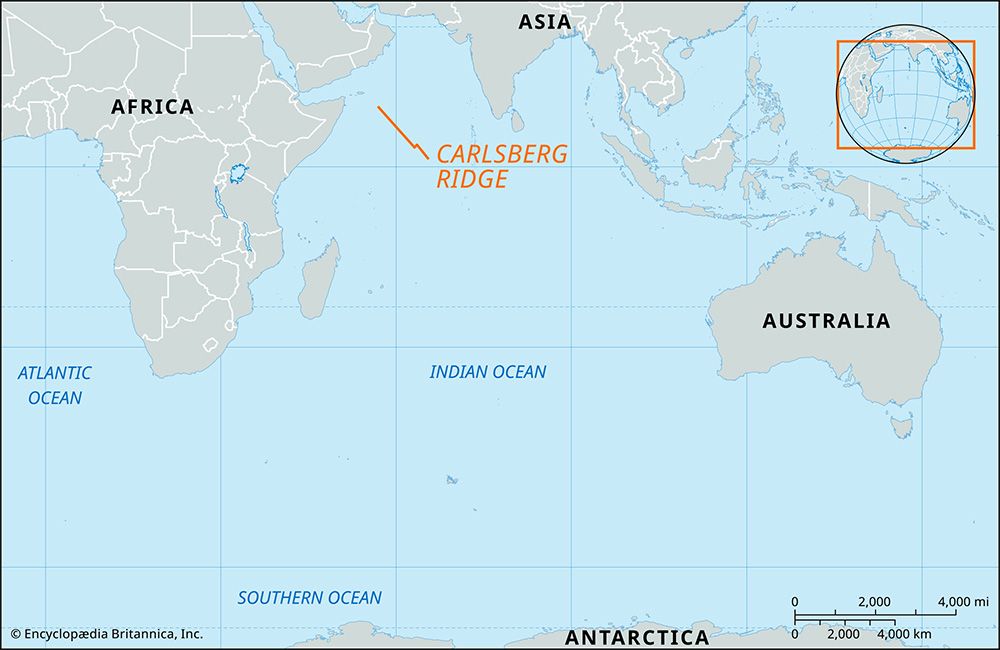
The Mid-Indian Ridge is a submarine mountain range located in the Indian Ocean and serves as a segment of the global midoceanic ridge system, acting as a…
What is Mid-Indian Ridge?
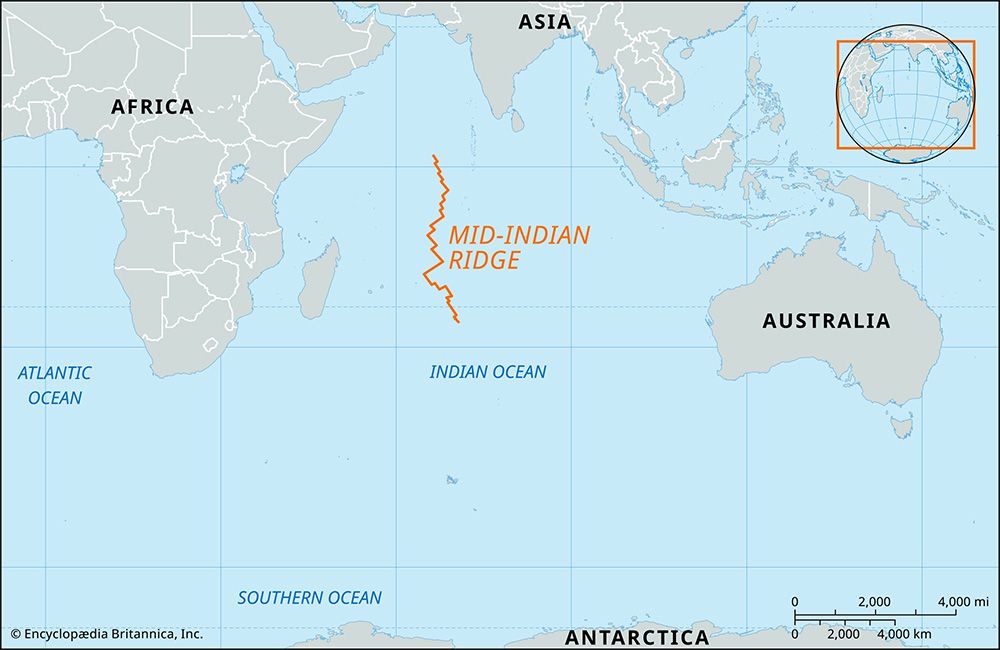
The Mid-Indian Ridge is a submarine mountain range located in the Indian Ocean and serves as a segment of the global midoceanic ridge system, acting as a direct continuation of the Mid-Atlantic Ridge.1
As a spreading centre, it marks the boundary where lithospheric plates diverge, allowing molten rock to rise and form new oceanic crust. Entering the Indian Ocean from the south, the ridge extends northward to Rodrigues Island, where it branches: one segment heads toward the Gulf of Aden (known as the Carlsberg Ridge in this section), while the other extends southeast.213
The ridge is characterized by its rough relief, thin sediment cover, and significant seismic activity, evidenced by a belt of earthquake epicentres. While spreading rates vary, the Mid-Indian and Carlsberg ridges generally exhibit intermediate spreading speeds.13
How does seafloor spreading create new oceanic crust?
Seafloor spreading is the geological process by which new oceanic crust is continuously created at divergent plate boundaries. This process occurs primarily along the global mid-ocean ridge system.45
The Mechanism of Crust Formation
The creation of new crust is driven by the upwelling of magma from the asthenosphere. As tectonic plates diverge, the underlying mantle undergoes decompression, which triggers partial melting of peridotite to produce basaltic magma.67
- Upwelling and Intrusion: Magma rises through fractures in the lithosphere, often forming “sheeted dikes” that act as a plumbing system to transport molten rock toward the surface.8
- Eruption and Cooling: Upon reaching the seafloor, the magma erupts as lava, forming features such as pillow lavas or expansive sheet flows. As this material cools and crystallizes, it solidifies into new oceanic crust.68
- Lateral Movement: As more magma wells up, the newly formed crust is pushed laterally away from the ridge axis. This continuous cycle results in an ocean floor that is progressively older with increasing distance from the spreading centre.45
This process is sustained by gravitational forces, where the elevated topography of the ridge—swollen by heat—pushes the crust apart, further facilitating the rise of new magma.49
What are hydrothermal vents and why are they found at ridges?
Hydrothermal vents are localized discharges of heated seawater that emerge from the ocean floor. They are primarily found at mid-ocean ridges because these areas are characterized by active volcanism and the formation of new oceanic crust.101112
Why They Form at Ridges
The formation of these vents is a direct result of the geological activity at spreading centres:
- Crustal Fissures: As tectonic plates diverge, the seafloor develops cracks and fissures. Cold seawater percolates deep into the crust through these openings.1312
- Geothermal Heating: Once deep within the crust, the water is heated by underlying magma from the Earth’s mantle. This heated solution leaches sulfide minerals—such as iron, copper, and zinc—from the surrounding rock.101312
- Pipelike Discharge: The buoyant, mineral-rich hot water rises back to the seafloor, discharging in a concentrated, pipelike flow at the axis of the neovolcanic zone.1112
These vents support unique ecosystems that rely on chemosynthesis by sulfur-fixing bacteria rather than sunlight, making them entirely independent of photosynthesis. rather than sunlight, making them entirely independent of photosynthesis.1012
How does the Mid-Atlantic Ridge compare to the Mid-Indian Ridge?
The Mid-Atlantic Ridge and the Mid-Indian Ridge are both segments of the global midoceanic ridge system, sharing a common geological origin and seismic activity.1
Key Comparisons
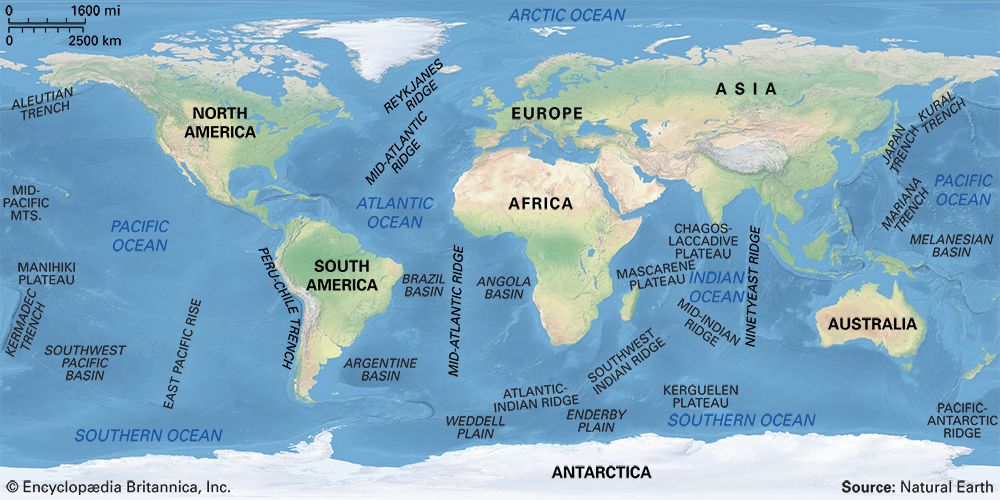
- Connectivity: The Mid-Indian Ridge is considered a direct continuation of the Mid-Atlantic Ridge, extending from the South Atlantic into the Indian Ocean.1
- Structure and Geography: The Mid-Atlantic Ridge is a massive, 10,000-mile-long mountain chain that bisects the Atlantic basin, occasionally rising above sea level to form islands like the Azores. In contrast, the Mid-Indian Ridge divides near Rodrigues Island, with one branch heading toward the Gulf of Aden (where it is known as the Carlsberg Ridge) and the other toward the Macquarie Islands.14151
- Geological Activity: Both ridges exhibit rough relief, thin sediment cover, and frequent earthquakes. sediment cover, and frequent earthquakes. The Mid-Atlantic Ridge is characterized as a “slow-spreading” ridge, featuring a prominent central rift valley in the North Atlantic.rift](https://www.britannica.com/science/rift-valley) valley in the North Atlantic.11415
We could dive deeper into the specific spreading rates that distinguish various segments of these global ridges.
Sources
- Mid-Indian Ridge — Encyclopædia Britannica
- oceanic ridge - Indian Ocean — Encyclopædia Britannica
- spreading centre — Encyclopædia Britannica
- plate tectonics - Seafloor spreading — Encyclopædia Britannica
- seafloor spreading — Encyclopædia Britannica
- plate tectonics - Continental rifting — Encyclopædia Britannica
- igneous rock - Origin of magmas — Encyclopædia Britannica
- plate tectonics - Mantle convection — Encyclopædia Britannica
- oceanic crust — Encyclopædia Britannica
- deep-sea vent — Encyclopædia Britannica
- community ecology - The pyramid structure of communities — Encyclopædia Britannica
- oceanic ridge - Spreading centre zones — Encyclopædia Britannica
- oceanic ridge - Hydrothermal vents — Encyclopædia Britannica
- Mid-Atlantic Ridge — Encyclopædia Britannica
- oceanic ridge - Atlantic Ocean — Encyclopædia Britannica
Published on · 3 min read