Midget Moth
A midget moth is any member of the family Nepticulidae (sometimes referred to as Stigmellidae), which comprises approximately 300 species. These insects are…
What is midget moth?
A midget moth is any member of the family Nepticulidae (sometimes referred to as Stigmellidae), which comprises approximately 300 species. These insects are among the smallest members of the order Lepidoptera, typically possessing a wingspan ranging from 3 to 6 mm (1/8 to 2/5 inch).1
Physically, most midget moths feature long, pointed wings covered with scales and spinelike hairs. Their life cycle is characterized by specialized feeding habits; most larvae are leaf miners, though some species are known to produce galls on plants. When it is time to pupate, they do so either within their larval galleries or by constructing thick, silken cocoons in soil or debris.1
What does it mean for a moth larva to be a leaf miner?
A leaf miner is an insect larva that lives and feeds within the internal tissues of a leaf. While this behavior is found in several insect orders—including beetles, flies, and sawflies—it is a specialized adaptation for many Lepidoptera (moths and butterflies) as well.56
Because they reside inside the leaf, these larvae are physically adapted to their environment: they are typically very small, greatly flattened, and often legless. As they consume the plant tissue, they create distinct tunnels or burrows, which are categorized as either:7
- Serpentine mines: Thin, winding, whitish trails.5
- Blotch mines: Broad, whitish or brownish patches.5
This protected habitat makes leaf miners difficult to manage with insecticides. While they generally do not cause significant injury to the plant, their feeding patterns can mar the appearance of ornamental trees and shrubs.5
How do scientists distinguish between butterflies and moths?
Scientists distinguish between moths and butterflies by observing several key physical and behavioral characteristics:
Physical Differences
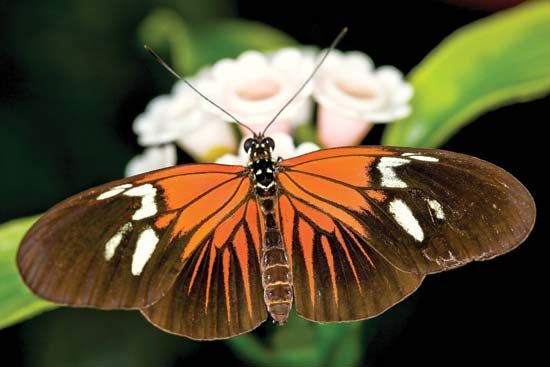
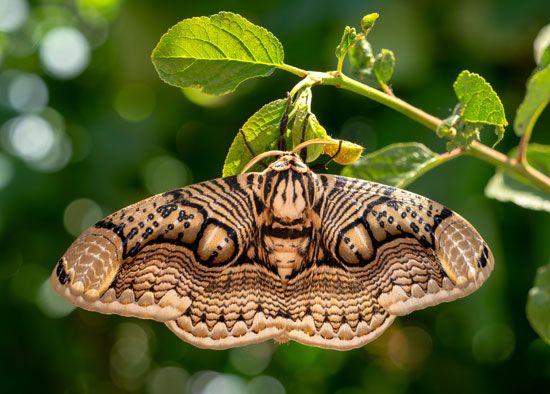
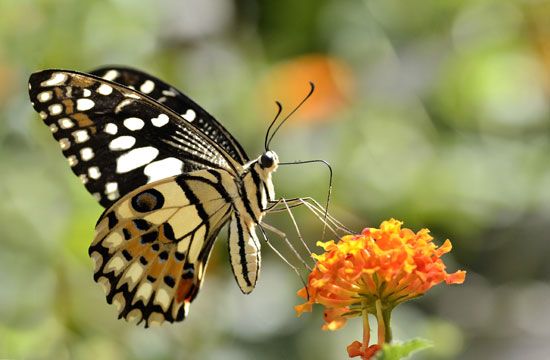
- Antennae: The most reliable indicator is the antennae. Most moths have thick, feathery, or comblike antennae, whereas butterflies possess simple, club-tipped antennae.910
- Body Shape: Butterflies typically have slim, dainty bodies, while moths are generally stout and often fuzzy.9
- Coloration: Butterflies are often brightly colored with dramatic wing patterns, while moths are frequently more drab, though there are notable exceptions in both groups.9
Behavioral and Developmental Differences
- Activity Patterns: Butterflies are typically diurnal (active during the day), while most moths are nocturnal.9
- Resting Posture: When at rest, butterflies usually hold their wings vertically over their backs. Moths typically fold their wings tentlike over the body, wrap them around the body, or hold them extended at the sides.9
- Pupation: During metamorphosis, butterflies form a naked chrysalis. Most moths construct a fibrous cocoon around themselves for protection.911
What are some other examples of extremely small insects?
While many insects are small, some are exceptionally tiny, often measuring less than 1 millimeter in length. Examples of these remarkably small insects include:
- Feather-winged beetles (family Ptiliidae): Most members of this family are between 0.25 and 1 mm (0.01 to 0.04 inch) long. Specifically, the species Nanosella fungi is among the smallest known insects, measuring approximately 0.25 mm (0.01 inch) in length.1213
- Parasitic wasps: Certain species within this group are nearly microscopic, often falling into the same size range as the smallest beetles.1214
- Scale insects: Some of the tiniest species of these insects measure only 0.5 mm (0.02 inch) in length.15
Despite their minute size, these insects possess complex internal structures and specialized adaptations that allow them to thrive in diverse environments, such as rotting wood, fungi, or as parasites on other organisms.1213
Sources
- midget moth — Encyclopædia Britannica
- List of insects - butterflies and moths (order Lepidoptera ) — Encyclopædia Britannica
- insect - Critical appraisal — Encyclopædia Britannica
- Lepidoptera - Size range and distribution — Encyclopædia Britannica
- leaf miner — Encyclopædia Britannica
- Lepidoptera - Larva, or caterpillar — Encyclopædia Britannica
- caterpillar — Encyclopædia Britannica
- Lepidoptera - Feeding habits — Encyclopædia Britannica
- What’s the difference between moths and butterflies? — Encyclopædia Britannica
- Lepidoptera - Pupa , or chrysalis — Encyclopædia Britannica
- Lepidoptera - Head — Encyclopædia Britannica
- arthropod - Size range — Encyclopædia Britannica
- homopteran - Size range — Encyclopædia Britannica
- insect - Appearance and habits — Encyclopædia Britannica
- homopteran - Habitats — Encyclopædia Britannica
- feather-winged beetle — Encyclopædia Britannica
Published on · 3 min read