Moth
Moths exhibit a remarkable range in size, with wingspans varying from as little as 4 mm (0.16 inch) to nearly 30 cm (about 1 foot).
What are some of the largest and smallest moth species in the world?
Moths exhibit a remarkable range in size, with wingspans varying from as little as 4 mm (0.16 inch) to nearly 30 cm (about 1 foot).12
Largest Moths
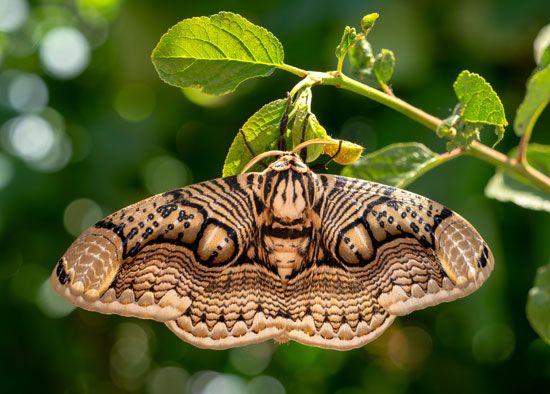
The white witch moth (Thysania agrippina) is widely considered to have the largest wingspan of any living moth, reaching 28 cm (11 inches) or more. Another notable giant is the atlas moth (Attacus atlas), which is one of the largest moths in the world by total wing surface area, often exceeding 160 square cm (25 square inches) and featuring a wingspan of up to 25 cm (10 inches). These large species belong to the family Saturniidae, which contains the largest individuals among moths.342
Smallest Moths
At the other end of the spectrum, members of the family Nepticulidae, commonly known as midget moths, are among the smallest members of the order Lepidoptera. These moths typically have a wingspan ranging from 3 to 6 mm (1/8 to 2/5 inch).5
What are some of the most common moth species found around the world?
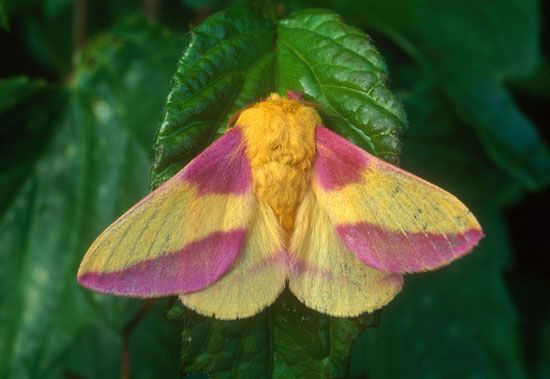
Moths are a diverse group of insects within the order Lepidoptera, comprising approximately 160,000 species distributed nearly worldwide. While many species are specialized to specific ecological niches, several families are considered dominant elements of the insect fauna across the globe.678
Some of the most common and widely encountered moth families include:
- Noctuidae (Owlet moths): One of the largest families of lepidopterans, containing more than 35,000 species. They are abundant everywhere and exhibit great diversity in size, color, and habit.98
- Geometridae (Measuring worm moths): With approximately 21,000 species, these moths are abundant worldwide. Their larvae, often called inchworms, are well-known for their characteristic looping gait.98
- Pyralidae (Snout moths): This family includes about 6,130 species of small, often plain moths. They are frequently encountered and include several significant agricultural and stored-product pests.95
- Crambidae (Webworms): A large group of approximately 11,600 species found worldwide, many of which are small and abundant in various habitats.9
These groups are widespread and successful in nearly every terrestrial environment, ranging from deserts to tropical rainforests.8
What types of antennae do moths have, and how do they use them?
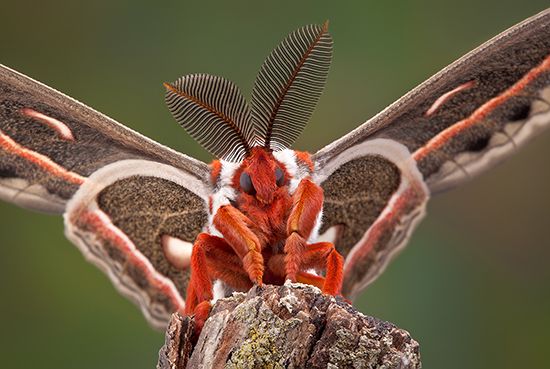
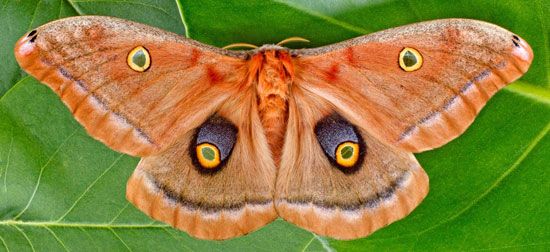
Moths possess prominent, multisegmented antennae that serve as their primary sensory organs for detecting odors in their environment. While many moths have slender, tapering antennae, others—particularly males—feature greatly enlarged, comblike, or featherlike (plumose) structures.1112
How Moths Use Their Antennae
The primary function of these antennae is chemoreception. The surface of the antennae is covered in microscopic receptors called sensilla, which contain olfactory receptor cells.1112
- Sensitivity and Surface Area: The branched, featherlike shape of many male moths’ antennae provides a massive surface area, allowing them to accommodate a high number of sensilla. For example, a male tobacco hornworm moth may have over 300,000 receptor cells on a single antenna.12
- Pheromone Detection: This high sensitivity is critical for reproductive success. Males use their antennae to detect sex-attractant pheromones released by females from distances as great as 5 to 6 km (3 to 4 miles).1210
- Environmental Sensing: Beyond mating, these receptors allow moths to perceive a wide range of chemical compounds, including those related to food sources, helping them navigate their environment and locate essential resources.12
How do moths use camouflage and mimicry for protection?
Moths utilize a sophisticated array of camouflage and mimicry strategies to evade visually hunting predators. These defenses are most effective when combined with specific behaviors, such as remaining immobile while resting on surfaces like bark or leaves.15
Camouflage (Cryptic Coloration)
Camouflage, or cryptic coloration, allows moths to blend into their surroundings. This is achieved through several methods:
- Background Matching: Many moths possess colors and patterns that mirror their environment. For example, some adult moths align their wing stripes with the patterns of tree bark to become nearly invisible.15
- Disruptive Markings: Bold, contrasting patches of color break up the moth’s outline, making it difficult for predators to recognize the insect as a distinct object.15
- Structural Mimicry: Many larvae have evolved shapes that simulate natural objects. Measuring worms often appear twiglike, while the caterpillars of prominent moths may resemble twisted dead leaves or have jagged edges that mimic leaf margins.15
- Startle Effects: Some moths use “startle” displays. When disturbed, they may suddenly expose bright, hidden patches of color on their hind wings, which can momentarily confuse or delay an attacker before the moth hides again.15
Mimicry
Mimicry occurs when a harmless, edible moth evolves to resemble a distasteful or dangerous “model” species. Predators that have learned to avoid the model will also avoid the mimic. A notable example is the clearwing moth, which mimics the appearance, wing shape, and coloration of stinging wasps.15
Sources
- atlas moth — Encyclopædia Britannica
- window-winged moth — Encyclopædia Britannica
- Defying Gravity: 7 of the Biggest Things That Ever Flew — Encyclopædia Britannica
- midget moth — Encyclopædia Britannica
- Lepidoptera - Size range and distribution — Encyclopædia Britannica
- moth — Encyclopædia Britannica
- Lepidoptera - Annotated classification — Encyclopædia Britannica
- pyralid moth — Encyclopædia Britannica
- cabbage looper — Encyclopædia Britannica
- What’s the difference between moths and butterflies? — Encyclopædia Britannica
- Lepidoptera - Head — Encyclopædia Britannica
- Chemoreception - Arthropods — Encyclopædia Britannica
- Chemoreception - Sex-attractant pheromones — Encyclopædia Britannica
- Lepidoptera - Courtship and mating — Encyclopædia Britannica
- Lepidoptera - Protection against danger — Encyclopædia Britannica
Published on · 4 min read