Moçâmedes Desert
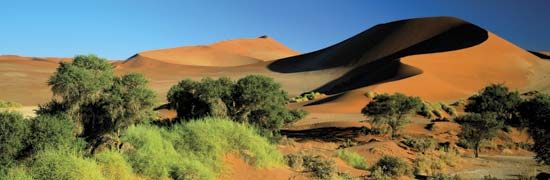
The Moçâmedes Desert is the northernmost extension of the Namib Desert, stretching approximately 275 miles (450 km) along the Atlantic coast of Angola. In…
How does the Moçâmedes Desert compare to other deserts in Africa in terms of size and characteristics?
The Moçâmedes Desert is the northernmost extension of the Namib Desert, stretching approximately 275 miles (450 km) along the Atlantic coast of Angola1. In contrast, the entire Namib Desert spans 1,200 miles (1,900 km) from Angola through Namibia to South Africa.1
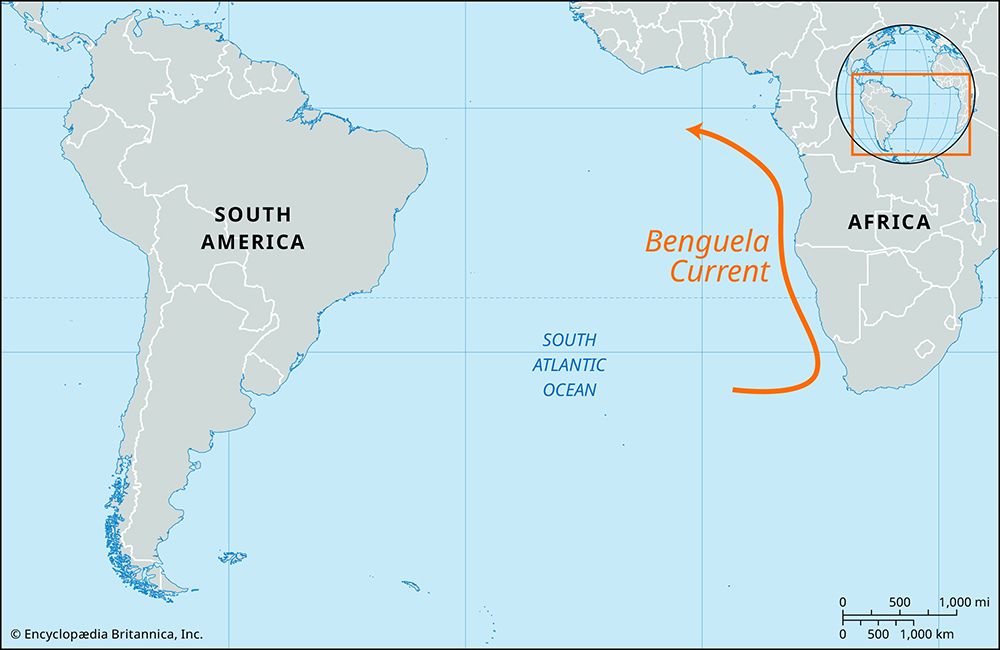
Characteristically, the Moçâmedes Desert is defined by gravel plains, rock platforms, and sand dune fields. Like other coastal deserts, such as the broader Namib, it is significantly influenced by the cool Benguela Current, which creates frequent fog and relatively cool temperatures. This fog serves as a vital moisture source in an otherwise arid environment where annual rainfall is typically less than 2 inches (50 mm). While many African deserts are shaped by subtropical high-pressure systems, the Moçâmedes is specifically distinguished by its coastal position and unique flora, such as the Welwitschia mirabilis.23
Are there any unique plant or animal species that have adapted to survive in the Moçâmedes Desert?
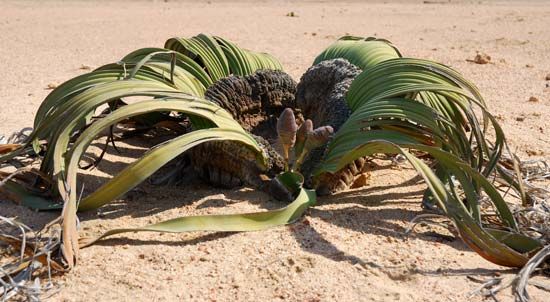
The Moçâmedes Desert is home to one of the world’s most remarkable botanical oddities, the Welwitschia mirabilis. This unique gymnosperm is endemic to the coastal desert regions of Angola and Namibia and is unlike any other plant on Earth.145
The Welwitschia mirabilis
- Physical Structure: The plant consists of a short, cone-shaped stem and only two permanent, straplike leaves that grow continuously throughout its life, often reaching lengths of several meters.45
- Longevity: Some specimens are estimated to be between 1,500 and 2,000 years old.4
- Survival Adaptations: To survive in an environment that receives less than 2 inches (50 mm) of rainfall annually, the plant utilizes a deep taproot to access groundwater. It is also believed that the plant absorbs moisture from the frequent morning fog that rolls in from the Atlantic Ocean, which is generated by the cool Benguela Current.14
While the Moçâmedes Desert itself is largely uninhabited, the broader Namib ecosystem—of which it is the northern extension—supports a variety of specialized wildlife, including gemsbok, springbok, ostriches, and various reptiles and insects that have adapted to utilize fog as a primary water source.67
What is the climate like in the Moçâmedes Desert, and how does it affect the local ecosystem?
The climate of the Moçâmedes Desert is characterized by extreme aridity, with annual rainfall typically falling below 2 inches (50 mm). This dry environment is heavily influenced by the cold, offshore Benguela Current, which chills the air and creates frequent, dense fog along the coast.17
Climatic Impact on the Ecosystem
The interaction between the desert’s climate and its environment creates unique conditions for life:
- Moisture Source: Because rainfall is so scarce, the frequent fog serves as a critical, life-sustaining source of moisture for the local ecosystem. Plants and other organisms have adapted to capture these moisture droplets directly from the air.19
- Temperature Regulation: The Benguela Current keeps temperatures relatively cool and uniform, preventing the extreme diurnal heat swings often found in other low-latitude deserts.17
- Vegetation: The harsh, arid conditions limit vegetation, but the area supports specialized flora such as the Welwitschia mirabilis. This plant is uniquely adapted to the environment, using its deep taproot to access groundwater and its leaves to potentially absorb moisture from the fog.17
- Landscape: The climate has shaped the region into a landscape of gravel plains, rock platforms, and sand dune fields, which provide the primary habitats for the desert’s sparse biological communities.19
How does the nearby Atlantic Ocean influence the Moçâmedes Desert’s environment?
The Atlantic Ocean plays a defining role in the environment of the Moçâmedes Desert through the influence of the cold, offshore Benguela Current. This current is the primary driver of the region’s unique climatic conditions, which distinguish it from many other low-latitude deserts.112
Key Environmental Influences
- Temperature Regulation: The cold waters of the Benguela Current chill the air above them, maintaining relatively cool and uniform temperatures along the coast. This prevents the extreme heat fluctuations typically associated with desert environments.112
- Fog Formation: As the cool air moves inland as a southwest sea breeze, it creates frequent, dense fog. This fog is a vital moisture source for the local ecosystem, as the area receives less than 2 inches (50 mm) of annual rainfall.112
- Atmospheric Stability: The interaction between the cold ocean current and the air creates a temperature inversion, with a layer of cool, foggy air trapped beneath warmer, drier air. This stability keeps the maritime air mass stable offshore, further contributing to the extreme aridity of the coastal strip.712
Sources
- Moçâmedes Desert — Encyclopædia Britannica
- Desert - Environment — Encyclopædia Britannica
- Namib — Encyclopædia Britannica
- Welwitschia — Encyclopædia Britannica
- Namib - Animal life — Encyclopædia Britannica
- Angola - Plant and animal life — Encyclopædia Britannica
- Namib - Climate — Encyclopædia Britannica
- Sossusvlei — Encyclopædia Britannica
- Angola - Climate — Encyclopædia Britannica
- Sahara - Climate of the Sahara — Encyclopædia Britannica
- Mozambique Current — Encyclopædia Britannica
- Africa - Factors influencing the African climate — Encyclopædia Britannica
- Desert - Origin — Encyclopædia Britannica
Published on · 3 min read