Monitor
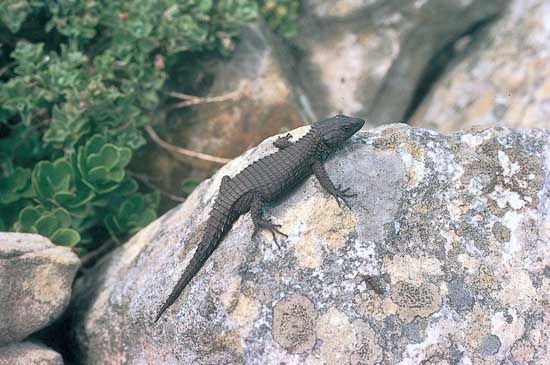
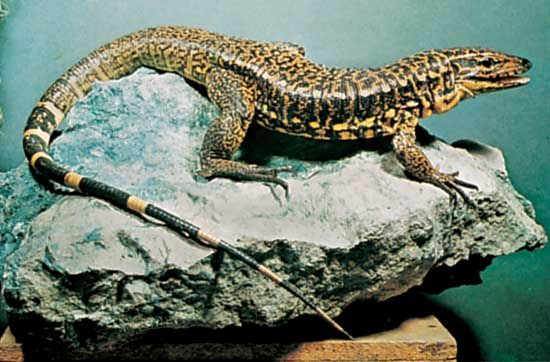
Monitor lizards (family Varanidae) are a diverse group of reptiles known for their elongated bodies, long necks, and forked, snakelike tongues. Some of the…
What are some of the most well-known species of monitor lizards?
Monitor lizards (family Varanidae) are a diverse group of reptiles known for their elongated bodies, long necks, and forked, snakelike tongues. Some of the most well-known species include:1
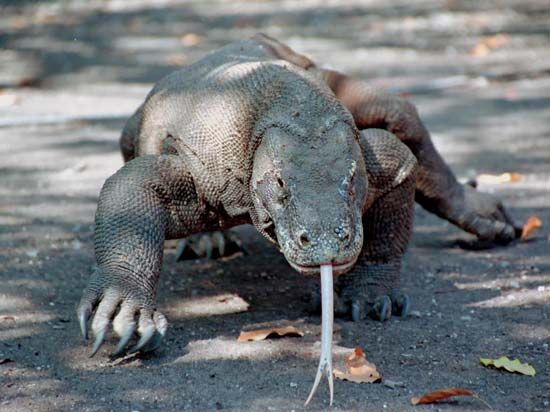
- Komodo dragon (Varanus komodoensis): The world’s largest living lizard, reaching lengths of 3 meters (10 feet). Native to Indonesia, it is a formidable predator that uses a venomous bite to hunt prey such as deer and water buffalo.123
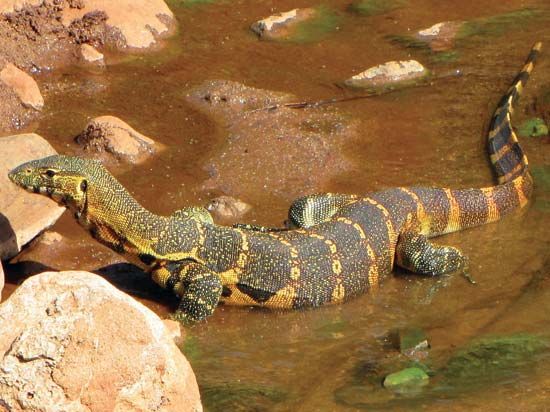
- Common, or Malayan, water monitor (Varanus salvator): Found throughout Southeast Asia, this species grows up to 2.7 meters (9 feet). Unlike ambush predators, it is known for actively pursuing prey by swimming, climbing, or running.13
- Crocodile monitor (Varanus salvadorii): Native to New Guinea, this species can reach lengths of up to 5 meters (16 feet), making it longer than the Komodo dragon, though it is lighter in weight.3
- Perentie (Varanus giganteus): An Australian monitor that can grow to 2.4 meters (8 feet) in length.1
- Earless monitor (Lanthanotus borneensis): A rare, small species native to Borneo, notable for being the only member of the subfamily Lanthanotinae.1
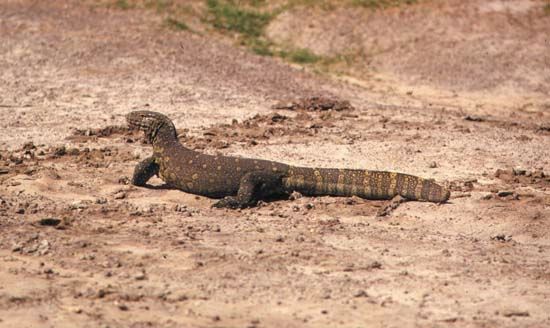
How large can monitor lizards grow, and which species is considered the largest?
Monitor lizards (family Varanidae) exhibit a wide range of sizes, with the smallest species reaching only 20 cm (8 inches) in total length. However, the family is well known for several species that attain significant size.5
The Komodo dragon (Varanus komodoensis) is considered the largest living lizard species, typically reaching a total length of 3 meters (10 feet). While the water monitor (V. salvator) may occasionally grow to a greater total length than the Komodo dragon, it does not exceed the Komodo dragon in weight. Other notable large species include the perentie (V. giganteus), which grows to 2.4 meters (8 feet), and V. bitatawa, which reaches about 2.0 meters (7 feet).156
Historically, monitor lizards grew even larger; fossils of the extinct Australian monitor Megalania prisca suggest it exceeded 7 meters (23 feet) in length and likely weighed nearly 600 kg (1,300 pounds).5
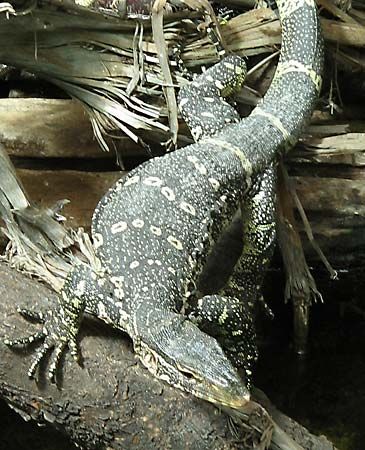
How do monitor lizards interact with humans, and are they considered dangerous?
Monitor lizards interact with humans in various ways, ranging from being sources of food and leather to serving as ecotourism attractions. However, their interactions can also lead to conflict, particularly when large species prey on livestock or threaten human safety.132
Are They Dangerous?
While many smaller lizards are harmless, large monitor lizards are considered potentially dangerous to humans. Their size, sharp claws, and powerful, whip-like tails can inflict serious injury.12
- Komodo Dragons: These are the largest monitor lizards and are capable of attacking and killing humans. They possess a venomous bite that delivers toxins inhibiting blood clotting, and their mouths can harbor bacteria that contribute to the severity of a wound.13
- Water Monitors: Humans bitten by water monitors may be exposed to infectious bacteria and injected with venom that causes mild effects. While there are historical reports of fatalities from large individuals, these are often considered unreliable.1
- Crocodile Monitors: Known for being highly aggressive, these lizards are considered risky to encounter in the wild.1
In general, monitor lizards are not typically aggressive toward humans unless provoked or threatened, but their predatory nature and physical capabilities necessitate caution.12
How have monitor lizards been portrayed in various cultures and mythologies?
The provided search results do not contain information regarding the portrayal of monitor lizards in various cultures and mythologies. While the documents detail the biological characteristics, ecological roles, and interactions between monitor lizards and humans, they do not address the symbolic, cultural, or mythological significance of these animals.
Sorry, the Britannica knowledge base does not contain this information.
Sources
- monitor — Encyclopædia Britannica
- Komodo dragon — Encyclopædia Britannica
- 7 of the World’s Most Dangerous Lizards and Turtles — Encyclopædia Britannica
- 11 Fascinating Nile River Plants and Animals — Encyclopædia Britannica
- reptile: Top Questions — Encyclopædia Britannica
- reptile - Size range — Encyclopædia Britannica
- Varanidae — Merriam-Webster
- lizard - General features — Encyclopædia Britannica
- monitor lizard — Merriam-Webster
Published on · 3 min read