Moss
Mosses, classified under the division Bryophyta, are small, nonvascular land plants that possess several distinct characteristics:
What are the main characteristics that distinguish mosses from other plants?
Mosses, classified under the division Bryophyta, are small, nonvascular land plants that possess several distinct characteristics:
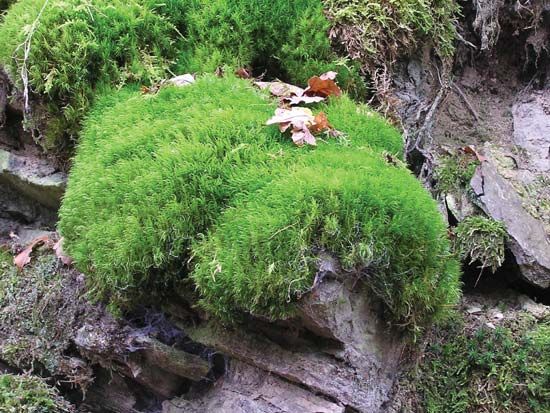
- Dominant Gametophyte: Unlike vascular plants, where the sporophyte is the dominant phase, mosses have an independent, photosynthetic gametophyte as their conspicuous, long-lived generation3.1
- Lack of Vascular Tissue: Mosses generally lack specialized xylem and phloem for internal transport, though some species contain primitive conducting cells called hydroids.2
- Simple Structures: They do not possess true roots, stems, or leaves. Instead, they have stemlike axes (caulids) and leaflike structures (phyllids) anchored by multicellular rhizoids.32
- Dependent Sporophyte: The sporophyte generation is physically attached to and nutritionally dependent on the gametophyte.42
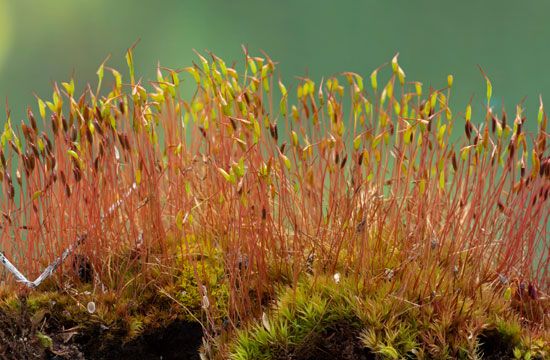
- Reproduction: Mosses rely on water for the transport of flagellated sperm to the egg for fertilization. They also reproduce via spores released from a capsule atop a stalk called a seta.234
What role do mosses play in ecosystems and why are they considered important?
Mosses are vital components of global ecosystems, providing essential services that influence hydrology, soil development, and climate regulation.
Ecological Contributions
- Hydrological Regulation: Mosses, particularly Sphagnum species, act as massive sponges that absorb and retain significant amounts of water. By controlling the water table and influencing the hydrology of surrounding landscapes, they are fundamental to the development of wetland habitats.56
- Soil Formation and Nutrient Cycling: Mosses are often pioneer species that colonize bare rock, initiating soil formation and creating conditions suitable for other plants. They also play a key role in nutrient cycling by capturing airborne minerals and precipitation.6
- Climate Mitigation: Peatlands formed by mosses are critical for the sequestration of carbon, making their protection a significant strategy for mitigating climate change.5
- Environmental Indicators: Because they are sensitive to their surroundings, mosses serve as indicator species, often signaling specific environmental conditions such as soil acidity.7
While mosses are ecologically essential, the harvesting of peat for fuel or gardening is damaging to delicate ecosystems and is increasingly viewed as unsustainable and unethical.5
What is the life cycle of a typical moss plant?
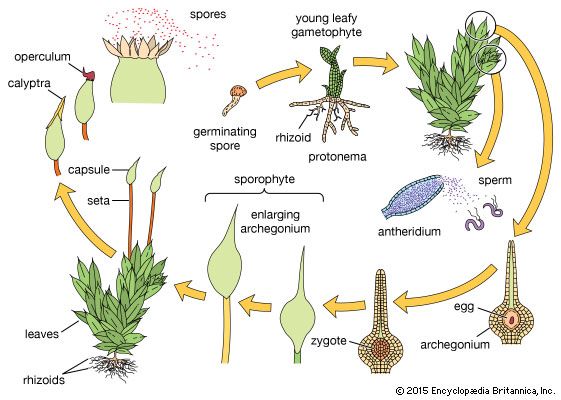
The life cycle of a moss follows a process known as alternation of generations, which involves two distinct phases: the haploid gametophyte and the diploid sporophyte.8
The Gametophyte Phase
The cycle begins when a spore germinates to form a protonema, a filamentous, threadlike structure that grows along the soil. From this protonema, buds develop into the leafy gametophore, which is the dominant, long-lived phase of the moss. The gametophore produces sex organs: the antheridia (male) and archegonia (female).9108
Fertilization and the Sporophyte Phase
When moisture from rain or heavy dew is present, biflagellate sperm are released from the antheridia and swim to the archegonia to fertilize the egg. This fertilization results in a diploid zygote, which develops into the [sporophyte]. The sporophyte remains attached to the gametophyte, relying on it for nutrients. It consists of a foot, a stalk called a seta, and a terminal capsule (sporangium). Inside the capsule, meiosis occurs to produce new haploid spores, which are eventually released into the environment to begin the cycle again.9810
How do mosses reproduce and spread in their environment?
Mosses reproduce and spread through a combination of sexual and asexual processes, allowing them to colonize and persist in diverse environments.
Sexual Reproduction
The life cycle of a moss involves an alternation of generations between the leafy, dominant gametophyte and the dependent sporophyte.84
- Fertilization: Mature gametophores produce sex organs: antheridia (male) and archegonia (female). When moisture from rain or heavy dew is present, biflagellate sperm are released and swim to the archegonia to fertilize the egg.8
- Spore Dispersal: The resulting sporophyte develops a capsule containing spores. These spores are shed gradually through various mechanisms, such as the movement of peristome teeth that respond to moisture, or, in the case of Sphagnum, by the buildup of internal pressure that ejects them into the air.86
Asexual and Vegetative Reproduction
Mosses also spread efficiently through vegetative means, which allows them to expand their populations without the need for fertilization.84
- Fragmentation: Any living fragment of a moss gametophyte—including leaves, stems, or rhizoids—has the potential to regenerate into a complete new gametophyte.412
- Protonema: Upon germination, a spore produces a protonema, a filamentous system that grows along the soil. This structure can proliferate indefinitely under favorable conditions, budding off new leafy shoots to increase the population.86
- Gemmae: Some species produce specialized masses of cells called gemmae, which can detach and grow into new plants.4
Sources
- Plant - Division Bryophyta — Encyclopædia Britannica
- moss — Encyclopædia Britannica
- Plant - Definition of the category — Encyclopædia Britannica
- bryophyte — Encyclopædia Britannica
- peat moss — Encyclopædia Britannica
- bryophyte - Ecology and habitats — Encyclopædia Britannica
- indicator species — Encyclopædia Britannica
- Plant reproductive system - Mosses — Encyclopædia Britannica
- Alternation of generations — Encyclopædia Britannica
- protonema — Merriam-Webster
- bryophyte - Form and function — Encyclopædia Britannica
- Plant reproductive system - Variations in reproductive cycles — Encyclopædia Britannica
Published on · 4 min read