Mount Karisimbi
Mount Karisimbi is the highest peak in the Virunga Mountains, a volcanic range located in east-central Africa. Standing at 14,787 feet (4,507 meters), it is…
What is Mount Karisimbi?
Mount Karisimbi is the highest peak in the Virunga Mountains, a volcanic range located in east-central Africa. Standing at 14,787 feet (4,507 meters), it is situated on the border between the Democratic Republic of the Congo and Rwanda-Congo) and Rwanda.1
Geologically, the mountain emerged during the latter part of the Pleistocene Epoch, approximately 900,000 to 130,000 years ago. It is located within the Virunga National Park and is recognized for its diverse ecological zones, which transition from dense forests at the base to a barren volcanic core. The mountain is a significant habitat for wildlife, most notably the gorilla, and is celebrated for its unique exotic plant life.12
What are the other major peaks in the Virunga Mountains?
The Virunga Mountains consist of eight major volcanic peaks stretching across the borders of the Democratic Republic of the Congo, Rwanda, and Uganda. Beyond the highest peak, Karisimbi, the range includes the following significant volcanoes:2
- Mikeno: One of the oldest peaks in the range, characterized by a jagged relief due to extensive erosion.2
- Sabinio: Also among the oldest volcanoes, its name translates to “Old Man with Large Teeth.”2
- Visoke: A central peak that emerged during the latter part of the Pleistocene Epoch.2
- Mgahinga: Another central volcano formed during the same period as Visoke and Karisimbi.2
- Muhavura: Known as a “landmark” or “guide,” this peak features a summit crater containing a small lake.2
- Nyiragongo: Located at the western end of the chain, this active volcano contains a large crater with a liquid lava pool.2
- Nyamulagira: Situated near Nyiragongo, this is the other active volcano at the western end of the range.2
How do mountain gorillas adapt to high-altitude environments?
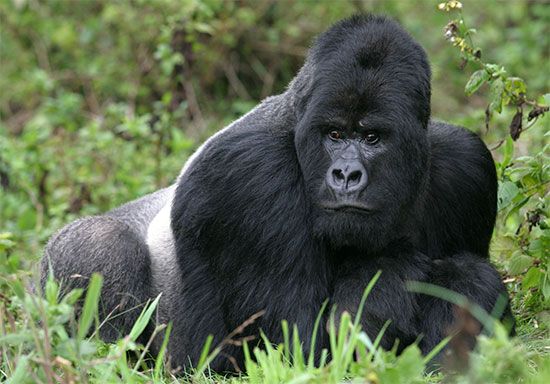
The mountain gorilla (Gorilla beringei beringei) is a subspecies of the eastern gorilla that inhabits the high-altitude montane and bamboo forests of the Virunga Mountains and other highland regions in east-central Africa.32
While the provided knowledge base details the physiological adaptations of various indigenous mountain animals—such as the llama and yak, which possess genetically based adaptations like high-affinity hemoglobin to thrive in low-oxygen environments—it does not explicitly detail the specific biological or physiological mechanisms that allow mountain gorillas to adapt to high-altitude conditions.4
We do know that mountain gorillas are physically distinguished from other subspecies by their longer, thicker hair, which likely serves as an adaptation to the colder temperatures found at higher elevations. Their survival in these environments is supported by a specialized vegetarian diet consisting of leaves, stalks, and shoots found within their forest habitat.3
What is the difference between active and extinct volcanoes?
The distinction between active and extinct volcanoes is primarily based on their history of eruption and the likelihood of future activity.
- Active Volcanoes: These are volcanoes that have erupted in recent history and are considered likely to erupt again. Scientists monitor these sites using tools like seismographs to detect earthquake tremors caused by the upward movement of magma, as well as tiltmeters and gas detectors to identify signs of impending activity. Permanent observatories are often established at these locations, such as Kilauea in Hawaii or Mount Etna in Italy, to provide early warnings for surrounding populations.6
- Extinct Volcanoes: While the provided search results focus on the mechanics of active volcanism and eruption types, they imply that volcanoes are dynamic features linked to plate tectonic activity or hotspots. A volcano is generally considered extinct when it is no longer connected to its magma supply, meaning it is unlikely to erupt again in the future.67
Sources
- Mount Karisimbi — Encyclopædia Britannica
- Virunga Mountains — Encyclopædia Britannica
- gorilla — Encyclopædia Britannica
- mountain gorilla — Merriam-Webster
- human respiratory system - High altitudes — Encyclopædia Britannica
- geology - Volcanology — Encyclopædia Britannica
- volcano - Six types of eruptions — Encyclopædia Britannica
- What Causes a Volcano to Erupt? — Encyclopædia Britannica
Published on · 3 min read