Mount Meru
The name "Mount Meru" refers to two distinct concepts: a physical mountain in Africa and a sacred mountain in religious tradition.
What is Mount Meru?
The name “Mount Meru” refers to two distinct concepts: a physical mountain in Africa and a sacred mountain in religious tradition.
Physical Geography
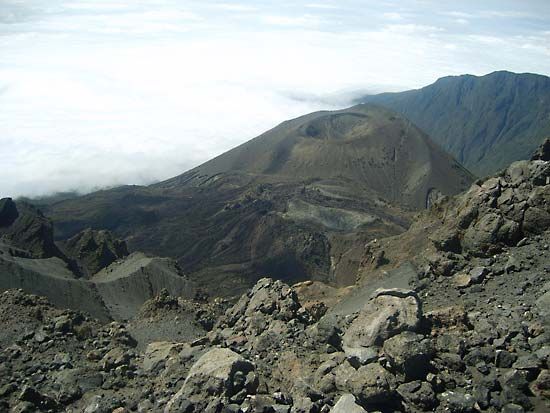
Mount Meru is a volcanic cone located in northern Tanzania, standing at 14,978 feet (4,565 m). Situated near the Kenyan border and west-southwest of Mount Kilimanjaro, its fertile volcanic slopes support coffee plantations and rain forests. The mountain’s extinct crater is accessible from the town of Arusha.1
Mythology and Religion
In Hindu mythology, Mount Meru is a golden mountain considered the axis of the world and the center of the universe. It serves as the abode of the gods, and its symbolic representation is found in the roof towers of Hindu temples.2
This concept of a cosmic mountain is significant across several traditions:
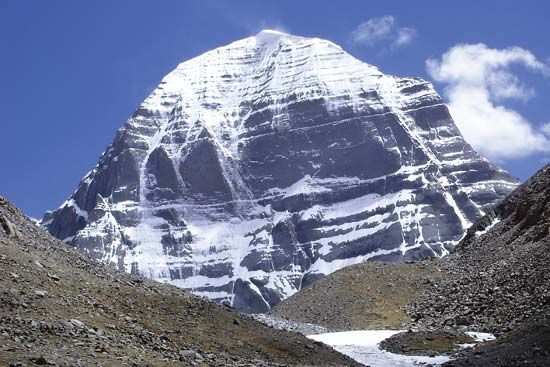
- Buddhism: Tibetan Buddhism identifies the physical Mount Kailash with the mythical Mount Meru.3
- Symbolism: It is often viewed as a “world pillar” connecting heaven and earth.4
How does Mount Kilimanjaro compare to Mount Meru in Tanzania?
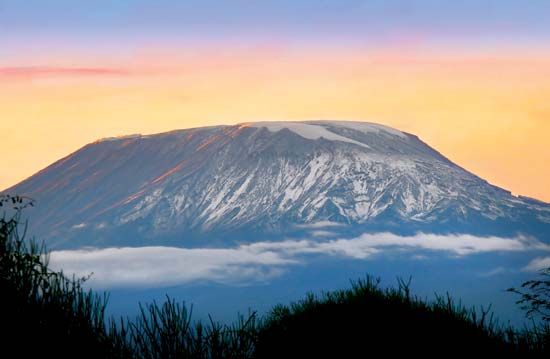
Mount Kilimanjaro and Mount Meru are both prominent volcanic features located in northern Tanzania within the East African Rift System. While they share a regional proximity—situated approximately 42 miles (68 km) apart—they differ significantly in scale and characteristics.
- Elevation: Mount Kilimanjaro is the significantly larger peak, rising to elevations over 16,000 feet (4,900 meters) and featuring a permanent ice cap despite its proximity to the Equator. In contrast, Mount Meru reaches an elevation of 14,978 feet (4,565 m).15
- Geography: Mount Kilimanjaro extends along Tanzania’s northern border with Kenya. Mount Meru is located to the west-southwest of Kilimanjaro, with its southern base near the town of Arusha. Its slopes are characterized by fertile volcanic soil that supports coffee plantations and rain forests up to approximately 9,500 feet (2,900 m).15
What other mountains are considered sacred in world religions?
Throughout history, many cultures have revered prominent mountains as sacred spaces, often viewing them as “heavenly ladders” that connect the earth to the divine, as abodes for gods, or as the center of the universe.6
Beyond Mount Meru, several other mountains hold profound religious significance:
- Mount Kailash: Located in the Himalayas, this peak is sacred to Hinduism, Buddhism, Jainism, and the Bon religion. It is considered the home of the god Shiva and is frequently identified with the mythical Mount Meru.3
- Mount Fuji: As the essential symbol of Japan, this volcano has long been central to Shintō tradition. It is associated with the goddess Konohanasakuya-hime, and its ascent has historically been practiced as an act of religious devotion.7
- Mount Sinai: Situated in Egypt, this peak is a site of immense importance in Judaism, Christianity, and Islam. It is traditionally recognized as the place where Moses received the Ten Commandments.8
- Mount Olympus: In ancient Greece, this mountain was believed to be the dwelling place of the gods, serving as a vital link between heaven and earth.6
How is the concept of a ‘world axis’ represented in architecture?
The concept of a “world axis,” or axis mundi, refers to a symbolic line or stem that connects the heavens, the earth, and the underworld, serving as the center around which the universe revolves. In architecture, this concept is represented through structures designed to mirror the cosmos and facilitate communication with the divine.91011
Architectural Representations
Architects often use symbolic equivalents to recreate sacred landscapes, such as mountains, trees, and pillars, to establish this cosmic connection:
- Mountains: Many temples are designed as architectural representations of a sacred mountain, serving as the “navel of the world.” Examples include the ziggurats of ancient Mesopotamia, the pyramidal temples of pre-Columbian Mexico, and the Hindu temple, which is often laid out geometrically to mirror the universe.1011
- Vertical Pillars and Trees: The world axis is frequently depicted as a central pole or column. This is seen in the parasol shaft (chattravali) of a stupa, the pagoda mast, or the obelisk of ancient Egypt. In Hindu architecture, the temple itself is understood as a cosmic pillar, with a vertical axis connecting all parts of the building to the worshiper’s own spiritual ascent.1011
- Enclosed Sacred Spaces: Buildings like Christian churches or the kiva often arrange symbolic elements—such as a raised chancel (mountain), a cross (tree), and an altar (stone)—to create a microcosm of the divine world.10
Sources
- Mount Meru — Encyclopædia Britannica
- Mount Meru — Encyclopædia Britannica
- Nature worship - Mountains — Encyclopædia Britannica
- Mount Kailash: Top Questions — Encyclopædia Britannica
- East African mountains — Encyclopædia Britannica
- Mount Kailash — Encyclopædia Britannica
- Mount Fuji — Encyclopædia Britannica
- Mount Sinai — Encyclopædia Britannica
- ceremonial object - Places of worship and sacrifice — Encyclopædia Britannica
- Hinduism - Religious organization of sacred architecture — Encyclopædia Britannica
- axis mundi — Merriam-Webster
- Architecture - Orientation — Encyclopædia Britannica
- stupa — Encyclopædia Britannica
Published on · 3 min read