Myricaceae
The Myricaceae family, commonly known as the wax myrtle family, possesses several unique adaptations that distinguish these trees and shrubs:
Are there any unique adaptations found in Myricaceae plants?
The Myricaceae family, commonly known as the wax myrtle family, possesses several unique adaptations that distinguish these trees and shrubs:
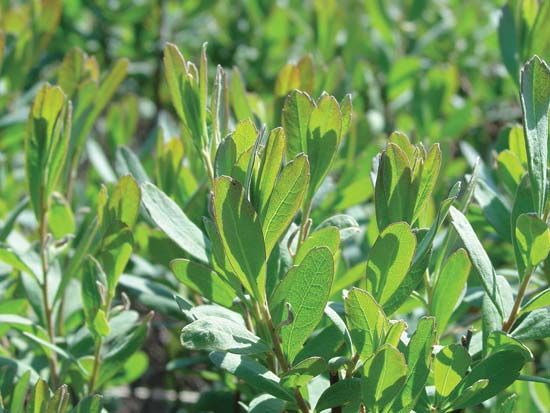
- Aromatic Glandular Dots: Many species feature yellow glandular dots on their leaf surfaces, which are the source of the plants’ characteristic, strong odor.1
- Waxy Fruit Coatings: The fruits of these plants are typically single-seeded and are often covered in waxy granules, bumps, or layers, which are historically significant for human use in products like candles.1
- Inconspicuous Flowers: The plants produce small, greenish, and inconspicuous flowers arranged in clusters known as catkins. These flowers are usually unisexual, with male and female structures appearing on the same or different plants.1
It is important to note that Myricaceae is distinct from the family Myrtaceae, which belongs to a different order and possesses its own set of unique adaptations, such as oil-bearing glands that appear as translucent spots on leaves and specialized structures like lignotubers.23
How are Myricaceae plants used by humans, both historically and in modern times?
Plants in the Myricaceae family have been utilized by humans for centuries, primarily for their aromatic properties and waxy secretions.
Historical and Traditional Uses
- Candle Making: The fruits of species such as the bayberry (M. pennsylvanica) and wax myrtle (M. cerifera) are covered in a thick, bluish-white waxy coating. Historically, this wax was harvested and processed to create candles, a practice that remains a well-known traditional application for these plants.16
- Folk Medicine: Various members of the family have long been valued in traditional medicine. The sweet gale, or bog myrtle, is a shrub found in wet environments that has been used for its resinous leaves in medicinal preparations.1
- Culinary Seasoning: The leaves of the sweet fern (Comptonia peregrina), an aromatic shrub native to eastern North America, have historically been used as a seasoning in addition to their role in folk medicine.1
These plants continue to be recognized for these practical applications today, particularly in artisanal candle making and traditional herbal practices.
How many genera and species are included in the Myricaceae family?
The Myricaceae family, also known as the wax myrtle family, consists of three genera of trees and shrubs. While the provided information specifies that the largest genus, Myrica, contains 50 species, the total number of species across all three genera is not explicitly stated in the available data.
What are the key characteristics of plants in the Myricaceae family?
Plants in the Myricaceae family, commonly known as the wax myrtle or bayberry family, are a group of dicotyledonous flowering plants within the Fagales order. They are found globally and consist of three genera: Myrica, Canacomyrica, and Comptonia (sweet fern).19
Key characteristics of the family include:
- Aromatic Foliage: These trees and shrubs possess aromatic leaves, often featuring yellow glandular dots on the surface that release a characteristic odor.1
- Fruit: The plants produce single-seeded fruits that are frequently covered in waxy granules, bumps, or layers.1
- Flowers: The flowers are small, greenish, and inconspicuous. They are typically unisexual (separately male and female) and arranged in clusters called catkins, which may appear on the same or different plants.1
- Floral Structure: Male flowers generally have 4 stamens (ranging from 2 to 16) attached above two small, scalelike bracteoles. Female flowers consist of a one-chambered ovary with two carpels, topped by a two-branched style and associated with two or four bracteoles.1
Sources
- Myricaceae — Encyclopædia Britannica
- Magnoliales - Myristicaceae — Encyclopædia Britannica
- Myrtales - Natural history — Encyclopædia Britannica
- Myrtales - Characteristic morphological features — Encyclopædia Britannica
- myrtle — Encyclopædia Britannica
- wax myrtle — Merriam-Webster
- Magnoliales - Myristicaceae — Encyclopædia Britannica
- Myrtales - Family distributions and abundance — Encyclopædia Britannica
- Fagales — Encyclopædia Britannica
- Fagales - Myricaceae — Encyclopædia Britannica
Published on · 3 min read