Net-winged Beetle
A net-winged beetle belongs to the family Lycidae, which comprises approximately 2,800 species of soft-bodied insects within the order Coleoptera. These…
What is net-winged beetle?
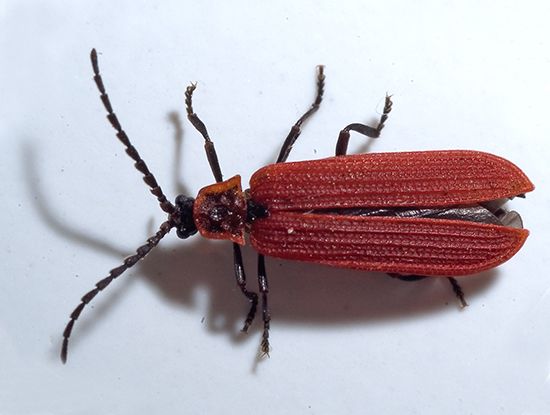
A net-winged beetle belongs to the family Lycidae, which comprises approximately 2,800 species of soft-bodied insects within the order Coleoptera. These beetles are primarily tropical and are easily recognized by their distinct wing covers, or elytra, which are broader at the tip than at the base and feature a raised network of lines or veins.1
Adults are often marked with bold orange, black, or blue patterns, which serve as a warning to predators that the beetles possess an acidic, burning taste. They are frequently observed flying slowly between plants or crawling on flowers, feeding on plant juices or other insects. Their larvae, meanwhile, are typically found in large numbers feeding on wet, rotting wood. Like other beetles, they undergo complete metamorphosis, progressing through egg, larval, pupal, and adult stages.123
What is aposematism and how does it protect these beetles?
Aposematism is a biological strategy where a noxious or dangerous organism advertises its unpalatability to potential predators through conspicuous signals. By clearly signaling their defensive capabilities, these organisms avoid the physical injury that might occur during an attack, even if the predator ultimately decides to release them.5
For net-winged beetles, aposematism serves as a vital protective mechanism. These beetles possess chemical defenses—specifically an acidic, burning taste—that make them highly undesirable to predators. To communicate this, they display bright, contrasting colors that act as a warning “label”.56
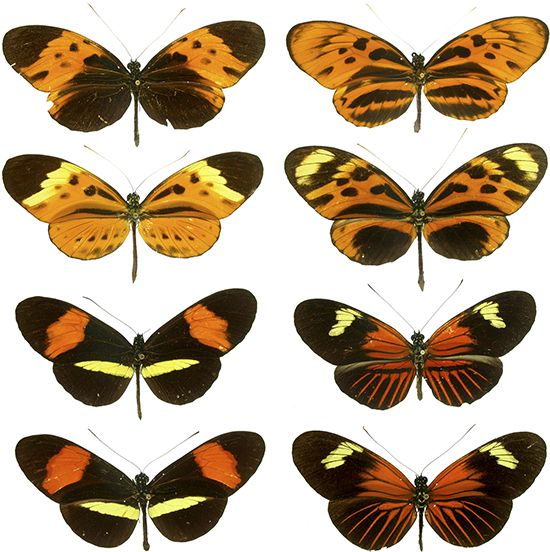
Predators, such as birds, quickly learn to associate these distinct color patterns with the unpleasant experience of consuming the beetle. Once a predator has been conditioned to recognize these visual cues, it will typically avoid attacking the insect altogether. This evolutionary adaptation is so effective that even harmless species may gain protection by evolving similar color patterns, a phenomenon known as mimicry color patterns, a phenomenon known as mimicry.657
What is the process of complete metamorphosis in beetles?
Beetles undergo a process known as complete, or holometabolous, metamorphosis, which consists of four distinct developmental stages: egg, larva, pupa, and adult.89
- Egg: The life cycle begins when the female lays eggs, which eventually hatch into larvae.9
- Larva: This stage is primarily focused on growth and development. As the larva feeds, its skin (cuticle) becomes too small and must be shed in a process called molting. This typically occurs three to five times until the larva reaches maturity. Larval forms vary significantly by species, ranging from the C-shaped grubs of scarabs to the slender, wood-boring forms of other families.92
- Pupa: Before this stage, the insect enters a nonfeeding prepupal period. The pupa forms beneath the final larval skin. During this inactive phase, the insect undergoes a dramatic transformation: larval tissues are broken down, and adult structures—such as wings and reproductive organs—are developed.89
- Adult: Once the transformation is complete, the adult emerges from the pupal skin. It then hardens and develops its final coloration.109
Some beetles also exhibit hypermetamorphosis, a variation where the insect passes through different larval types across several instars.82
Why do other insects mimic the appearance of net-winged beetles?
Other insects mimic net-winged beetles primarily to gain protection from predators through a strategy known as Batesian mimicry.
Because net-winged beetles are noxious or unpalatable, they often display conspicuous aposematism—bright, warning coloration that signals their defensive nature to predators. Predators, having learned through experience that these beetles taste foul or are otherwise dangerous, typically avoid them.
Harmless insects that evolve to resemble these beetles benefit from this established warning system. By mimicking the beetle’s distinct color patterns, the “mimic” species deceives predators into mistaking them for the unpalatable “model,” thereby avoiding attack without needing to invest in their own chemical defenses. This evolutionary advantage allows the mimic to survive by “borrowing” the protection afforded by the beetle’s reputation.111213
Sources
- net-winged beetle — Encyclopædia Britannica
- Coleoptera - General features — Encyclopædia Britannica
- Lycidae — Merriam-Webster
- louse - Distinguishing taxonomic features — Encyclopædia Britannica
- aposematism — Encyclopædia Britannica
- insect - Protection from enemies — Encyclopædia Britannica
- mimicry - The effectiveness of warning systems — Encyclopædia Britannica
- Metamorphosis — Encyclopædia Britannica
- Coleoptera - Pupae — Encyclopædia Britannica
- Coleoptera - Larvae — Encyclopædia Britannica
- Batesian mimicry — Encyclopædia Britannica
- mimicry - Müllerian mimicry — Encyclopædia Britannica
- aggressive mimicry — Encyclopædia Britannica
- mimicry - Batesian mimicry — Encyclopædia Britannica
- mimicry - Batesian mimicry — Encyclopædia Britannica
- Coleoptera - Protection — Encyclopædia Britannica
Published on · 3 min read