New Caledonia
New Caledonia’s economy is primarily driven by the services sector, the mining and processing of nickel, and financial subsidies from France.
What are the main economic activities and industries in New Caledonia?
New Caledonia’s economy is primarily driven by the services sector, the mining and processing of nickel, and financial subsidies from France.12
Key Economic Sectors
- Mining and Industry: Nickel mining is the backbone of the economy, with the territory holding a significant share of the world’s known reserves. The industry includes the extraction of ore and its partial refinement at a large foundry near Nouméa. Other import-substitution industries, such as the manufacturing of cement, soap, and beverages, exist but have a limited impact due to the small local market.341
- Services: Government services, trade, and finance account for a large portion of the gross domestic product and provide approximately two-thirds of total employment.2
- Agriculture and Resources: While agriculture, forestry, and fishing are important, they play a smaller role in the broader economy. Cattle raising supports local meatpacking, and there is potential for growth in tourism.124
The economy faces challenges, including a chronic balance-of-trade deficit and significant wealth inequality between ethnic groups.12
How does the mix of Melanesian, European, and other cultures influence New Caledonian society?
New Caledonian society is defined by a complex interplay between its indigenous Melanesian population and its European and migrant communities, resulting in two distinct ways of life: kanak and caldoche.5
Cultural Dynamics
- Kanak Identity: The Melanesian way of life is deeply rooted in clan membership, family alliances, and specific land rights. Even among urbanized Melanesians, traditional customs remain strong, with individuals frequently returning to their villages for ceremonies, gift exchanges, and agricultural rituals.56
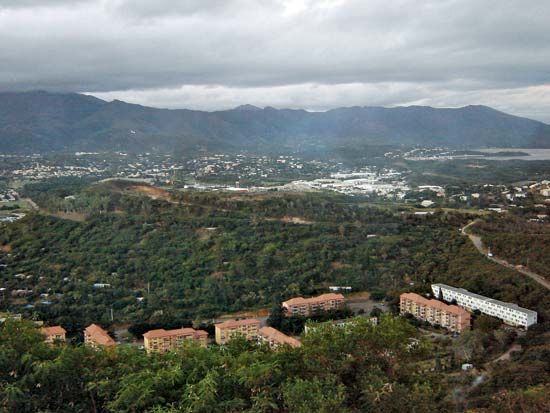
- Caldoche Identity: The European-descended population, or caldoche, is primarily integrated into a modern cash economy. Their cultural influence is most visible in the capital, Nouméa, which features European-style amenities such as restaurants, cinemas, and libraries.56
- Migrant Influence: Smaller communities, including Polynesians (primarily from Wallis and Futuna), Indonesians, and Vietnamese, contribute to the territory’s diversity. Many of these groups are descendants of laborers brought to the islands during the colonial era.57
Social Integration
While French serves as the lingua franca, the territory maintains a rich linguistic landscape with approximately 30 Melanesian languages still in use. Religious life is also diverse, with the Roman Catholic Church and various Protestant denominations playing significant roles in community cohesion. Despite these influences, the society continues to navigate historical tensions regarding land rights, political status, and wealth inequality.564
What languages are spoken in New Caledonia, and how does this reflect its history?
In New Caledonia, there is no single official language, though French and Kanak have special legal recognition. The linguistic landscape is a direct reflection of the territory’s colonial history and its diverse population.5
Linguistic Diversity and History
- French: As the language of the colonial power that annexed the island in 1853, French has become the lingua franca of the territory. Its prevalence is largely due to its central role in the educational system and its use in government, trade, and urban life in Nouméa.845
- Melanesian Languages: There are approximately 30 Melanesian languages spoken across the islands. These languages represent the indigenous heritage of the Melanesian peoples, who are believed to have settled the region by about 3000 BCE. Despite the dominance of French, the use of these local languages remains strong, particularly in rural areas and the Loyalty Islands, where the population is almost entirely Melanesian.584
- Migrant Influence: The presence of other languages reflects the history of indentured labor and migration, which brought workers from various parts of Asia and the Pacific to support the territory’s mining and agricultural industries.8
This linguistic mix highlights the ongoing tension between the preservation of indigenous Kanak identity and the influence of French colonial institutions.54
Where is New Caledonia located, and what is its geographical composition?
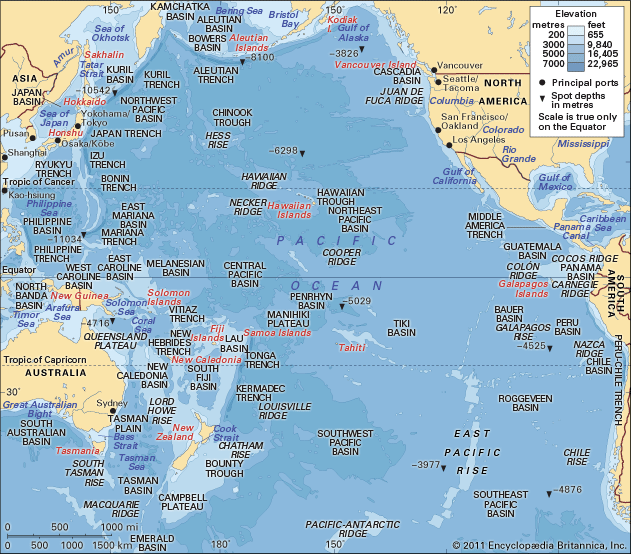
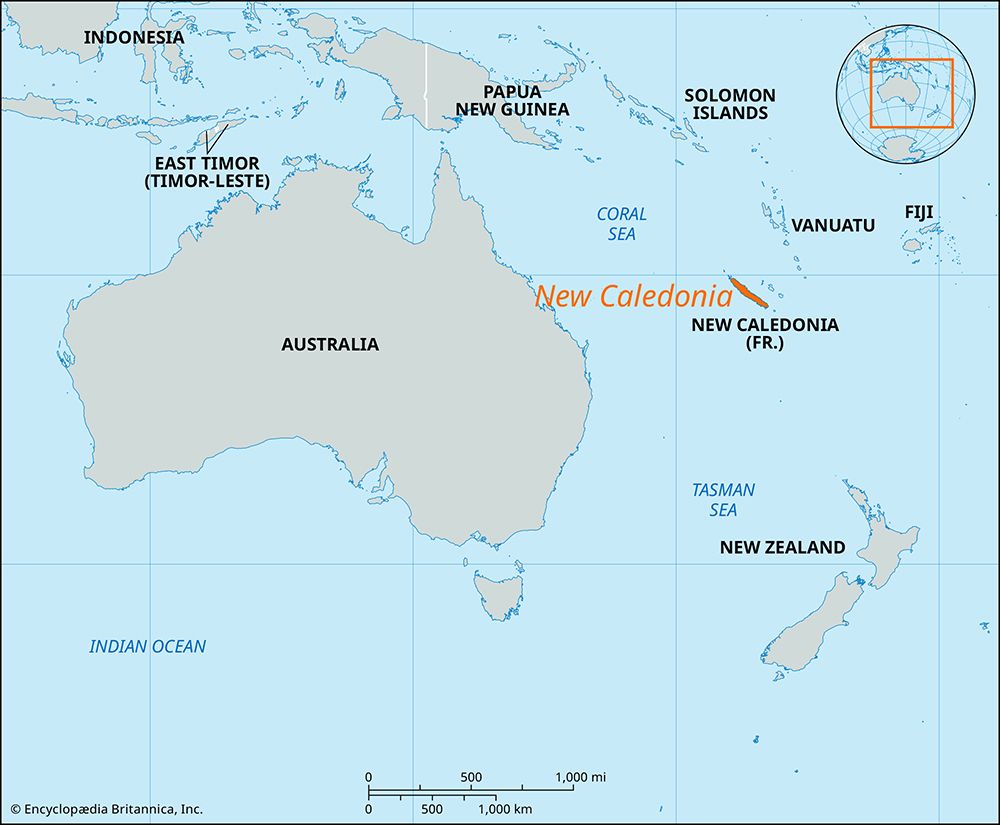
New Caledonia is a French unique collectivity located in the southwestern Pacific Ocean, approximately 750 to 900 miles east of Australia.104
Geographical Composition
The territory is composed of several islands and islets, with the main island—New Caledonia (also known as Grande Terre)—accounting for more than 99 percent of the total land area. Other significant components include:10
- The Loyalty Islands
- The Bélep Islands
- The Île des Pins
- Various far-flung, uninhabited islets and atolls, such as the Chesterfield Islands10
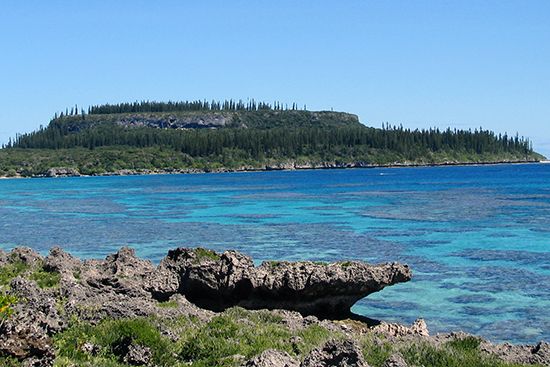
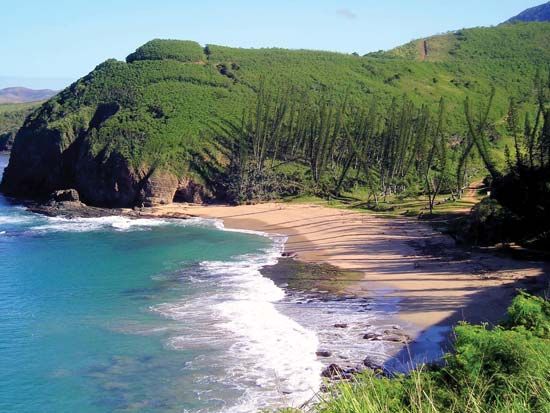
The main island is characterized by a double chain of central mountains, with Mount Panié reaching an elevation of 5,341 feet (1,628 meters). It is encircled by one of the world’s longest barrier reefs, which encloses extensive lagoons designated as a UNESCO World Heritage site in 2008.410
Sources
- New Caledonia - Economy — Encyclopædia Britannica
- New Caledonia - Resources and power — Encyclopædia Britannica
- New Caledonia - Services and trade — Encyclopædia Britannica
- New Caledonia — Encyclopædia Britannica
- New Caledonia - People of New Caledonia — Encyclopædia Britannica
- New Caledonia - Cultural life — Encyclopædia Britannica
- New Caledonia - History of New Caledonia — Encyclopædia Britannica
- New Caledonia — Merriam-Webster
- Nouméa — Encyclopædia Britannica
- New Caledonia — Encyclopædia Britannica
Published on · 4 min read