Norfolk Island
Norfolk Island’s culture is deeply rooted in the 1856 resettlement of the population from Pitcairn Island, who were descendants of the HMS Bounty mutineers…
How has the Polynesian and Pitcairn Islander heritage influenced Norfolk Island’s culture?
Norfolk Island’s culture is deeply rooted in the 1856 resettlement of the population from Pitcairn Island, who were descendants of the HMS Bounty mutineers and their Tahitian Polynesian consorts1.1
This heritage has created a distinctive society characterized by a strong blend of Polynesian and European influences. The cultural identity of the islanders is defined by values such as neighbourliness, self-help, and a tradition of barter. Nearly half of the current population claims lineal descent from these original Pitcairn settlers, maintaining a unique social fabric that distinguishes the island from the Australian mainland.2
While the official language of the region is English, the influence of the settlers’ origins is also reflected in the development of Pitkern, a language that emerged as a mixture of 18th-century English and Tahitian. This fusion of backgrounds continues to shape the social and historical character of the territory today.12
What are some of the notable flora and fauna species found on Norfolk Island?
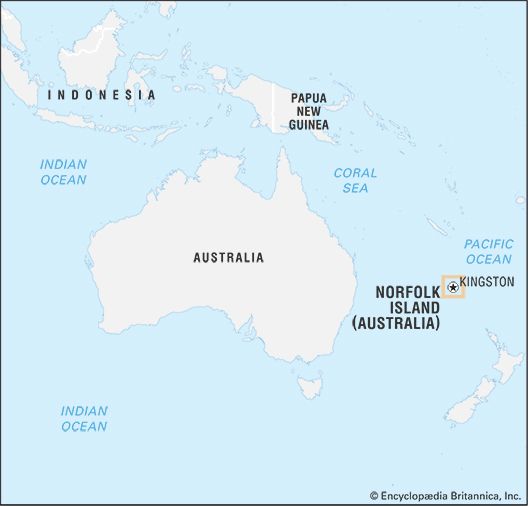
Norfolk Island possesses a diverse range of flora and fauna, shaped by its volcanic origins and isolated location in the southwestern Pacific Ocean.
Flora
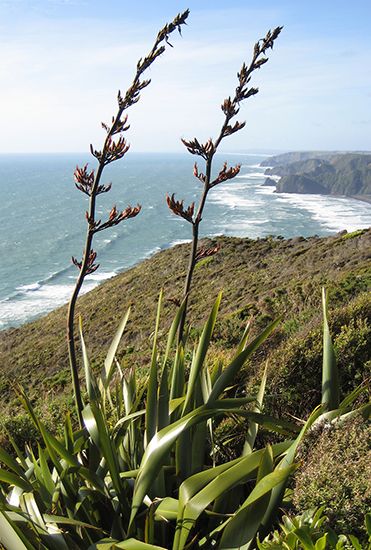
The most iconic plant species on the island is the Norfolk Island pine (Araucaria heterophylla). Despite its name, it is not a true pine but a conifer belonging to the family Araucariaceae. These trees are known for their symmetrical whorls of branches and can reach heights of up to 60 metres (200 feet). Historically, the island was also noted for its abundance of indigenous flax (Phormium tenax), which impressed early explorers like Captain James Cook. Additionally, the island supports the cultivation of Kentia palm seeds as part of its local agricultural activity.41
Fauna
The island’s wildlife includes a variety of species adapted to its rugged, volcanic terrain:
- Reptiles and Amphibians: The island is home to various geckos.1
- Marine Life: The surrounding waters host turtles and a plentiful supply of fishes.1
- Birds and Mammals: The ecosystem supports numerous seabirds and bats.1
How do the education and healthcare systems on Norfolk Island operate?
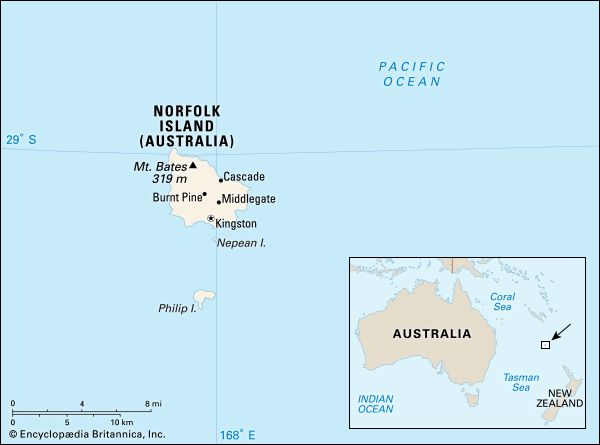
The education and healthcare systems on Norfolk Island are structured to serve its small, remote population as an external territory of Australia.
Education
Education on the island is both free and compulsory for children between the ages of 6 and 15. A notable feature of the system is its integration with the Australian state of New South Wales; specifically, teachers for the island’s school are provided by the New South Wales Department of Education, ensuring that the curriculum aligns with broader Australian educational standards.1
Healthcare
Healthcare services on the island are provided through a small local hospital. While the island maintains its own facility to address the immediate medical needs of its residents, it operates within the administrative framework of an Australian territory.1
What is the unique history of Norfolk Island, including its use as a penal colony?
Norfolk Island’s history is defined by its transition from an uninhabited territory to a notorious penal colony, and eventually to a unique community with deep ties to the HMS Bounty mutineers.
Early Settlement and Penal History
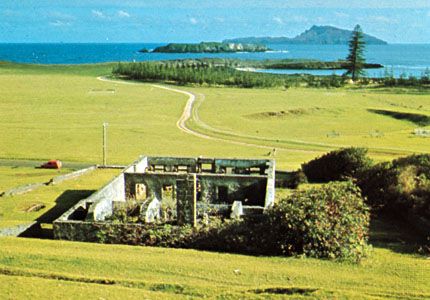
Discovered by Captain James Cook in 1774, the island was initially valued for its potential to provide flax and timber for ships’ masts. It was settled in 1788 by the British colony of New South Wales, serving as a penal colony for 26 years before being abandoned in 1814.
The island was reestablished as a penitentiary from 1825 to 1855. During this period, it became infamous for its harsh discipline and served as a destination for the most desperate criminals from Australian convict settlements. The site was eventually closed due to the immense difficulty of managing both the prisoners and the administrators.
The Pitcairn Connection
In 1856, the island’s demographic shifted significantly when the descendants of the HMS Bounty mutineers were resettled there from Pitcairn Island. This migration created a distinctive society blending Polynesian and European heritage. Today, nearly half of the island’s population claims lineal descent from these settlers.
Sources
- Norfolk Island — Encyclopædia Britannica
- Pitcairn Island — Encyclopædia Britannica
- Fletcher Christian — Encyclopædia Britannica
- Norfolk Island pine — Encyclopædia Britannica
- Australia - Education — Encyclopædia Britannica
- Andaman and Nicobar Islands - Health and welfare — Encyclopædia Britannica
- Norfolk Island — Merriam-Webster
- New Norfolk — Encyclopædia Britannica
Published on · 3 min read