Phormium
Phormium (specifically Phormium tenax), often referred to as New Zealand flax or New Zealand hemp, is a plant native to New Zealand belonging to the day lily…
What are the main characteristics of phormium plants?
Phormium (specifically Phormium tenax), often referred to as New Zealand flax or New Zealand hemp, is a plant native to New Zealand belonging to the day lily family, Hemerocallidaceae.12
Its primary characteristics include:
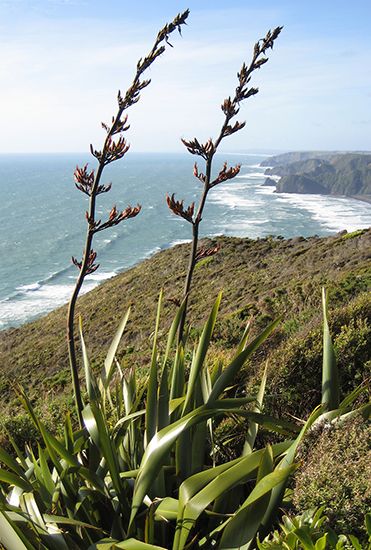
- Structure: The plant consists of 8 to 12 shoots emerging from a central rootstock. Each shoot features at least five dark green, sword-shaped or lance-shaped leaves arranged in a fanlike pattern.12
- Dimensions: Leaves can grow between 3 and 14 feet (0.9 to 4.2 meters) long and are about 2 inches (5 cm) wide, tapering to a point.1
- Flowers: A central flower stalk rises to a height of 12 to 15 feet (3.6 to 4.5 meters), bearing clusters of yellow or scarlet flowers.12
- Fiber: The plant is a significant source of leaf fiber, which is valued for its strength, luster, and resistance to saltwater damage. It is commonly used for cordage, ropes, twine, mats, and bagging fabrics.12
How is phormium fiber extracted and processed?
The extraction and processing of phormium fiber is a precise, labor-intensive procedure that begins with careful harvesting. Workers hand-cut three to four outer leaves from each shoot, ensuring the cut is made 6 to 8 inches above the stalk base; cutting lower would release a red-colored juice that stains the fiber.1
Once harvested, the leaves are sorted by quality and length before undergoing commercial processing:
- Decortication: The leaves are subjected to machine decortication, a process involving crushing and scraping to strip away the surrounding leaf tissue and free the fiber bundles.15
- Cleaning and Drying: The resulting fiber strands are washed to remove impurities and then sun-dried. This drying stage is essential as it promotes bleaching and enhances the natural luster of the fiber.1
When processed correctly, the resulting phormium fiber is creamy white, flexible, and possesses good strength and resistance to saltwater damage. These properties make it highly suitable for manufacturing cordage, ropes, twine, bagging fabrics, and mats.15
What are the different species of phormium and how do they differ?
While the genus Phormium is often associated with the well-known species Phormium tenax, the available information does not detail a list of distinct species or their specific differences. Phormium is recognized as a genus of herbs within the day lily family (Hemerocallidaceae or Liliaceae) characterized by rigid, sword-shaped leaves and tall, leafless scapes bearing yellow or scarlet flowers.14
Phormium tenax, commonly known as New Zealand flax or New Zealand hemp, is the primary species documented for its significant commercial use as a leaf fiber. It is native to New Zealand and has been cultivated globally for its strong, lustrous fiber, which is particularly valued for its resistance to saltwater damage.1
Because the provided search results focus primarily on Phormium tenax as the representative of the genus, I cannot provide a comparison of other species at this time.
What are the modern applications of phormium fiber in textiles and industry?
Phormium fiber, often referred to as New Zealand “hemp” or “flax,” remains a valuable material in various industrial and textile applications due to its strength, flexibility, and notable resistance to saltwater damage.12
Its primary modern applications include:
- Cordage and Twine: The fiber is widely utilized in the production of high-strength ropes and various types of twine, benefiting from its durability and structural integrity.124
- Textiles and Bagging: It is processed into heavy-duty bagging fabrics, which are valued for their robustness.14
- Consumer Goods: The fiber is frequently used to manufacture mats and floor coverings, as well as components for footwear, such as shoe soles, where its hard-wearing nature is an advantage.12
While historically used for traditional baskets and fabrics, its contemporary utility is largely defined by these industrial and utility-focused roles.14
Sources
- phormium — Encyclopædia Britannica
- New Zealand flax — Merriam-Webster
- flax — Encyclopædia Britannica
- phormium — Merriam-Webster
- Leaf fiber — Encyclopædia Britannica
Published on · 3 min read