Northeast Plain
The Northeast Plain, also known as the Manchurian or Sung-liao Plain, is the central lowland of northeastern China (Manchuria). It covers an area of…
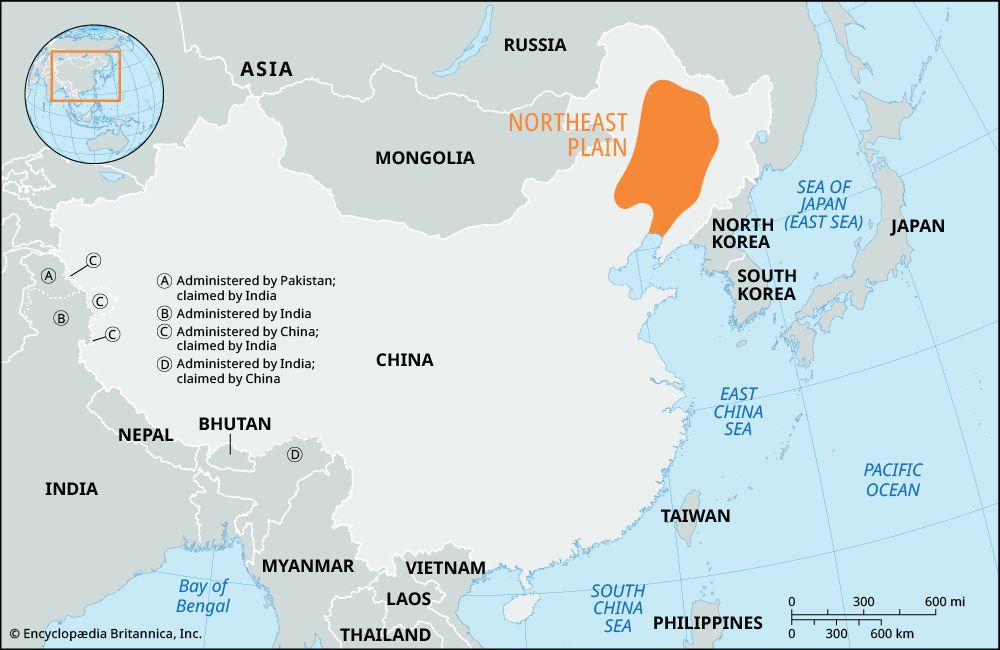
What is the geographical location and extent of the Northeast Plain in China?
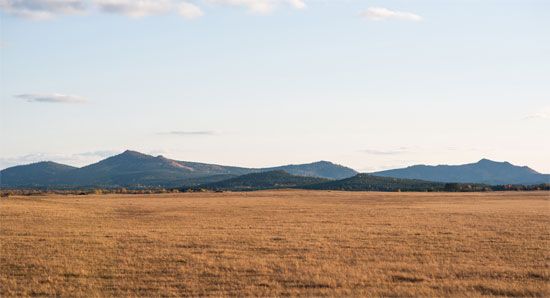
The Northeast Plain, also known as the Manchurian or Sung-liao Plain, is the central lowland of northeastern China (Manchuria). It covers an area of approximately 135,000 square miles (350,000 square km), with its entire surface lying below 1,000 feet (300 meters) above sea level300 meters) above sea level.1
The plain is defined by the following geographical boundaries:
- West and North: Bordered by the Da Hinggan Range.21
- East: Bordered by the Xiao Hinggan Range and the Changbai Mountains.21
- South: Open to the Gulf of Liaodong, with a narrow coastal connection to the North China Plain.2
The region is characterized by undulating terrain and fertile black soils, drained by the Sungari and Nen rivers in the north and the Liao River in the south.21
How does the Northeast Plain compare to other major plains in China?
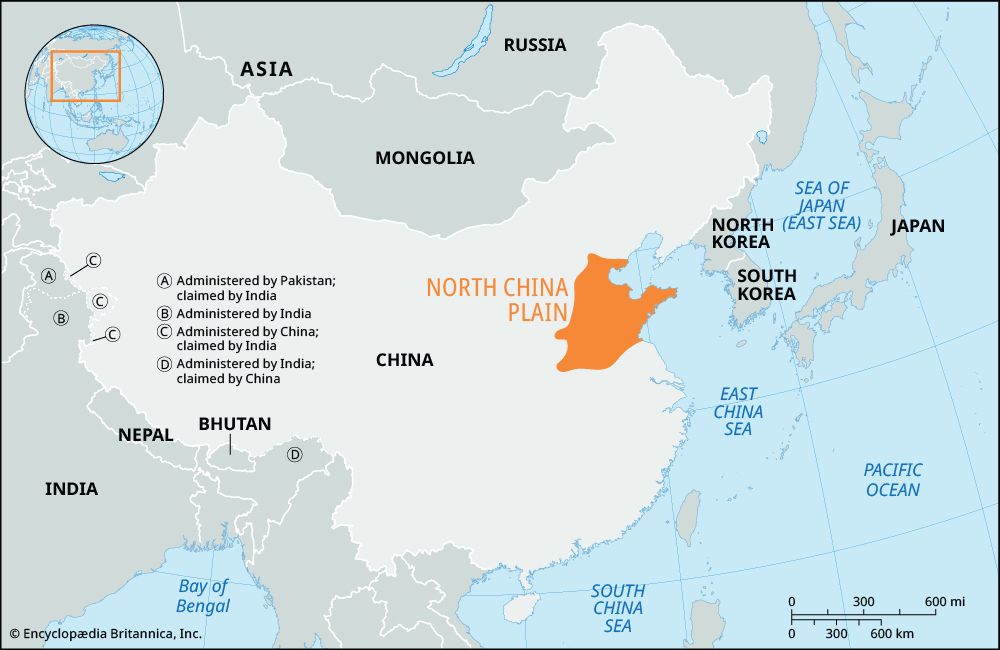
The Northeast Plain and the North China Plain are the two primary lowland regions of eastern China, both comparable in size. However, they differ significantly in their geological formation, relief, and land use.1
Geological and Physical Differences
- Formation: The Northeast Plain is largely an erosional surface covered with deep, fertile black soils. In contrast, the North China Plain is a vast alluvial plain built up by massive sedimentary deposits from the Huang He and Huai River, with deposits reaching depths of up to 3,000 feet.341
- Relief: The Northeast Plain is characterized by undulating terrain. The North China Plain is “monotonously flat,” with river channels often elevated above the surrounding landscape, creating depressions that historically formed lakes and swamps.341
- Elevation: While both are low-lying, the North China Plain is generally lower, with most areas below 160 feet (50 meters) above sea level, whereas the Northeast Plain lies below 1,000 feet (300 meters).513
Economic and Social Context
- Agriculture: The Northeast Plain is a critical base for soybeans, corn, and wheat, supported by large-scale state farms. The North China Plain has the highest proportion of cultivated land in China, focusing on wheat, cotton, and tobacco.31
- Population: The North China Plain has been a central focus of Chinese culture since ancient times and remains one of the most densely populated regions in the world.5
- Industry: The Northeast Plain is a major hub for heavy industry, rich in coal, iron ore, and oil. The North China Plain serves as a vital commercial and political center, housing the national capital, Beijing.35
The Yangtze Plain further differs by being a network of alluvial plains and waterways, heavily defined by its lakes and intensive rice cultivation.6
What natural resources are found in the Northeast Plain, and how are they utilized?
The Northeast Plain is a vital economic region in China, characterized by its rich endowment of natural resources that support both large-scale agriculture and heavy industry.1
Agricultural Resources
The plain is renowned for its fertile black soils, which make it a primary agricultural hub. It is China’s major area for growing soybeans, alongside significant production of:1
- Corn (maize)
- Rice
- Wheat
- Sorghum
- Sugar beets
- Flax1
Following 1949, the region underwent extensive land reclamation and the establishment of large state farms to maximize agricultural output.1
Mineral and Energy Resources
The Northeast Plain is a cornerstone of China’s heavy industry, supported by significant mineral and energy deposits:1
- Petroleum and Natural Gas: The region is a major center for onshore petroleum, most notably at the Daqing oil field, which has been a primary source of crude oil since the 1960s. Natural gas is also produced, often as an associated resource in these major oil fields.910
- Coal: The region contains substantial coal reserves, which have been a focus of mining development since the 1950s to fuel industrial growth.910
- Other Minerals: The area is rich in iron ore, gold, and graphite, which provide essential raw materials for the region’s industrial enterprises.1910
These resources are utilized to power an extensive industrial system, with major manufacturing hubs located in cities such as Harbin, Shenyang, and Changchun.1
What is the historical significance of the Northeast Plain in Chinese civilization?
The Northeast Plain, historically known as Manchuria, has played a pivotal role in Chinese history as a frontier region defined by the convergence of diverse ethnic groups, including the Han Chinese, Mongols, and various Tungus peoples.16
Historical Significance
- Strategic Frontier: For centuries, the region served as a natural highway for nomadic peoples moving across the Eurasian plain. While Chinese colonies were established in the southern Liao Plain as early as the 3rd century BCE, the region remained a site of frequent conflict between nomadic empires—such as the Khitan and Juchen—and Chinese dynasties.16
- Dynastic Transformation: The Northeast Plain was the cradle of the Qing dynasty. The Manchu people, under leaders like Nurhachi, unified the region before establishing control over all of China in 1644, marking the beginning of the last imperial dynasty.16
- Sinicization and Development: Although the Qing initially restricted migration to their homeland, the region was eventually “Sinicized” through massive waves of Chinese immigration in the 19th and 20th centuries. This influx transformed the area from a tribal frontier into a vital center for agriculture and international trade.16
Sources
- Northeast Plain — Encyclopædia Britannica
- China - The Northeast Plain — Encyclopædia Britannica
- North China Plain — Encyclopædia Britannica
- Yangtze Plain — Encyclopædia Britannica
- China - The North China Plain — Encyclopædia Britannica
- China - Soils of China — Encyclopædia Britannica
- Anhui - Drainage — Encyclopædia Britannica
- China - Farming and livestock — Encyclopædia Britannica
- China - Resources and power — Encyclopædia Britannica
- China - Minerals of China — Encyclopædia Britannica
- Heilongjiang - Resources and power — Encyclopædia Britannica
- Wisconsin - Soils — Encyclopædia Britannica
- New Hampshire - Resources and power — Encyclopædia Britannica
- Maine - Resources and power — Encyclopædia Britannica
- Ohio - Soils — Encyclopædia Britannica
- Manchuria - Manchuria to about 1900 — Encyclopædia Britannica
- China - Regional cultures of the Late Neolithic — Encyclopædia Britannica
- China - Urbanization and assimilation — Encyclopædia Britannica
- history of China - The Qing empire — Encyclopædia Britannica
- India-China relations - Relations after 2017: Strategic competition and border skirmishes — Encyclopædia Britannica
Published on · 4 min read