Ovenbird
The term "ovenbird" refers to two distinct groups of birds, both of which share a thrushlike appearance.
What are the physical characteristics and appearance of the ovenbird?
The term “ovenbird” refers to two distinct groups of birds, both of which share a thrushlike appearance.1
North American Ovenbird (Seiurus aurocapillus)
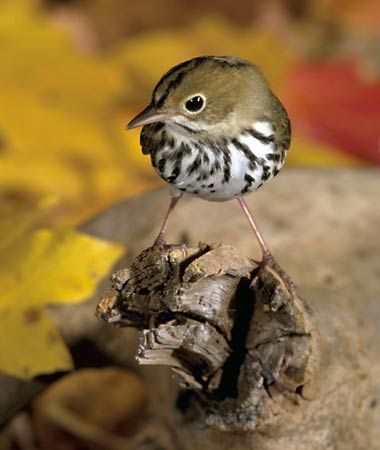
This wood warbler is characterized by its brownish-olive upperparts and a streaked breast. Key physical features include:1
- A white eye ring.1
- A distinctive orange crown bordered by black.1
- A small, thrushlike build.1 Unlike most wood warblers that hop, this species is known for walking.1
Tropical American Ovenbirds (Family Furnariidae)
Often referred to as horneros (Spanish for “baker”), these birds are common throughout South America. Their characteristics include:1
- A length of 15–20 cm (6–8 inches).1
- A reddish-brown coloration.1
- A thrushlike appearance.1 They are named for their unique, ovenlike nests constructed from mud and grass, which can reach about 30 cm in height.1
Where is the ovenbird typically found, and what kind of habitat does it prefer?
The term “ovenbird” refers to two distinct groups of birds with different geographical ranges and habitat preferences.1
North American Ovenbird (Seiurus aurocapillus)
This species is a wood warbler found in North America east of the Rocky Mountains. It prefers “dank woods,” where it builds its nest—a dome of grass—directly on the ground. During the winter, this bird migrates south as far as Colombia.1
Tropical American Ovenbirds (Family Furnariidae)
Commonly known as horneros (or “bakers”), these birds are found throughout most of South America. Unlike their North American counterparts, they prefer open country. They are well-known for building distinctive, ovenlike nests made of mud and grass, which they place on elevated surfaces such as branches, fence posts, or roof ledges.1
How did the ovenbird get its name, and what is unique about its nesting behavior?
The name “ovenbird” is derived from the unique, dome-shaped nests these birds construct, which resemble traditional outdoor ovens.15
Nesting Behavior
While the name is applied to two distinct groups, both are defined by their specialized, enclosed nesting structures:
- Tropical American Ovenbirds (Furnarius): Often called horneros (Spanish for “baker”), these birds build thick-walled, ovenlike nests made of mud and grass. These structures are typically about 30 cm high and are placed on elevated, exposed sites such as fence posts, tree branches, or roof ledges.15
- North American Ovenbird (Seiurus aurocapillus): This wood warbler constructs a domed, oven-shaped nest made of plant materials, such as grass, located directly on the forest floor.15
Both types of nests feature a side entrance, providing a secure, enclosed chamber for the birds’ eggs and young.15
Are there any interesting cultural or historical references to ovenbirds in literature or folklore?
The available information does not contain significant references to ovenbirds in literature or general folklore, though there are notable cultural observations regarding their behavior.
In Argentina, the hornero (a South American ovenbird) is widely regarded with friendly respect and is considered a prominent avian personality. Folklore surrounding the bird includes the charming belief that it is a diligent worker that refuses to build its nest on Sundays, restricting its construction activities to weekdays.1
Beyond this, the primary cultural association with the name “ovenbird” remains its descriptive link to the bird’s architectural skill. The name itself serves as a testament to the birds’ ability to construct elaborate, oven-shaped nests—a behavior that has fascinated observers and led to the common Spanish name hornero, or “baker,” for the South American species.56
Sources
- Ovenbird — Encyclopædia Britannica
- ovenbird — Merriam-Webster
- Furnariidae — Merriam-Webster
- Coraciiform - Life history — Encyclopædia Britannica
- Passeriform - Nesting — Encyclopædia Britannica
- 12 More Bird Names that Sound Like Insults (and Sometimes Are) | Hornero — Merriam-Webster
Published on · 3 min read