Painted Redstart
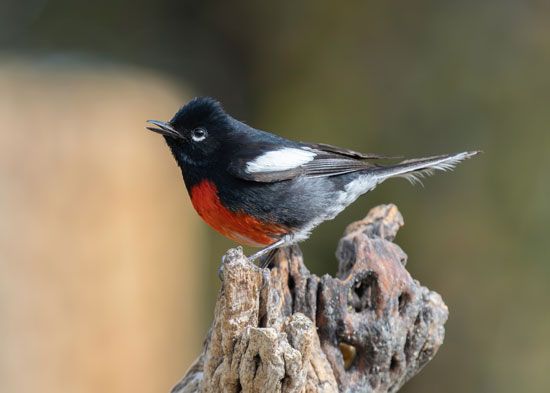
The painted redstart (Myioborus pictus) is a "showy" New World warbler belonging to the family Parulidae. It is primarily found in high-elevation pine-oak…
What is Painted redstart?
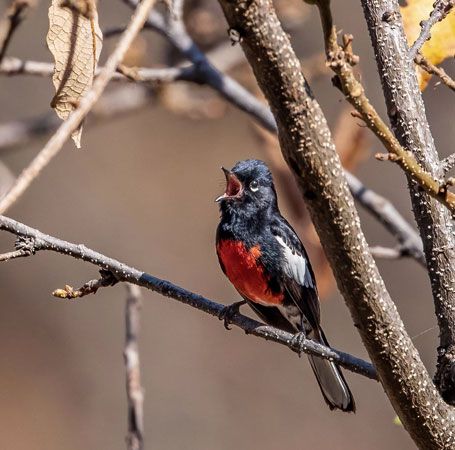
The painted redstart (Myioborus pictus) is a “showy” New World warbler belonging to the family Parulidae. It is primarily found in high-elevation pine-oak and pinyon-juniper forests ranging from the southwestern United States south to northern Nicaragua.12
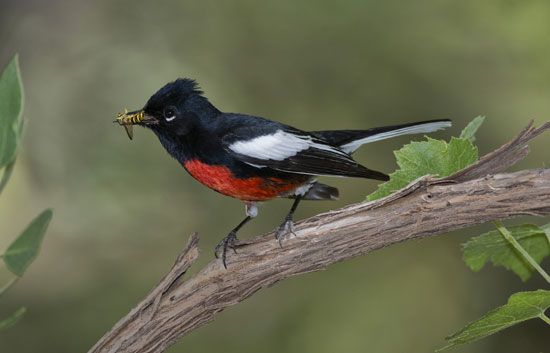
These birds are known for their striking plumage, which features a glossy black head and back, white wing patches, and a vibrant red-orange breast and abdomen. They are insectivores that hunt by using a unique “flashing” technique; they suddenly display their white-on-black tail and wing feathers to shock prey into revealing themselves on branches.1
Unlike many songbirds, males and females look similar. They typically nest on the ground, often under rocks or in cliff crevices. Currently, the species is classified as Least Concern due to its stable population and large geographic range, though researchers monitor the potential future impacts of habitat loss and climate change.1
What other types of birds belong to the wood warbler family?
The family Parulidae, commonly known as wood warblers, comprises approximately 120 species of small, brightly colored songbirds native to the New World. They are distinct from the unrelated Old World warblers of the family Sylviidae.45
Notable members of the wood warbler family include:
- Yellow warbler: A widely distributed species often miscalled the “wild canary,” known for its bright yellow plumage.4
- Northern parula: The namesake of the family, characterized by its pale blue coloration, white wing bars, and yellow breast.4
- Ovenbird: Known for constructing a unique, domed nest on or near the ground.4
- Yellowthroats: A genus (Geothlypis) of eight species, including the common yellowthroat, which is easily identified by the male’s distinctive black mask.4
- Blackpoll warbler: A common species noted for its migration patterns.4
- Black-and-white warbler: A species that exhibits creeper-like habits while foraging.4
- Painted redstart: A species recognized for its striking black-and-white plumage with red-orange accents and a relatively loud voice.5
How does the painted redstart’s ‘flashing’ behavior help it catch insects?
The painted redstart (Myioborus pictus) utilizes its “flashing” behavior as a specialized hunting strategy to secure insect prey. By performing sudden, rapid movements of its white-on-black tail and wing feathers, the bird creates a startling visual effect.
This sudden display shocks insects—such as butterflies, leafhoppers, flies, and cicadas—that are resting on tree branches or trunks. The shock causes the prey to move or reveal their position, allowing the warbler to quickly pick them off before they can escape.1
What are some other examples of birds that build their nests on the ground?
Many bird species nest on the ground, often utilizing simple scrapes or hollows for protection. Here are several examples across different avian groups:
- Gallinaceous Birds: The vast majority of galliforms nest on the ground in shallow scrapes lined with grass or leaves. Notable exceptions include cracids and the hoatzin, which nest in trees.8
- Megapodes: These birds use unique ground-nesting strategies. Some species bury eggs in sand to be incubated by solar radiation, while others, such as the mallee fowl, build large mounds of decaying vegetation to regulate incubation temperatures.8
- Shorebirds: Most members of the Scolopacidae family, including woodcock and snipe, nest on the ground. Similarly, plovers, pratincoles, and thickknees typically lay their eggs in unlined scrapes or hollows on open ground.9
- Gruiforms: Within the order Gruiformes, several species are ground nesters. For example, button quails build grass-lined hollows, often with a domed roof, while the kagu constructs a nest of sticks and leaves in a ground depression. Bustards often lay eggs directly on bare ground with minimal or no nest structure.10
Sources
- Painted redstart: Top Questions — Encyclopædia Britannica
- Redstart — Encyclopædia Britannica
- Painted redstart — Encyclopædia Britannica
- Wood warbler — Encyclopædia Britannica
- Warbler — Encyclopædia Britannica
- Parulidae — Merriam-Webster
- parulid — Merriam-Webster
- Gruiform - Nesting — Encyclopædia Britannica
- Charadriiform - Shorebirds (suborder Charadrii) — Encyclopædia Britannica
- Galliform - Nesting — Encyclopædia Britannica
Published on · 3 min read