Pack Ice
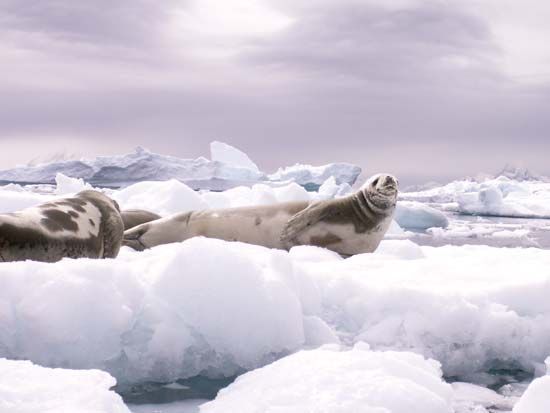
Pack ice is any area of sea ice that is not attached to the shoreline or other fixed structures, making it mobile. It consists of a mass of individual pieces…
What is pack ice?
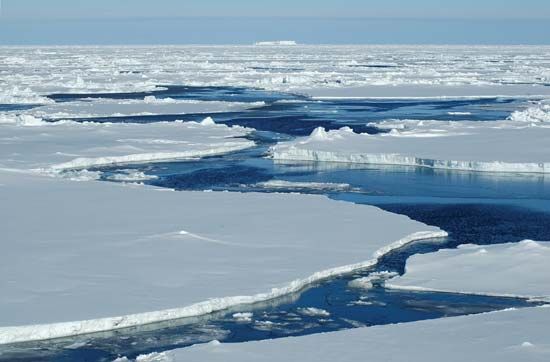
Pack ice is any area of sea ice that is not attached to the shoreline or other fixed structures, making it mobile. It consists of a mass of individual pieces of ice, ranging from small “cakes” to large floes, which are crushed together by wind and water stresses.123
Key characteristics include:
- Composition: It is often formed through the “frazil-pancake cycle,” where ice crystals aggregate into discs that eventually solidify into larger floes.2
- Dynamics: Because it is in constant motion, the ice frequently fractures, creating open water areas known as leads and polynyas.42
- Structure: Mechanical compression causes the ice to raft and ridge, forming pressure ridges that can project deep into the ocean.42
- Distribution: While most Antarctic pack ice is first-year ice, the Arctic contains significant amounts of multiyear ice, also known as “polar pack,” which is thicker and less saline.42
How does the salinity of seawater change as it freezes into ice?
When seawater freezes, it does not turn entirely into solid ice; instead, the process of freezing expels salt, which is concentrated into liquid brine trapped within a matrix of pure ice crystals.52
As ice forms, the salt is rejected from the crystal structure. The efficiency of this process depends on the rate of freezing: slower freezing allows for more effective salt rejection. Newly formed ice, such as nilas, typically has a salinity of 12–15 parts per thousand, which is significantly lower than the average 35 parts per thousand of liquid ocean water.25
Over time, the ice continues to desalinate through several mechanisms:
- Gravity drainage: Brine moves downward through a network of cells and channels within the ice.5
- Brine expulsion and migration: Temperature-dependent processes force brine out of the ice structure.5
- Flushing: In the Arctic, summer melting allows fresh meltwater to percolate through the ice, further reducing its salt content.5
By the time ice is one year old, it is often sufficiently desalinated to be melted for drinking water. Arctic multiyear ice eventually reaches a low salinity of 3–4 parts per thousand.25
What are the main differences between Arctic and Antarctic sea ice?
Arctic and Antarctic sea ice differ significantly in their composition, structure, and environmental dynamics.
Key Differences
- Age and Thickness: Arctic sea ice is characterized by a high proportion of multiyear ice, which is thicker and less saline, often reaching depths of 6–8 metres in ridged areas. In contrast, most Antarctic sea ice is first-year ice, typically less than 1 metre thick, with multiyear ice rarely exceeding 2 metres.910
- Formation Processes: While both regions experience the “frazil-pancake cycle,” it is particularly dominant in Antarctica, leading to ice floes with a higher granular texture compared to the columnar, congelation-grown ice common in the Arctic. Additionally, Antarctic ice often includes “snow ice,” formed when heavy snow depresses the floe, allowing seawater to soak the base and freeze.10
- Movement and Circulation: Arctic ice drift is dominated by the clockwise Beaufort Gyre and the Transpolar Drift, which recirculate ice within the basin. Antarctic ice is governed by the westward coastal flow and the eastward Antarctic Circumpolar Current; its gyres, such as those in the Weddell and Ross seas, do not appear to recirculate ice.9
- Coastal Features: Antarctica features extensive coastal polynyas—often called “ice factories”—where katabatic winds push ice away from the shore, facilitating continuous new ice growth.10
How do polynyas act as ‘ice factories’ in polar regions?
Polynyas act as “ice factories” primarily through a continuous cycle of ice formation and removal, a process most prominently observed in coastal regions of Antarctica.12
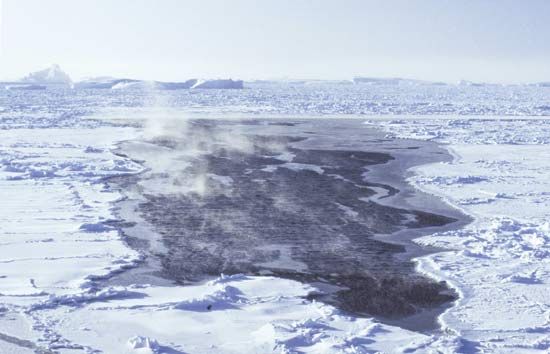
These areas remain partially or totally ice-free despite being in regions where sea ice is expected to persist. In coastal polynyas, powerful katabatic winds blow off the continent, physically pushing existing ice away from the shore. This action exposes the relatively warm ocean surface to the frigid polar atmosphere, creating an open-water area that facilitates rapid, continuous new ice growth.123
As this new ice forms, it is repeatedly pushed away by the winds, allowing the cycle to repeat indefinitely throughout the winter. This process has significant environmental consequences:12
- Brine Rejection: As ice forms within these open areas, it rejects salt into the surrounding water. This brine increases the density of the water, driving deep ocean mixing and influencing global ocean circulation patterns.13
- Heat Exchange: Polynyas facilitate significant turbulent heat and mass transfer between the ocean and the atmosphere, often manifesting as frost smoke.13
Sources
- pack ice — Encyclopædia Britannica
- Arctic Ocean - Sea ice — Encyclopædia Britannica
- sea ice - Sea ice formation and features — Encyclopædia Britannica
- pack ice — Merriam-Webster
- sea ice - Ice salinity , temperature, and ecological interactions — Encyclopædia Britannica
- Why Does Salt Melt Ice? — Encyclopædia Britannica
- brine — Encyclopædia Britannica
- seawater - Salinity distribution — Encyclopædia Britannica
- sea ice - Pack ice drift and thickness — Encyclopædia Britannica
- sea ice — Encyclopædia Britannica
- iceberg - Impact on ocean structure — Encyclopædia Britannica
- polynya — Encyclopædia Britannica
- sea ice - Interactions with the oceans , atmosphere , and climate — Encyclopædia Britannica
Published on · 4 min read