Palmer Archipelago
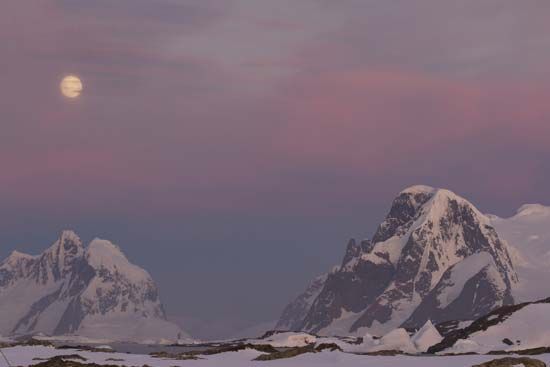
The Palmer Archipelago is a group of islands situated off the northwestern coast of the Antarctic Peninsula, separated from the mainland by the Gerlache and…
What is Palmer Archipelago?
The Palmer Archipelago is a group of islands situated off the northwestern coast of the Antarctic Peninsula, separated from the mainland by the Gerlache and Bismarck straits. Formerly known as the Antarctic Archipelago, this island chain includes major landmasses such as Anvers, Liège, Brabant, and Wiencke islands.12
The archipelago was discovered in 1898 by the Belgian explorer Adrien de Gerlache. Today, the region is a site of international interest, with research stations operated by Argentina and the United Kingdom. The islands are currently subject to overlapping territorial claims by Argentina, Chile, and the United Kingdom.1
Who was Adrien de Gerlache?
Adrien-Victor-Joseph, baron de Gerlache de Gomery (1866–1934) was a Belgian naval officer and explorer best known for leading the first Antarctic expedition focused on scientific observation (1897–1899).3
During this expedition, his ship, the Belgica, became the first vessel to winter in the Antarctic after being trapped in pack ice for 13 months. His crew included Roald Amundsen, who later became the first person to reach the South Pole. In 1898, de Gerlache discovered the Palmer Archipelago off the coast of the Antarctic Peninsula.314
Beyond his Antarctic work, de Gerlache conducted extensive oceanographic research in the Persian Gulf, Greenland, and the seas north of Scandinavia and Russia. He also assisted Ernest Shackleton in planning the British Imperial Trans-Antarctic Expedition.3
What kind of wildlife lives on the Antarctic Peninsula?
The wildlife of the Antarctic Peninsula is primarily marine-dependent, as the harsh climate and limited ice-free land restrict terrestrial life.56
Marine Life
The ecosystem is driven by krill, which serve as the primary food source for a vast array of predators.7
- Mammals: Native mammals are exclusively marine, including seals (such as the Weddell, crabeater, leopard, and Ross seals) and various whales, including humpback, blue, and killer whales.7
- Fish: The waters host specialized species, notably the Antarctic perches (Notothenioidea), which are highly adapted to freezing temperatures.7
Birds
The peninsula’s coasts provide essential breeding grounds for seabirds, as there are no mammalian land predators.8
- Penguins: The Adélie and emperor penguins are the only species that live along the Antarctic coastline, while others like the chinstrap and gentoo penguins inhabit the northern peninsula.8
- Other Birds: The region supports various petrels, skuas, cormorants, and gulls.8
Terrestrial Life
Terrestrial flora and fauna are sparse, consisting mainly of algae, lichens, mosses, and a few invertebrates like mites and primitive insects, which are typically found in moist moss beds.6
Why do multiple countries claim territory in Antarctica?
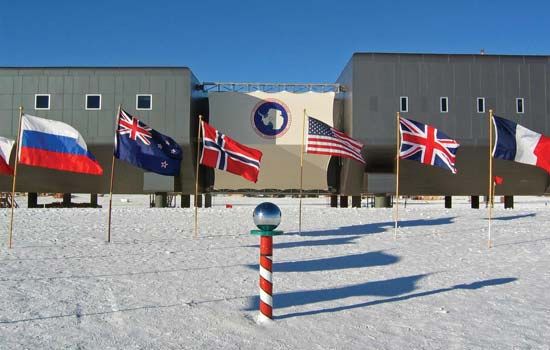
Multiple countries have historically claimed territory in Antarctica primarily due to a desire for national influence, strategic positioning, and the legacy of early exploration. During the first half of the 20th century, seven nations—Argentina, Australia, Chile, France, New Zealand, Norway, and the United Kingdom—formally decreed sovereignty over pie-shaped sectors of the continent.10
These claims were often based on:
- Discovery and Exploration: Early expeditions and the mapping of coastal regions.10
- Effective Occupation: Establishing permanent bases and weather stations to demonstrate a continued presence.10
- Geographical Contiguity and Historical Treaties: Arguments used by nations like Argentina and Chile to link their claims to their own national territories.10
The Antarctic Treaty, signed in 1959, addressed these competing claims in an innovative way. Article IV of the treaty does not renounce or support existing claims, nor does it allow for new claims to be made while the treaty is in force. Instead, it effectively freezes the status quo, allowing nations to maintain their positions without the need for military enforcement. Today, the continent is reserved for peaceful purposes and scientific research, with the Antarctic Treaty System managing international cooperation and environmental protection.1112
Sources
- Palmer Archipelago — Encyclopædia Britannica
- Palmer Archipelago — Merriam-Webster
- Adrien-Victor-Joseph, baron de Gerlache de Gomery — Encyclopædia Britannica
- Antarctica - The “ heroic era ” of exploration — Encyclopædia Britannica
- Antarctica - Sea life — Encyclopædia Britannica
- Antarctica - Birds — Encyclopædia Britannica
- Polar ecosystem - The Antarctic region — Encyclopædia Britannica
- Polar ecosystem - Biota of Antarctica — Encyclopædia Britannica
- How do penguins stay warm? — Encyclopædia Britannica
- Antarctica - The Antarctic Treaty — Encyclopædia Britannica
- Antarctica - National rivalries and claims — Encyclopædia Britannica
- Antarctic Treaty — Encyclopædia Britannica
- Antarctica - Post-IGY research — Encyclopædia Britannica
Published on · 3 min read