Photic Zone
The photic zone is the surface layer of the ocean that receives sunlight, making it a critical region for marine life. This illuminated area is divided into…
What is photic zone?
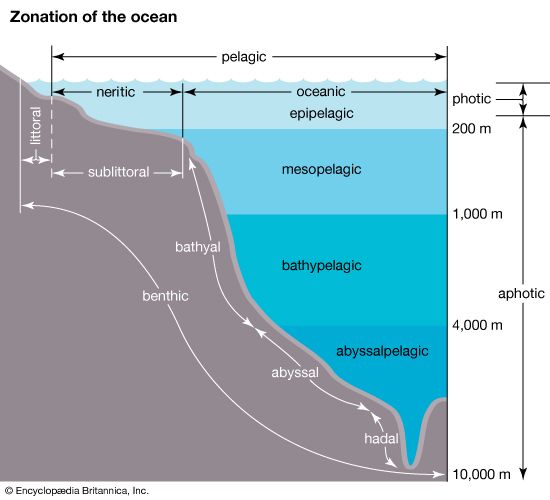
The photic zone is the surface layer of the ocean that receives sunlight, making it a critical region for marine life. This illuminated area is divided into two distinct sub-zones based on the intensity of light penetration:12
- Euphotic zone: The uppermost layer, typically extending to 80–100 meters, where light is sufficient to support photosynthesis by phytoplankton and plants.12
- Disphotic zone: The deeper, dimly lit region where light is present but insufficient for photosynthesis, as respiration rates exceed those of production.12
The thickness of the photic zone is not constant; it fluctuates based on latitude, seasonal changes, and water turbidity. Beneath this layer lies the aphotic zone, a region of perpetual darkness that encompasses the vast majority of the ocean’s volume. While marine organisms are particularly abundant in the photic zone, many species migrate between these layers or reside permanently in the deep, dark waters below.12
What is the role of phytoplankton in the marine food web?
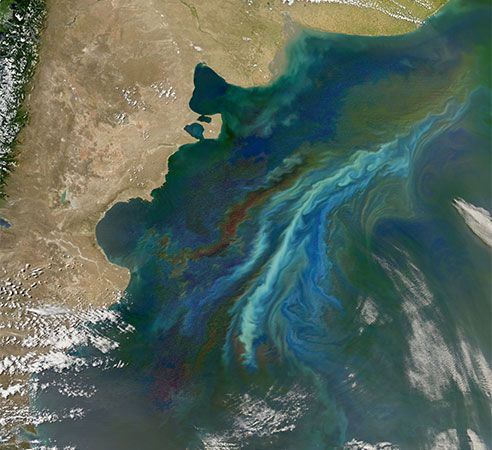
Phytoplankton serve as the foundational primary producers in the marine food web, responsible for approximately 98 percent of the ocean’s primary production. By utilizing sunlight, carbon dioxide, and dissolved minerals, these microscopic, drifting organisms convert inorganic matter into energy-rich organic compounds through photosynthesis.34
Their role in the ecosystem is multifaceted:
- Primary Food Source: Phytoplankton provide the essential nutrition that supports nearly all marine life, either directly or indirectly. They are grazed upon by zooplankton, which in turn serve as prey for higher-level consumers such as fish, squid, and marine mammals5.45
- Nutrient Cycling: By converting minerals into forms accessible to animals and releasing oxygen as a byproduct, they maintain the chemical balance necessary for the biosphere.46
- Carbon Sequestration: Phytoplankton play a vital role in the global carbon cycle. Despite representing a small fraction of Earth’s total producer biomass, they account for roughly 40 percent of global carbon fixation. When they die, they often sink to the ocean floor, effectively sequestering carbon in the deep sea for long periods.1
How do marine animals survive in the dark aphotic zone?
Marine animals in the aphotic zone—the vast, dark region of the ocean below the reach of sunlight—have evolved specialized adaptations to survive in an environment characterized by high pressure, cold temperatures, and a lack of photosynthesis.910
Survival Strategies
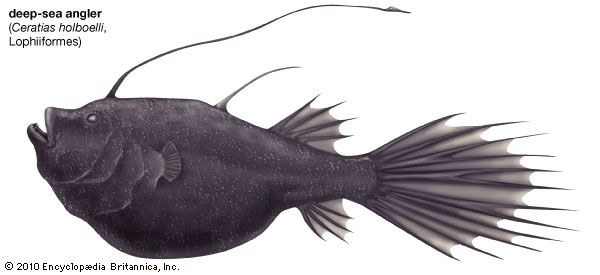
- Bioluminescence: Many deep-sea organisms utilize bioluminescence for survival. This light production is used to attract prey, confuse enemies, or serve as species-recognition and mating signals. For example, anglerfishes use a luminous lure to draw in unsuspecting prey, while other species use light organs, or photophores, to match the intensity of light from above, effectively concealing their shadows from predators below.11
- Physical Adaptations: Animals in the abyssal zone are often delicately structured and unstreamlined, with gray or black coloration. To navigate the soft sediment of the seafloor, many mobile forms have developed long legs, while others are attached to the bottom via stalks to rise above the oxygen-poor water layer near the floor.9
- Sensory and Metabolic Adjustments: Due to the perpetual darkness, some crustaceans and fish have evolved to be blind. Others, such as certain lampridiforms, possess specialized features like telescopic eyes to detect movement. Additionally, many species exhibit slow reproductive rates and have adapted to survive on the limited food supply that settles from the upper layers of the ocean.92
What is vertical migration in ocean ecosystems?
Vertical migration is a widespread behavioral pattern in ocean ecosystems where organisms, including plankton, fish, and squid, move throughout the water column on a daily or diurnal basis.1415
Typically, these organisms remain in the dim light or darkness beneath the photic zone during the day to avoid visually oriented predators. After sunset, they ascend toward the surface to feed in nutrient-rich waters under the cover of darkness, often returning to deeper, daytime levels before dawn.1514
This behavior is influenced by several factors:
- Light Levels: Light is a primary stimulus for these movements.15
- Life Cycle and Environment: Migratory patterns vary based on an organism’s life stage, the season, latitude, and local meteorological or hydrographic conditions.14
- Transport: Some larval forms use vertical migration to facilitate horizontal transport by accessing different ocean currents that flow in varying directions at different depths.15
Beyond daily cycles, vertical migration can also be a strategy for finding mates or dispersing to different habitats while minimizing exposure to predators.15
Sources
- photic zone — Encyclopædia Britannica
- Marine ecosystem - Geography, oceanography, and topography — Encyclopædia Britannica
- phytoplankton — Encyclopædia Britannica
- primary productivity — Encyclopædia Britannica
- Marine ecosystem - Plankton — Encyclopædia Britannica
- Marine ecosystem - The pelagic food chain — Encyclopædia Britannica
- plankton - Plankton and biological productivity — Encyclopædia Britannica
- decarbonization - Natural carbon removal — Encyclopædia Britannica
- Bioluminescence - The role of bioluminescence in behavior — Encyclopædia Britannica
- abyssal zone — Encyclopædia Britannica
- atheriniform - Natural history — Encyclopædia Britannica
- How do sea otters stay warm? — Encyclopædia Britannica
- commercial fishing - The oceans — Encyclopædia Britannica
- plankton - Zooplankton — Encyclopædia Britannica
- Marine ecosystem - Migrations of marine organisms — Encyclopædia Britannica
- estuary - Primary productivity — Encyclopædia Britannica
Published on · 3 min read