Poppy
Poppy seeds and the rest of the opium poppy plant differ significantly in their properties and uses.
How do poppy seeds differ from the rest of the plant in terms of uses and properties?
Poppy seeds and the rest of the opium poppy plant differ significantly in their properties and uses.
Poppy Seeds
Poppy seeds are non-narcotic and are primarily used as a culinary ingredient. They are valued for their mild, nutty flavor and are commonly used in baking, seasoning, and as a source of poppy-seed oil. While the seeds themselves do not contain opiates, they can become contaminated with morphine residue during the harvesting process, which may occasionally lead to a positive result on a drug test.123
The Rest of the Plant
In contrast, the unripe seed capsules of the opium poppy contain a milky latex that is the source of potent alkaloids, including morphine, codeine, and heroin. These compounds have significant pharmacological effects, serving as essential analgesics in medicine while also possessing a high potential for addiction and abuse.2
What is the history of poppy cultivation and how has it changed over time?
The opium poppy (Papaver somniferum), native to Turkey, has been cultivated for millennia. Historically, it was used for its medicinal properties, with ancient Assyrian texts and the Greek physician Dioscorides documenting its use as a painkiller.42
Evolution of Use and Trade
Initially, opium was consumed orally as medicine, which rarely caused widespread addiction. The practice of smoking opium emerged later, influenced by tobacco smoking, and spread rapidly through Asia in the 17th century. During the 18th and 19th centuries, the opium trade became a major geopolitical force, leading to the Opium Wars between China and Britain.4
In the West, the 19th-century isolation of morphine and the invention of the hypodermic syringe significantly increased addiction rates, particularly during the American Civil War. By the 20th century, the synthesis of heroin and the subsequent rise of illicit trade led to strict international regulations.4
Modern Cultivation
Today, the plant remains a paradox. It is legally grown in some regions for essential medicinal alkaloids, yet its unlicensed cultivation is a serious offense due to its role in the global opioid crisis. While cultivation has shifted across regions like the Golden Triangle and Afghanistan in response to law enforcement and disease, the plant continues to be a source of both vital medicine and dangerous addiction.42
What are the main differences between opium poppies and other poppy varieties?
The primary distinction between the opium poppy (Papaver somniferum) and other poppy varieties lies in its unique chemical composition and the resulting pharmacological potential of its milky latex.
Key Differences
- Narcotic Properties: The unripe seed capsules of the opium poppy exude a latex that contains potent alkaloids, including morphine, codeine, and heroin. These substances are classified as opiates and have significant effects on the central nervous system, acting as powerful analgesics while also carrying a high risk of addiction.56
- Culinary Use: While other poppies are grown almost exclusively as garden ornamentals, the opium poppy is also cultivated for its nonnarcotic, edible seeds. These seeds are widely used in baking, seasoning, and oil production.76
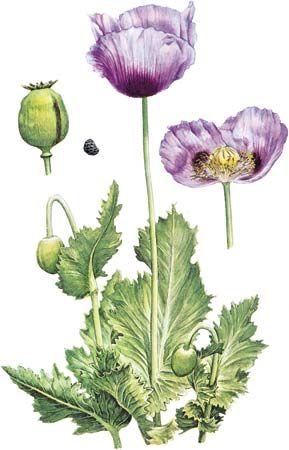
- Botanical Characteristics: The opium poppy is an annual plant that typically reaches 1–1.5 meters in height, featuring silver-green foliage and large, often blue-purple or white flowers. In contrast, the Papaveraceae family includes roughly 2,220 species, ranging from the perennial Oriental poppy to the California poppy, which are valued primarily for their diverse floral displays and foliage rather than medicinal latex.72
What are some common garden varieties of poppies and how are they cultivated?
Many species within the Papaveraceae family are popular garden ornamentals, valued for their striking flowers and foliage. While cultivation requirements vary by species, most thrive in well-drained soil and are often grown from seeds that can persist in soil seed banks until conditions are favorable.689
Common Garden Varieties
- Oriental Poppy (P. orientale): A long-lived perennial native to the Middle East, known for its large, showy scarlet, salmon, pink, or white blooms.610
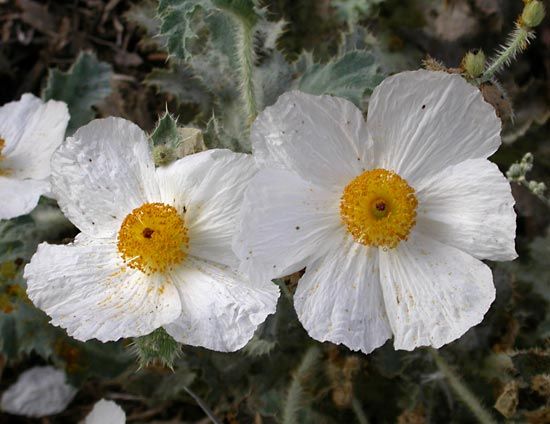
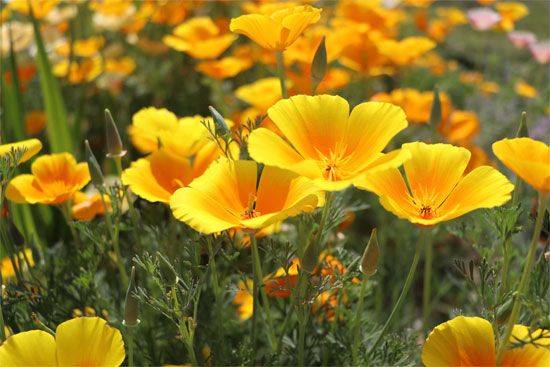
- California Poppy (Eschscholzia californica): A hardy annual with feathery gray-green foliage and brilliant orange, yellow, or cream flowers. It is highly adaptable and often naturalizes easily.68
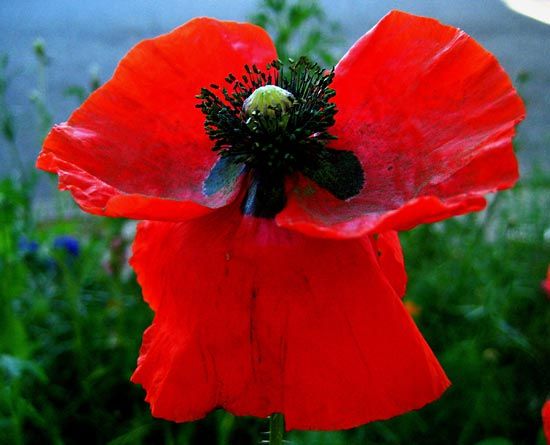
- Corn Poppy (P. rhoeas): A classic annual known for its brilliant red flowers. It is the source of the Shirley poppy and serves as a poignant symbol of World War I.69
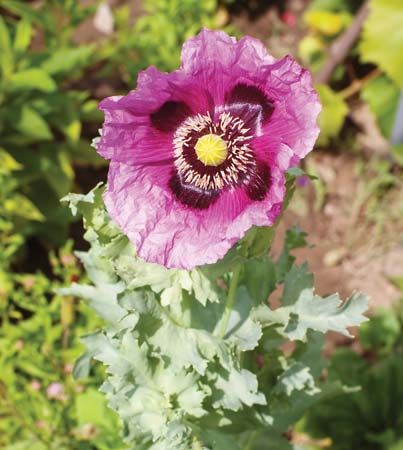
- Opium Poppy (P. somniferum): While primarily known for its medicinal latex, specific strains with double or semidouble blooms in white, pink, and red are cultivated as ornamentals.6
- Iceland Poppy (P. nudicaule): A short-lived perennial from Arctic North America, prized for its fragrant, colorful flowers.6
These plants generally prefer sunny locations. Annual varieties are typically sown directly into the garden, while perennials are often established as long-term features in flower beds.689
Sources
- poppy seed — Encyclopædia Britannica
- opium poppy — Encyclopædia Britannica
- Can Eating Poppy Seeds Make You Fail a Drug Test? — Encyclopædia Britannica
- opium - History of opium — Encyclopædia Britannica
- 9 Mind-Altering Plants - Opium poppy ( Papaver somniferum ) — Encyclopædia Britannica
- poppy — Encyclopædia Britannica
- Papaveraceae — Encyclopædia Britannica
- California poppy — Encyclopædia Britannica
- list of plants in the family Papaveraceae — Encyclopædia Britannica
- Oriental poppy — Merriam-Webster
- corn poppy — Encyclopædia Britannica
Published on · 4 min read