Prasopora
Prasopora is an extinct genus of bryozoans, which were small colonial animals known for forming mosslike or encrusting growths. These organisms were…
What is Prasopora?
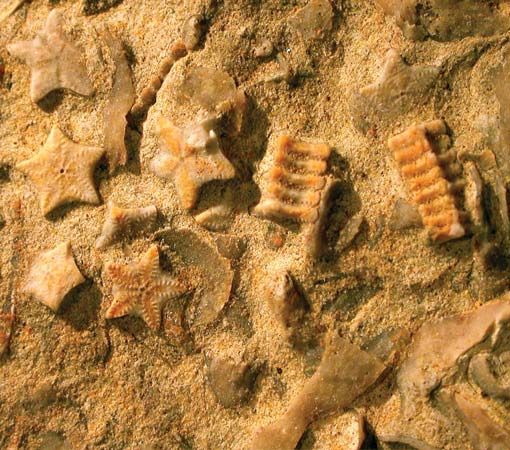
Prasopora is an extinct genus of bryozoans, which were small colonial animals known for forming mosslike or encrusting growths. These organisms were particularly characteristic of the Ordovician Period, dating back approximately 488.3 million to 443.7 million years ago.1
The colonies of Prasopora are typically identified by their distinctive caplike shape, featuring a domed top and a flat bottom. The hard framework of these colonies was constructed from calcium carbonate, which created the tightly packed, tubelike structures that served as homes for the individual animals within the colony.1
What are bryozoans?
Bryozoans, also known as moss animals, are a phylum of aquatic invertebrate animals comprising about 5,000 living species and 15,000 fossil species. They are characterized by a lophophore, a ring of ciliated tentacles used to collect food particles from the water.2
Key features of bryozoans include:
- Colonial Structure: Bryozoans form colonies composed of numerous connected units called zooids. While individual zooids are typically less than one millimeter long, colonies can grow to exceed 0.5 meters in diameter.2
- Habitat: They are widely distributed in both fresh and salt water, often found as crusts or growths on stones, shells, seaweed, and submerged man-made structures like ship hulls.34
- Classification: They are divided into three classes: Phylactolaemata (freshwater), Stenolaemata (marine), and Gymnolaemata (mostly marine).2
- Fossil Record: Because many species possess calcified walls, they have an extensive fossil record dating back to the Ordovician Period, approximately 500 million years ago.45
What defines the Ordovician Period?
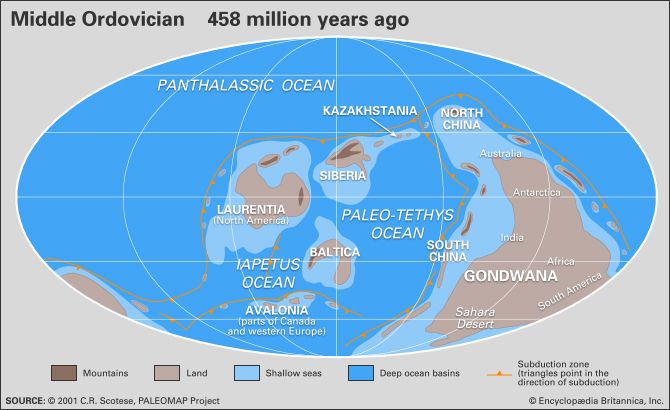
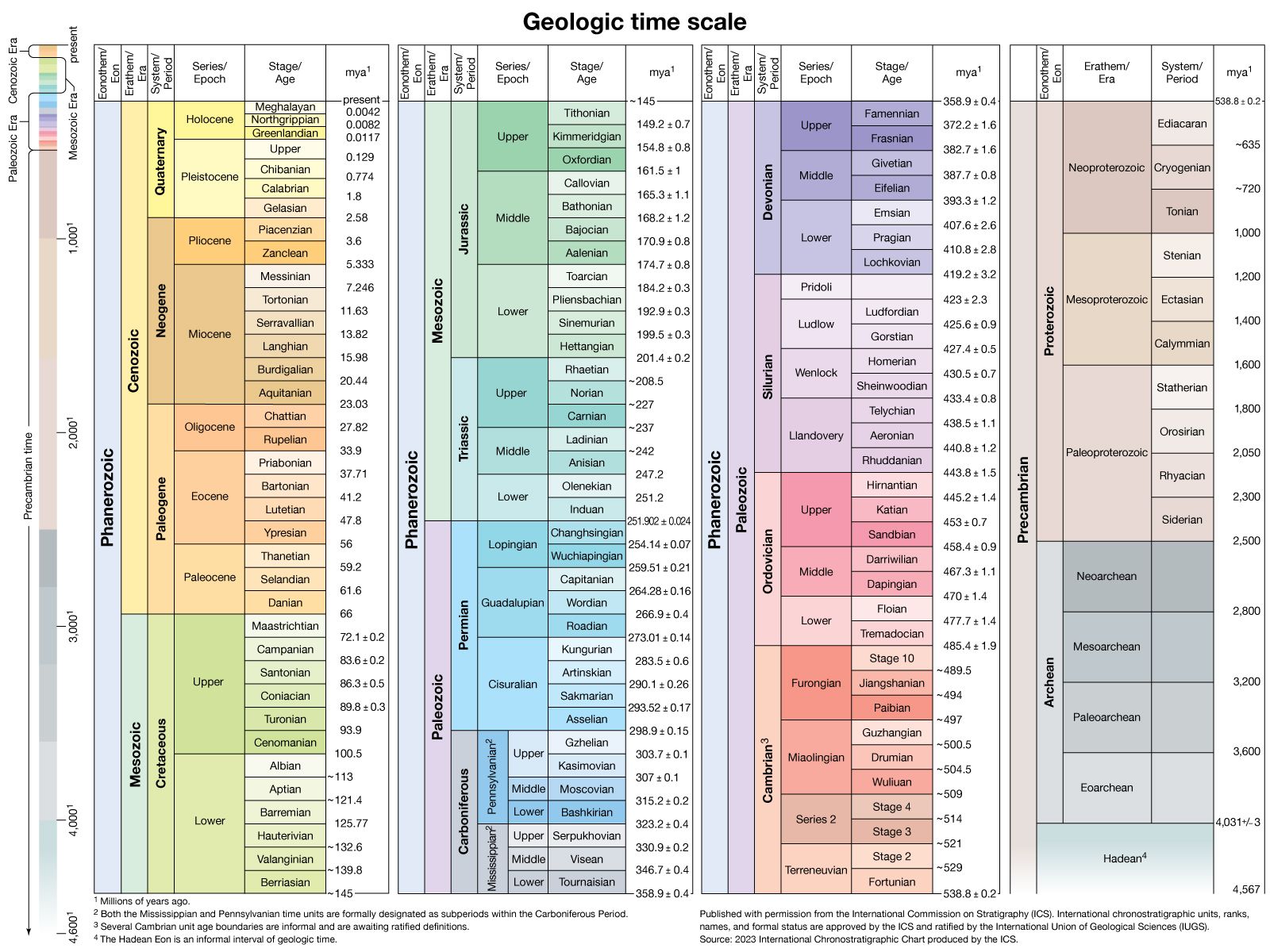
The Ordovician Period was the second period of the Paleozoic Era, spanning from approximately 485.4 million to 443.8 million years ago. It was a time of profound transformation in Earth’s plate tectonics, climate, and biological systems.78
Geological and Climatic Context
Rapid seafloor spreading led to some of the highest global sea levels in the Phanerozoic Eon, causing extensive flooding of the continents. Atmospheric carbon dioxide levels were significantly higher than today, generally fostering a warm, greenhouse climate. However, the period concluded with a brief, intense interval of glaciation over the Southern Hemisphere.879
Biological Evolution and Extinction
The period is defined by the Ordovician radiation, an intense diversification of marine life that saw the emergence of almost every modern invertebrate phylum and the rise of fish. Common marine life included brachiopods, bryozoans, trilobites, mollusks, echinoderms, and graptolites. On land, the first plants and possibly the first terrestrial arthropods appeared. The period ended with the second-largest mass extinction in Earth’s history, which claimed roughly 85 percent of all species.871011
How do fossils help us understand ancient marine life?
Fossils serve as the primary record of life on Earth, offering critical insights into the history and evolution of ancient marine organisms. Because most fossils are preserved in sedimentary rock within aquatic environments, they provide a window into the biological and physical conditions of past oceans.1314
Fossils help us understand ancient marine life through several key functions:
- Documenting Evolution: By observing progressive morphological changes in fossil groups over time, scientists can describe the evolution of specific lineages, including how organisms adapted to their environments through natural selection.131514
- Environmental Indicators: Paleoecologists use fossil remains to reconstruct ancient habitats. For example, the presence of specific coral species indicates that the area was once a warm, shallow sea, helping researchers map how Earth’s crust and climate have shifted over millions of years.131514
- Geologic Dating: Index fossils—organisms that were geographically widespread and lived for a short geologic duration—allow geologists to assign relative ages to rock strata, enabling the correlation of marine deposits across different continents.161514
- Biodiversity Records: The fossil record reveals the emergence and extinction of diverse groups, such as trilobites, brachiopods, and early fishes, providing a timeline for the radiation of marine life.1718
Sources
- Prasopora — Encyclopædia Britannica
- moss animal — Encyclopædia Britannica
- moss animal - Marine bryozoans — Encyclopædia Britannica
- moss animal - Colonies — Encyclopædia Britannica
- moss animal - Distribution and abundance — Encyclopædia Britannica
- moss animal - Evolution and paleontology — Encyclopædia Britannica
- A Journey Through Time Since the Precambrian - Ordovician Period: 485.4 million to 443.4 million years ago — Encyclopædia Britannica
- Ordovician Period - Invertebrates — Encyclopædia Britannica
- Ordovician Period — Encyclopædia Britannica
- Ordovician Period - Causes — Encyclopædia Britannica
- Ordovician Period - Mass extinction at the end of the Ordovician — Encyclopædia Britannica
- Ordovician Period - Paleoclimate — Encyclopædia Britannica
- index fossil — Encyclopædia Britannica
- fossil record — Encyclopædia Britannica
- Marine ecosystem - Origins of marine life — Encyclopædia Britannica
- geology - Paleontology — Encyclopædia Britannica
- fish - Evolution and paleontology — Encyclopædia Britannica
- fossil — Encyclopædia Britannica
- geology - Invertebrate paleontology — Encyclopædia Britannica
Published on · 3 min read