Proconodontid
A proconodontid is a small, toothlike structure found in marine rocks that represents one of the most primitive forms of conodonts. These fossils date back…
What is proconodontid?
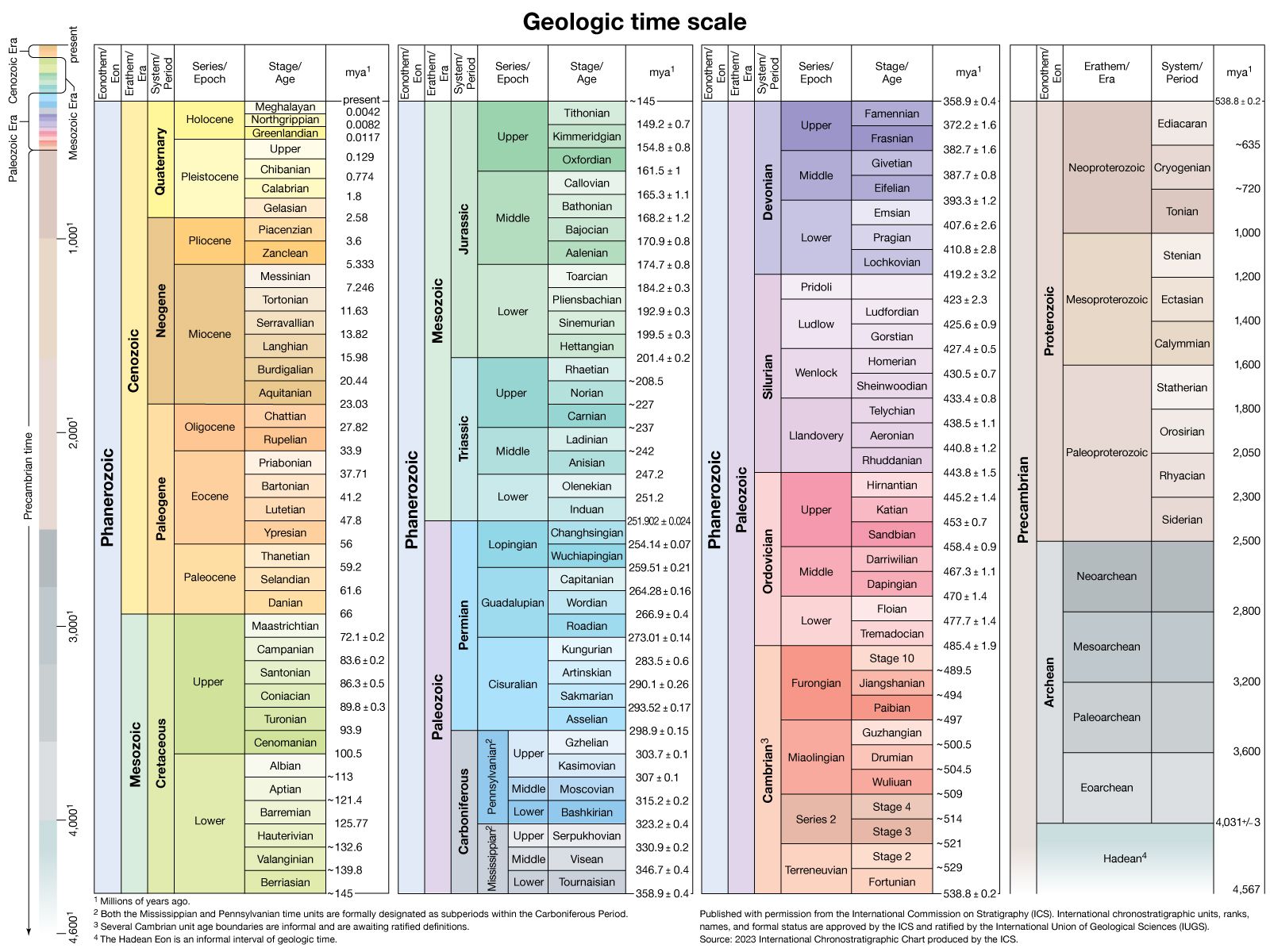
A proconodontid is a small, toothlike structure found in marine rocks that represents one of the most primitive forms of conodonts. These fossils date back to the Late Cambrian Period, which occurred approximately 542 to 488 million years ago.1
In terms of morphology, proconodontids are characterized by a simpler form and structure compared to the more complex conodonts that evolved from them later in geologic time. Like other conodonts, they are composed of the mineral apatite and serve as valuable microfossils for scientists studying the history of marine life and the correlation of sedimentary rock strata.12
Why are conodonts considered important for dating rock layers?
Conodonts are considered essential tools for dating and correlating sedimentary rock strata due to several key characteristics:
- Rapid Evolution: Conodonts evolved quickly, undergoing frequent changes in their physical shapes over geologic time. This allows geologists to characterize specific time intervals by identifying distinct conodont assemblages or faunas.2
- Widespread Distribution: These organisms were geographically widespread, meaning identical or similar species are found in many parts of the world. This enables the correlation of rock layers across different regions and continents.2
- Abundance and Preservation: As microfossils composed of durable apatite, they are frequently found in marine rocks, particularly in limestones and black shales. Their resilience allows them to be recovered by dissolving host rock in acetic acid.2
- Zonal Schemes: Scientists have established standardized “zones” based on specific conodont successions. By comparing fossils found in new locations to these established reference standards, researchers can precisely date the strata.2
What do scientists think the conodont animal looked like?
Scientists have determined that the conodont animal was a small, primitive, eel-like vertebrate. Measuring approximately 30–40 mm in length, these creatures were marine invertebrates that inhabited open oceans and coastal waters during the Paleozoic Era.32
The “conodonts” themselves are actually mineralized, toothlike elements that formed an apparatus located at the entrance of the animal’s gut, likely assisting in the movement of food particles. These elements were arranged in bilaterally symmetrical pairs and could include various forms, such as bars, blades, and platforms, within a single apparatus.2
While the exact nature of the creature was long debated—with some early theories incorrectly suggesting they were related to polychaete worms—the discovery of preserved specimens in fine-grained rock from North America confirmed their identity as vertebrates. Despite this classification, the conodont animal remains unique, as no exactly compatible creature exists today.423
How do scientists extract microfossils from rocks?
Scientists extract microfossils from rocks using methods tailored to the composition of the specimen and the host material. For acid-resistant microfossils like conodonts, which are composed of the mineral apatite, the process typically involves the following steps:
- Dissolution: The host sedimentary rock, such as limestone, is dissolved using a 15 percent solution of acetic acid. Because the conodonts are insoluble in this acid, they remain intact while the surrounding rock matrix breaks down.2
- Separation: Once the rock has dissolved, the remaining residue is washed and dried. To isolate the microfossils from other acid-insoluble mineral grains, the residue is placed in a heavy liquid, such as bromoform. The denser conodonts sink, while the lighter mineral grains float, allowing for easy collection.2
- Examination: After extraction, the microfossils are studied under high magnification using a binocular microscope.2
For other types of microfossils or when analyzing rock chips from oil wells, scientists may utilize advanced technology like the scanning electron microscope to observe specimens that are too small for the naked eye.5
Sources
- proconodontid — Encyclopædia Britannica
- conodont — Encyclopædia Britannica
- Polychaete hypothesis — Encyclopædia Britannica
- Devonian Period - Vertebrates — Encyclopædia Britannica
- fossil — Encyclopædia Britannica
- Earth sciences - Micropaleontology — Encyclopædia Britannica
- sample preparation - Dissolution of inorganic samples — Encyclopædia Britannica
- dating - Technical advances — Encyclopædia Britannica
Published on · 3 min read