Maritime Alps
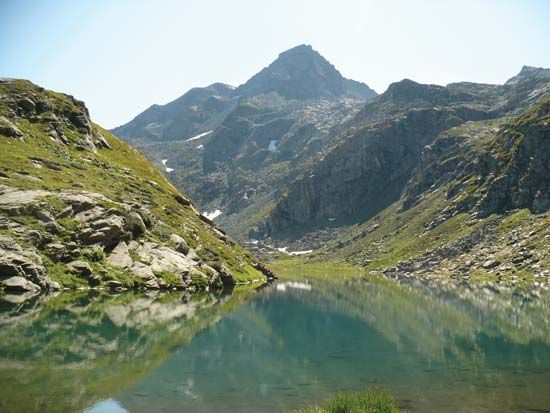
The Maritime Alps are a segment of the Western Alps that extend in an arc along the border between France and Italy. Stretching approximately 120 miles (190…
What is Maritime Alps?
The Maritime Alps are a segment of the Western Alps that extend in an arc along the border between France and Italy. Stretching approximately 120 miles (190 km), this range reaches from the Colle di Cadibona in the east to the Colle della Maddalena in the west, ultimately extending toward the Mediterranean Sea.12
The highest point in the range is Punta Argentera, which stands at 10,817 feet (3,297 meters). Geographically, the Maritime Alps are bounded by the Cottian Alps to the north and the Ligurian Apennines to the east. The region encompasses the Alpi Liguri and the Provence Alps.12
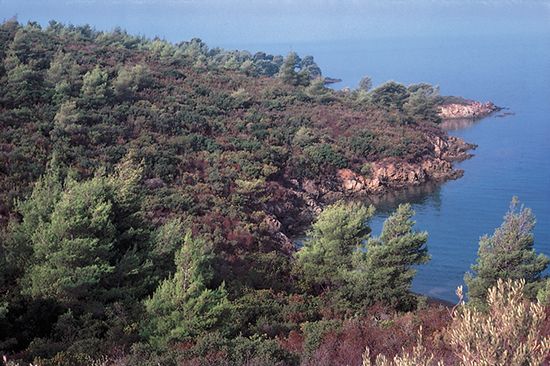
Due to their southern location, the lower reaches of the Maritime Alps are characterized by Mediterranean vegetation, including maritime pine, palm, and agave, distinguishing them from the more northern sections of the Alps.3
What unique animals live in the Maritime Alps?
The animal life in the Maritime Alps and the broader Alpine region is characterized by species highly adapted to rugged, high-altitude environments. Several animals have evolved specific behaviors to survive the harsh mountain climate:
- High-Altitude Specialists: The ibex, a type of wild goat, and the goatlike chamois are noted for their exceptional agility on craggy, steep terrain.34
- Seasonal Adaptations: To cope with extreme temperature changes, many species exhibit seasonal shifts. Marmots survive the winter by hibernating in underground galleries. Other animals, such as the mountain hare and the ptarmigan (a type of grouse), change their coat or plumage to white during the winter months for camouflage.3
- Reintroduced Species: Due to historical population pressures, several rare animals have been successfully reintroduced to the region, including the lynx, the brown bear, and the bearded vulture, also known as the lammergeier.3
National parks within these ranges play a critical role in protecting these native species from further decline.3
How does the Mediterranean climate affect the local plants?
The Mediterranean climate, characterized by hot, dry summers and mild, wet winters, exerts a profound influence on local plant life, forcing the evolution of specialized adaptations to survive drought, grazing, and frequent fire regimes.6
Key botanical responses to this environment include:
- Water Conservation: Many perennial trees and shrubs are sclerophyllous, possessing small, leathery leaves that help minimize water loss and prevent nutrient depletion.63
- Fire Resistance: Plants have developed various strategies to endure or recover from wildfires. Some species, such as the cork oak, feature thick, fire-resistant bark. Others, like certain Protea species, utilize moist, corky tissues to protect their buds from heat. Many plants are also rich in flammable essential oils, which allow them to resprout rapidly after a fire.6
- Insulation: Some plants, such as aloes and grass trees, retain dense layers of dead leaves around their stems to insulate against the intense heat of wildfires.6
- Nutrient Management: Because soils in these regions are often low in fertility, many plants form mutualistic relationships with nitrogen-fixing bacteria to thrive.6
What are the main differences between the Western and Eastern Alps?
The Alps are divided into Western, Central, and Eastern segments, each defined by distinct geological, geographical, and cultural characteristics.9
Geological and Physical Differences
- Elevation and Relief: The highest peaks, composed of autochthonous crystalline rocks, are concentrated in the west, including the Mont Blanc massif. In contrast, the Eastern Alps generally feature lower elevations; for instance, the highest peak in the Austrian Alps, the Grossglockner, is significantly lower than the giants of the west.9
- Drainage Patterns: Rivers in the Western Alps flow west into the Rhône or east into the Po. The Eastern Alps exhibit a more complex northerly and southeasterly drainage pattern, with many rivers flowing into the Danube or toward the Gulf of Venice.9
Linguistic and Cultural Variations
- Languages: The Western Alps are primarily associated with French speakers, particularly in parts of Switzerland and Italy. The Central and Eastern Alps are dominated by German in Switzerland, Germany, and Austria, while Italian is spoken in the southern regions. Additionally, the Eastern Alps contain unique linguistic pockets, including Ladin, Friulian, and Slovenian.10
Sources
- Maritime Alps — Encyclopædia Britannica
- Maritime Alps — Merriam-Webster
- Alps - Plant and animal life — Encyclopædia Britannica
- Mediterranean Sea - Climate — Encyclopædia Britannica
- Italy - Animal life — Encyclopædia Britannica
- Mediterranean vegetation — Encyclopædia Britannica
- Africa - Mediterranean vegetation — Encyclopædia Britannica
- Mountain ecosystem - Environment — Encyclopædia Britannica
- Alps - Physiography — Encyclopædia Britannica
- Italy - Mountain ranges — Encyclopædia Britannica
- Alps - Languages — Encyclopædia Britannica
- Languages of Northern Italy: Top Questions — Encyclopædia Britannica
- Alps - Climate of the Alps — Encyclopædia Britannica
Published on · 3 min read