Pterosaur
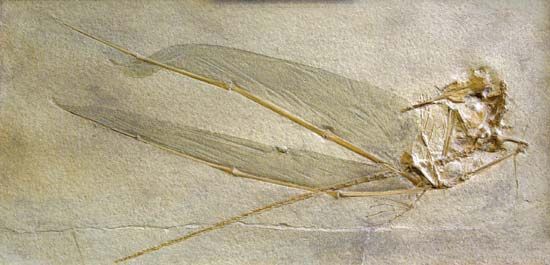
Pterosaur wings differed significantly from those of birds and bats in their structural composition and the way they supported a flight membrane.
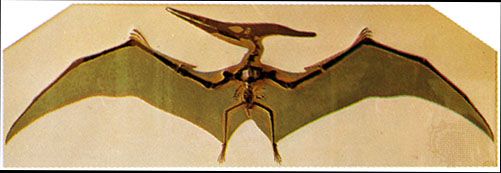
How did pterosaur wings differ from those of birds and bats?
Pterosaur wings differed significantly from those of birds and bats in their structural composition and the way they supported a flight membrane.
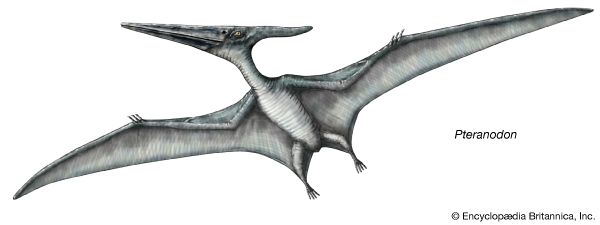
- Pterosaurs: Their wings consisted of a skin membrane supported primarily by a single, greatly elongated fourth finger. The first three fingers remained short and clawed for clutching. To enhance strength and maneuverability, the membrane was reinforced by a system of fine, parallel, keratinous fibers.1
- Birds: Unlike pterosaurs and bats, bird wings do not rely on a skin membrane for flight. Instead, they are modified forelimbs where the fingers are reduced and fused, and the primary flight surface is created by feathers attached to the arm and hand bones.23
- Bats: Bat wings are formed by a flight membrane stretched across all of the fingers except for the thumb, which remains free.13
While all three groups evolved forelimbs into wings for flight, these distinct anatomical strategies represent different evolutionary solutions to the challenges of aerial locomotion.13
What different types of pterosaurs existed, and how were they classified?
Pterosaurs, the first vertebrates capable of flight, are traditionally divided into two major groups, though scientists recognize this classification as an oversimplification of their evolutionary history.7
Traditional Classification
- Rhamphorhynchoidea: This group includes basal (primitive) forms found from the Late Triassic through the Late Jurassic. They are characterized by long tails, long fifth toes, sharply pointed teeth, and only slightly elongated wing metacarpals (palm bones). Examples include Eudimorphodon, Peteinosaurus, and Rhamphorhynchus.7
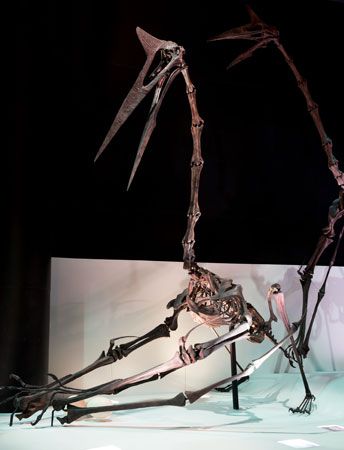
- Pterodactyloidea: Appearing in the Middle Jurassic and surviving until the end of the Cretaceous, these forms are distinguished by reduced teeth, shorter tails, and the absence of a fifth toe. Their metacarpals were significantly more elongated than those of earlier forms. This group includes diverse genera such as Pterodactylus, the large-crested Pteranodon, and the massive azhdarchids like Quetzalcoatlus.27
Evolutionary Complexity
The distinction between these groups is not always clear-cut. The discovery of Darwinopterus, which features a mix of primitive and advanced skeletal traits, provides evidence for modular evolution, suggesting that certain body parts evolved at different rates than others.7
What are the main characteristics that distinguish pterosaurs from other flying animals?
Pterosaurs were the first vertebrates capable of flight, flourishing throughout the Mesozoic Era. They are distinguished from other flying animals by several unique anatomical characteristics:
- Wing Structure: Unlike birds, which use feathers for flight, pterosaurs utilized a membrane of skin. While this membrane is similar to that of bats, the structural support differs significantly: in pterosaurs, the membrane was attached solely to an elongated fourth finger, whereas bats use all fingers except the thumb to support their wings.2
- Reinforcement: To enhance strength and maneuverability, the pterosaur wing contained a system of fine, parallel, keratinous fibers, and an accessory membrane stretched between the shoulder and wrist to reduce turbulence.2
- Skeletal Adaptations: Despite their often large size, pterosaurs maintained a low body weight through hollow, thin-walled bones. Their skulls were typically fused for strength, and their eyes were reinforced by a series of bony plates known as a sclerotic ring.28
- Sensory Dominance: Similar to birds, pterosaurs possessed large brains and relied primarily on sight rather than smell to navigate and locate food.28
How did pterosaurs evolve over time, and what were some of their notable adaptations?
Pterosaurs, the first vertebrates to achieve flight, evolved throughout the Mesozoic Era by adapting their anatomy for aerial dominance. Their ancestors possessed a bipedal gait, which freed their forelimbs to evolve into specialized wings supported by an elongated fourth finger and a skin membrane.2
Evolutionary Development
Pterosaurs are traditionally categorized into two groups, though this is an oversimplification:
- Basal Forms (Rhamphorhynchoidea): Appearing in the Late Triassic, these early pterosaurs featured long tails, long fifth toes, and pointed teeth. They were generally smaller, with wingspans often under 1.5 meters.2
- Advanced Forms (Pterodactyloidea): Emerging in the Middle Jurassic, these pterosaurs exhibited shorter tails, no fifth toe, and highly elongated metacarpals. They evolved in landlocked environments and eventually produced massive species like Pteranodon.2
Notable Adaptations
- Modular Evolution: The discovery of Darwinopterus suggests that pterosaurs evolved through modularity, where natural selection acted on specific body parts—such as the head and neck—independently of the rest of the skeleton.2
- Flight Efficiency: To maintain a low body weight, they developed hollow, thin-walled bones. Their wings were reinforced with parallel keratinous fibers and an accessory membrane to reduce turbulence.2
- Sensory and Physical Traits: They possessed large brains, with sight as their dominant sense. Their skulls were strong yet delicate, often featuring a sclerotic ring to reinforce the eyes.2
Sources
- Bird - Skeleton — Encyclopædia Britannica
- pterosaur — Encyclopædia Britannica
- Bird - The origin of flight — Encyclopædia Britannica
- Bird - Evolution and paleontology — Encyclopædia Britannica
- Wing — Encyclopædia Britannica
- Locomotion - Wings of birds and bats — Encyclopædia Britannica
- pterodactyl — Encyclopædia Britannica
- Pteranodon — Encyclopædia Britannica
Published on · 3 min read