Puffbird
It is important to clarify that puffbirds (family Bucconidae) are distinct from puffins (family Alcidae). While puffins are diving birds known for their…
What are the defining physical characteristics of puffbirds?
It is important to clarify that puffbirds (family Bucconidae) are distinct from puffins (family Alcidae). While puffins are diving birds known for their brightly colored, triangular beaks, puffbirds are tropical, insect-eating birds named for their habit of perching with their feathers puffed out.123
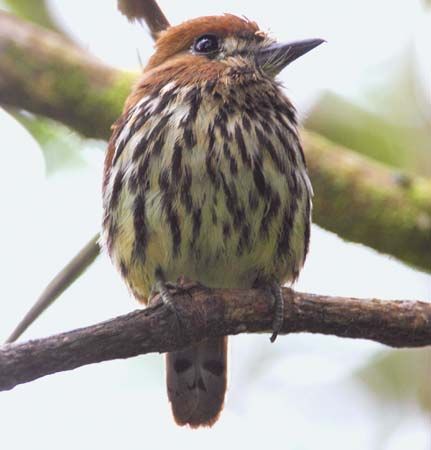
The defining physical characteristics of puffbirds include:
- Head and Neck: They possess an unusually large head and a short neck, which they often puff out while perching.12
- Bill: They are thick-billed birds, distinguished by a bill that is shorter and wider than that of their relatives, the jacamars, and features a decurved tip.12
- Plumage: Their feathers are lax and non-iridescent, typically appearing in dull or plain colors, such as shades of brown.12
- Size: They are generally moderate to small-sized birds, ranging from approximately 13 cm to 30 cm depending on the species.12
- Legs: Their legs feature scutellate scales (small scales) on both the front and back.2
How do puffbirds build their nests and what are their breeding habits?
Puffbirds (family Bucconidae) exhibit specific nesting behaviors characterized by their choice of location and protective measures. Rather than building traditional nests in trees, these birds dig holes in either flat or sloping ground to serve as their nesting sites.1
Regarding their breeding and nesting habits, some species demonstrate unique protective behaviors. For instance, the white-whiskered puffbird (Malacoptila panamensis) has been observed plugging the entrance to its nest burrow with green leaves at night, likely as a strategy to conceal or protect the nest. While general information on their incubation and parental care is limited in the provided text, the family is known for these ground-nesting habits, which contrast with the arboreal nesting strategies of many other bird species.1
What are some of the most common or well-known species of puffbirds?
There are approximately 34 species of puffbirds within the family Bucconidae. Some of the most well-known or widespread species include:
- Collared puffbird (Bucco capensis): A species measuring about 18 cm (7 inches) in length, found in northern South America east of the Andes.1
- White-necked (or large-billed) puffbird (Notharchus macrorhynchos): A larger species reaching 24 cm (9 inches) that ranges geographically from Mexico to Argentina.1
- White-whiskered puffbird (Malacoptila panamensis): A member of the genus Malacoptila, which consists of medium-sized, brownish birds often featuring white facial patches.1
- Lanceolated monklet (Micromonacha lanceolata): Known as the smallest species in the family at 14 cm, this bird is recognized for its quiet demeanor and modest brown plumage.1
- Nunlets (Nonnula) and Nunbirds (Monasa): These groups consist of several species of quiet, dull-colored puffbirds, with nunlets typically measuring 13–16 cm and nunbirds ranging from 20–30 cm.1
What is the typical diet of puffbirds, and how do they hunt for their food?
Puffbirds (family Bucconidae) are primarily insectivorous, feeding on flying insects. Beyond insects, their diet also includes other arthropods and small vertebrates.13
Regarding their hunting strategy, puffbirds are known as flycatchers. They typically hunt by perching in the open, waiting for prey to pass by, and then launching from their perch to capture it on the wing. This behavior is similar to that of their close relatives, the jacamars, though puffbirds are distinguished by their thicker, wider bills with a decurved tip.31
Sources
- Puffbird — Encyclopædia Britannica
- Piciform - Annotated classification — Encyclopædia Britannica
- Puffin — Encyclopædia Britannica
- Charadriiform - Adaptations for feeding — Encyclopædia Britannica
- Reproductive behaviour - Parental care — Encyclopædia Britannica
- Reproductive behaviour - Caring for offspring — Encyclopædia Britannica
- puffbird — Merriam-Webster
Published on · 2 min read