Puffin
Puffins are diving birds belonging to the auk family and are found in various coastal regions across the Northern Hemisphere. Their distribution depends on…
Where can puffins be found in the wild, and what are their preferred habitats?
Puffins are diving birds belonging to the auk family and are found in various coastal regions across the Northern Hemisphere. Their distribution depends on the specific species:1
- Atlantic Puffin (Fratercula arctica): Found along Atlantic coasts, ranging from the Arctic south to Brittany and Maine.1
- Horned Puffin (F. corniculata): A Pacific relative of the Atlantic species.1
- Tufted Puffin (Lunda cirrhata): Distributed in more southerly regions of the Pacific.1
Puffins prefer habitats that provide access to both marine food sources and secure nesting sites. They nest in large colonies on seaside and island cliffs. To protect their young, they dig burrows typically one to two metres deep into the ground. These nesting colonies are often situated near upwelling currents in the sea, which are rich in the fish and invertebrates that puffins rely on for food.12
What is the typical diet of a puffin, and how do they catch their food?
Puffins consume a variety of marine organisms, with fish serving as a primary component of their diet, particularly when feeding their young.1
These birds are highly efficient hunters, capable of catching as many as 10 small fish in succession during a single foraging trip. Their unique bill structure allows them to carry multiple fish crosswise in their mouths while continuing to capture more. To manage this, they use their spiny tongues to hold the fish securely against the roof of the upper jaw. This specialized adaptation enables them to transport significant amounts of food back to their nesting colonies to nourish their offspring.14
What are the different species of puffins, and how do they differ from each other?
There are three species of puffins, all of which are diving birds belonging to the auk family. While your query mentions “puffins,” it is important to distinguish them from “puffbirds,” which are unrelated tropical American birds of the family Bucconidae.15
The three species of puffins are:
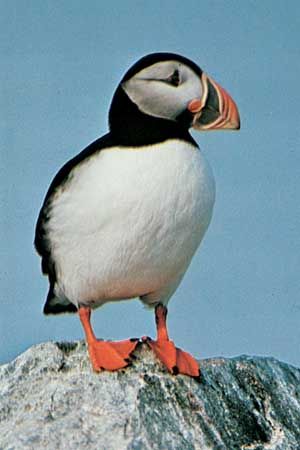
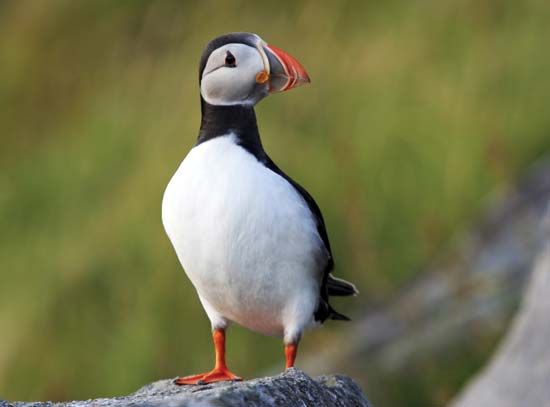
- Atlantic Puffin (Fratercula arctica): Found along Atlantic coasts from the Arctic to Maine and Brittany. It measures about 30 cm (12 inches) in length and is characterized by black upper plumage, white underparts, a gray face, red-orange feet, and a colorful bill featuring blue-gray, yellow, and red hues.1
- Horned Puffin (F. corniculata): A Pacific relative of the Atlantic puffin.1
- Tufted Puffin (Lunda cirrhata): Distributed in more southerly Pacific regions. This species is black with red legs and a red bill. It is distinguished by a white face and distinctive straw-colored plumes that curve backward from behind the eyes.1
All three species share the characteristic large, triangular, brightly colored beaks that define the genus.1
How do puffins hunt and catch multiple fish at once?
Puffins are highly efficient hunters capable of catching as many as 10 small fish in succession during a single foraging trip. Their ability to carry multiple fish crosswise in their bill while continuing to capture more is a specialized adaptation for feeding their young.14
To achieve this, puffins use their spiny tongues to hold the captured fish securely against the roof of the upper jaw. This mechanism allows them to keep their mouths open to hunt for additional prey without losing the fish they have already secured. This unique feeding strategy ensures that they can transport a significant amount of food back to their nesting colonies in one journey.41
Sources
- Puffin — Encyclopædia Britannica
- Polar ecosystem - Biota of the Arctic — Encyclopædia Britannica
- Fiordland penguin — Encyclopædia Britannica
- Charadriiform - Adaptations for feeding — Encyclopædia Britannica
- Puffbird — Encyclopædia Britannica
Published on · 3 min read