Racerunner
Biologists study racerunner lizards—a genus comprising about 60 species—primarily due to their unique reproductive strategies and genetic makeup. Research…
How have racerunner lizards been studied by scientists?
Biologists study racerunner lizards—a genus comprising about 60 species—primarily due to their unique reproductive strategies and genetic makeup. Research has focused on the following key areas:
- Reproductive Biology: Scientists are particularly interested in the existence of both sexual and parthenogenetic species. In parthenogenetic populations, young are produced from unfertilized eggs, often resulting in all-female species.12
- Hybridization and Genetics: Research indicates that many parthenogenetic forms originated from the hybridization of two bisexual species. Scientists have studied these lizards to understand how they possess multiple sets of chromosomes; while most species have two sets, some possess three or four. This includes allotriploid offspring, which result from a backcross between a sexual species and a parthenogenetic one.12
- Sensory Ecology: Biologists have examined how these highly active lizards forage by using their tongues to sample environmental chemicals, which are then processed by Jacobson’s organ to identify prey.1
What unique physical features help racerunner lizards move quickly?
Racerunner lizards (genus Aspidoscelis) are renowned for their impressive speed, capable of reaching up to 29 km (18 miles) per hour. Their ability to achieve such high velocities—comparable to fast terrestrial mammals relative to their body size—is primarily attributed to their powerful limb musculature.1
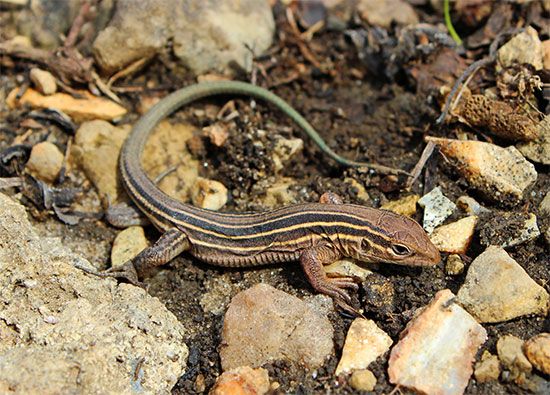
While many lizards rely on a traditional sprawled gait, where limbs project perpendicularly from the body, racerunners utilize this quadrupedal limb structure to facilitate rapid acceleration and quick changes in direction. During movement, these lizards hold their bodies slightly above the substrate, bending from side to side to maximize the length of each step.13
Unlike some other lizard species that have evolved specialized toe fringes for sand traction or lamellae for climbing, the speed of the racerunner is fundamentally driven by their efficient, high-energy limb movement and their capacity for rapid, agile locomotion across open habitats.41
What role do racerunner lizards play in their ecosystem?
Racerunner lizards play a significant role in their ecosystems primarily as active predators and as a component of the food web. By searching widely for food, they help regulate populations of insects and spiders, which constitute the primary diet for most species in the genus. In certain island environments, some racerunner species have adapted to feed largely on plants, further diversifying their ecological impact.1
As highly active, wary animals, they also serve as prey for various predators within their habitats, which range from southwestern deserts to forest clearings. Their reliance on open, sun-exposed areas makes them a visible part of these environments, where they utilize their keen ability to detect chemical cues to navigate and forage effectively.1
What are the defining characteristics of racerunner lizards?
Racerunner lizards, belonging to the genus Aspidoscelis (formerly Cnemidophorus), are a diverse group of approximately 60 species within the family Teiidae. They are defined by several key characteristics:1
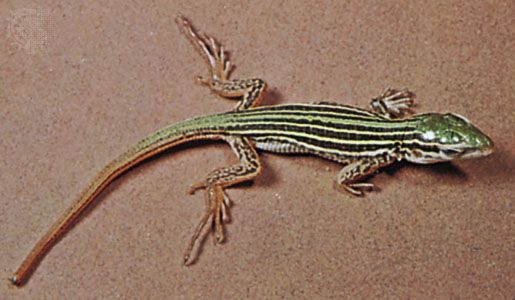
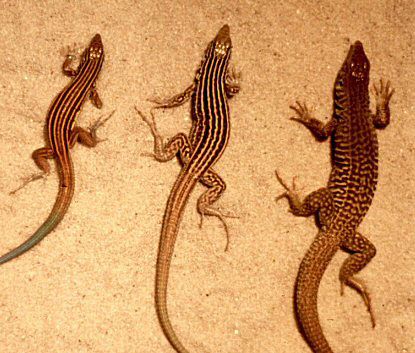
- Physical Appearance: They range in size from 20 to over 50 cm (8 to 20 inches). Their coloration is highly variable, even within a single species, often featuring yellow stripes or spots on black or brown backgrounds, though some individuals appear nearly black.1
- Locomotion: Named for their impressive speed, some species can reach velocities of up to 29 km (18 miles) per hour. They are highly active, wide-ranging foragers that rely on powerful limb musculature to move quickly across open terrain.13
- Habitat and Behavior: These lizards prefer open, sun-exposed environments, such as deserts, forest clearings, and trails. They are wary animals that maintain distance from observers and retreat to shelter when threatened.1
- Sensory Foraging: They use their tongues to sample chemicals in the environment, utilizing the Jacobson’s organ to detect and discriminate prey.1
- Reproductive Diversity: The genus is of significant scientific interest due to the presence of both sexual and parthenogenetic species, as well as the occurrence of polyploidy, where some species possess three or four sets of chromosomes.12
Sources
- racerunner — Encyclopædia Britannica
- lizard - Parthenogenesis — Encyclopædia Britannica
- lizard - Locomotion and limb adaptations — Encyclopædia Britannica
- reptile - Walking and crawling — Encyclopædia Britannica
Published on · 3 min read