Rainbow Trout
The rainbow trout (Oncorhynchus mykiss) is a highly regarded game fish belonging to the family Salmonidae. Originally native to western North America, this…
What is rainbow trout?
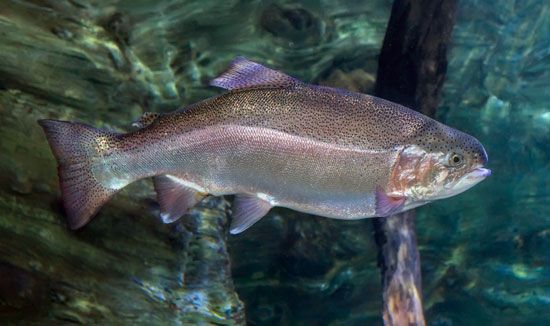
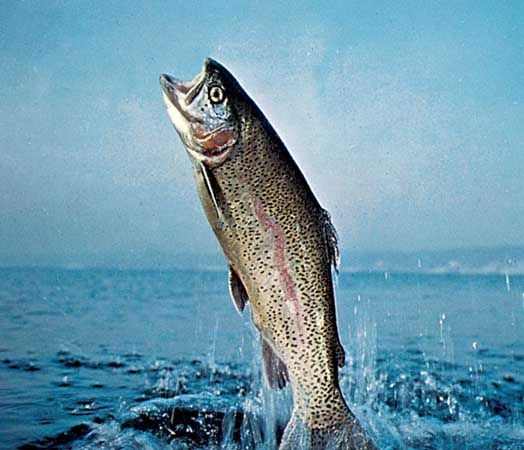
The rainbow trout (Oncorhynchus mykiss) is a highly regarded game fish belonging to the family Salmonidae. Originally native to western North America, this species has been introduced to many countries worldwide due to its popularity among anglers, who prize it for its spectacular leaps and fighting spirit when hooked.12
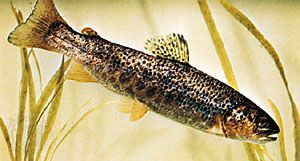
Physically, the rainbow trout is characterized by a reddish or lavender band along its sides, a greenish back, and a white belly, all covered with small black spots. While typically found in cool lakes and swift streams, the species exhibits significant variation in size and habitat. An oceangoing form known as the steelhead is particularly large and bluish in color, often weighing between 4.5 and 25 kg. Other notable forms include the Kamloops or Kootenay trout of Idaho, which can grow quite large. As a member of the genus Oncorhynchus, it is closely related to Pacific salmon.132
What is the difference between a rainbow trout and a steelhead?
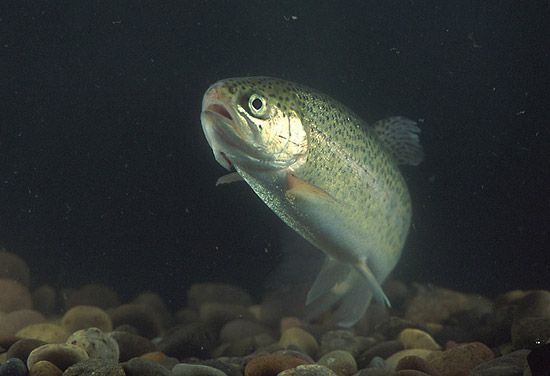
While rainbow trout and steelhead are the same species (Oncorhynchus mykiss), they are distinguished primarily by their life cycles and environments.14
- Rainbow Trout: These are typically freshwater fish that spend their entire lives in lakes or streams. They are generally smaller, often weighing around 2.8 kg (6 pounds), and are characterized by a reddish or lavender band along their sides with small black spots.14
- Steelhead: These are the anadromous form of the species. They migrate from their freshwater birthplaces to the ocean, where they spend two to three years maturing before returning to fresh water to spawn. Due to their time in the ocean, they grow significantly larger—typically between 4.5 and 25 kg (10 to 55 pounds)—and develop a distinct bluish, silvery appearance.451
Interestingly, the differences in their life cycles are governed by slight heritable factors. Research has shown that offspring of anadromous steelhead can establish landlocked populations, and conversely, non-anadromous rainbow trout may migrate to the sea if given the opportunity.4
How do trout reproduce in their natural environment?
All salmonid fishes, including trout, reproduce in fresh water through a process of external fertilization known as spawning.4
Spawning Behavior and Environment
Trout have evolved specific reproductive strategies to survive in cold, swift-moving rivers where food can be scarce. These environments have driven the evolution of nest-building behavior and the production of relatively large, heavy eggs (4 to 8 mm in diameter). These eggs are demersal, meaning they develop on or within the bottom substrate of a stream or lake.4
A key aspect of trout reproduction is their homing instinct. Whether they are resident freshwater populations or anadromous individuals that have migrated to the ocean, trout return to their specific natal streams or spawning sites to reproduce. This behavior is largely guided by their sense of smell, which helps them navigate back to the precise location of their birth.46
Life Cycle Variations
Reproductive success is determined by the number of mature adults produced. Because their spawning grounds can be perilous, trout produce fewer, larger eggs compared to fish in more benign environments, providing the developing embryos with a larger yolk for direct development. Upon hatching, the young emerge in an advanced stage, resembling miniature adults.4
What are some other common species of trout?
Trout belong primarily to the genera Oncorhynchus and Salvelinus, with the brown trout (Salmo trutta) being the only species still classified under the genus Salmo. Beyond the rainbow trout, several other common species are highly regarded as game and food fish:3
- Brook trout: A member of the Salvelinus genus (a type of char), this fish is native to northeastern North America. It is recognized by dark, wormlike markings on its back and red and whitish spots on its body.37
- Lake trout: Another large char, this species is widely distributed across the Great Lakes basin and northern North America. It typically inhabits deep, cool lakes and can grow to significant sizes.38
- Cutthroat trout: Found primarily in northwestern North America, this Oncorhynchus species is easily identified by the distinctive reddish streaks on the skin of its lower jaw.39
- Golden trout: A mountain species native to the clear waters of California’s Sierra Nevada range, it is also classified within the genus Oncorhynchus.3
- Dolly Varden trout: Like the brook and lake trout, this is a species of char belonging to the genus Salvelinus.3
Sources
- rainbow trout — Encyclopædia Britannica
- rainbow trout — Merriam-Webster
- trout — Encyclopædia Britannica
- protacanthopterygian - Life cycle and reproduction — Encyclopædia Britannica
- steelhead — Merriam-Webster
- protacanthopterygian - Behaviour and locomotion — Encyclopædia Britannica
- brook trout — Encyclopædia Britannica
- cutthroat trout — Merriam-Webster
- lake trout — Encyclopædia Britannica
- protacanthopterygian - Distribution and abundance — Encyclopædia Britannica
Published on · 3 min read