Cutthroat Trout
The cutthroat trout (Oncorhynchus clarki) is a black-spotted game fish belonging to the family Salmonidae, native to western North America. It is easily…
What is cutthroat trout?
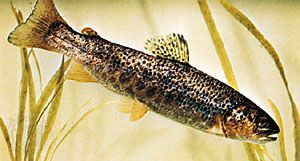
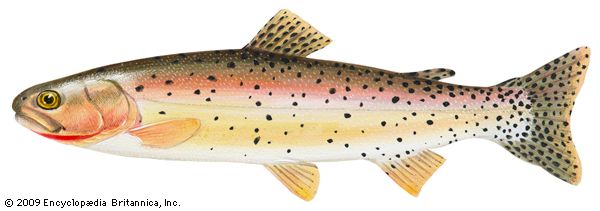
The cutthroat trout (Oncorhynchus clarki) is a black-spotted game fish belonging to the family Salmonidae, native to western North America. It is easily identified by the distinctive bright-red streaks of color located beneath its lower jaws, a feature that gives the species its common name.12
As a popular sport fish, the cutthroat trout is known to strike at various baits, flies, and lures, and it is also valued as a food fish. While typically weighing between 2 and 4 kg (4.4 to 8.8 pounds), some specimens can reach up to 10 kg (22 pounds). Many populations are migratory; those that travel to the sea are often referred to as sea trout and may remain in saltwater for several years before returning to freshwater. The species includes numerous subspecies, such as the Yellowstone and Tahoe trout, all of which share the characteristic red markings.1
How do cutthroat trout differ from rainbow trout?
While both the cutthroat trout and rainbow trout belong to the genus Oncorhynchus and are highly valued as game fish, they are distinct species with specific identifying characteristics.1
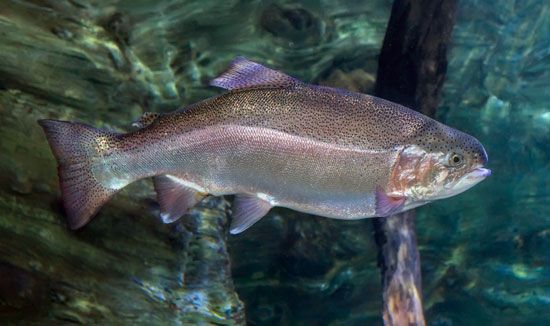
The most prominent difference is the cutthroat trout’s namesake feature: a pair of bright-red streaks located beneath the lower jaw. In contrast, rainbow trout are typically recognized by a broad, pinkish-red horizontal band that runs along each side of their body.24
Taxonomically, both species are members of the family Salmonidae and share similar behaviors, such as the tendency to spawn in gravel nests and the ability of some populations to migrate to the sea. However, because trout species within the same genus hybridize easily, distinguishing between them in the wild can sometimes be challenging due to variations in color and anatomy.21
What does it mean for a fish to be anadromous?
An anadromous fish is a species that spends the majority of its life in the sea but migrates to fresh water to spawn. This life cycle allows species, such as salmon and certain trout, to expand their range into colder freshwater regions that might otherwise be inaccessible.567
The process involves precise physiological adaptations to handle varying levels of water salinity. When ready to spawn, these fish return to their natal rivers—the specific streams where they hatched—using environmental cues such as the Earth’s magnetic field, the Sun, and the distinct smell or chemistry of the water.56
This behavior is distinct from catadromous migration, where fish like the European eel live in fresh water and migrate to the ocean to spawn.6
Why is hybridization a challenge for trout classification?
Hybridization presents a significant challenge for trout classification because species within the same genus, such as Oncorhynchus, can interbreed with relative ease. This biological tendency to hybridize often results in offspring that exhibit a mix of physical and anatomical traits, making it difficult for researchers and biologists to distinguish between species in the wild.14
Furthermore, the management of these fish is complicated by the existence of discrete populations and races within a single species, each possessing unique life-history characteristics. When hybridization occurs, it can blur the lines between these distinct groups, complicating efforts to maintain the genetic integrity of specific populations. Because trout classification relies heavily on identifying species-specific traits—such as coloration and morphology—the variability introduced by crossbreeding often obscures these markers, leading to ongoing taxonomic uncertainty.41
Sources
- cutthroat trout — Encyclopædia Britannica
- cutthroat trout — Merriam-Webster
- trout — Encyclopædia Britannica
- protacanthopterygian - Behaviour and locomotion — Encyclopædia Britannica
- Migration - Anadromous fish — Encyclopædia Britannica
- Marine ecosystem - Migrations of marine organisms — Encyclopædia Britannica
- protacanthopterygian - Distribution and abundance — Encyclopædia Britannica
- aquaculture - Trout and salmon — Encyclopædia Britannica
Published on · 2 min read