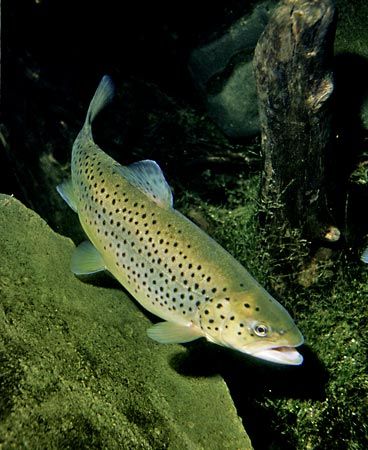
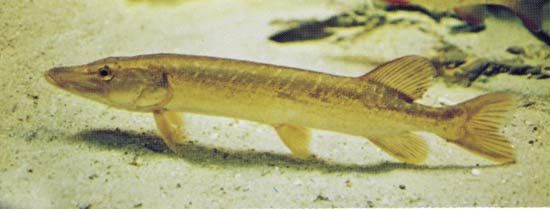
Protacanthopterygian
Protacanthopterygian fishes, a diverse group of bony fishes including salmons, trouts, and pikes, exhibit virtually every mode of reproduction and life cycle…
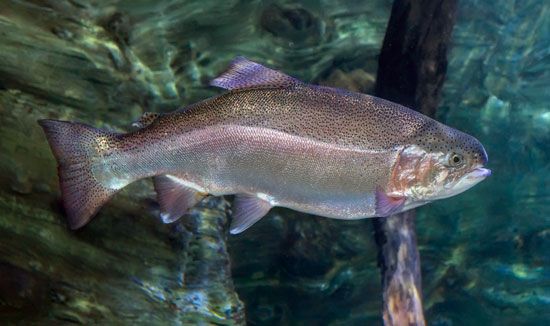
How do protacanthopterygian fishes reproduce and what are their life cycles like?
Protacanthopterygian fishes, a diverse group of bony fishes including salmons, trouts, and pikes, exhibit virtually every mode of reproduction and life cycle known among fish.12
Reproduction
All known salmoniform fishes are oviparous, meaning they lay eggs and rely on external fertilization eggs and rely on external fertilization. Reproductive strategies are shaped by natural selection:1
- Freshwater species: Typically lay heavy, demersal eggs on or in the bottom of streams or lakes. Species in harsh environments, such as cold, swift rivers, often produce fewer, larger eggs and engage in nest-building to protect embryos.1
- Marine species: Often produce numerous, smaller, pelagic (free-drifting) eggs that float with ocean currents.1
Life Cycles
Life cycles vary significantly, ranging from entire lifespans in small ponds to migrations spanning thousands of kilometers between streams and the ocean. While some species develop directly into miniature adults, others undergo striking larval transformations. Most families include species that migrate between fresh and salt water, though pikes and mudminnows are strictly freshwater.1
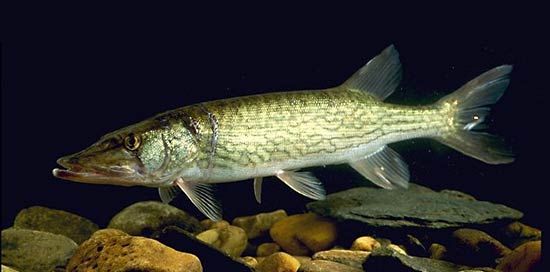
How has the classification of protacanthopterygian fishes evolved over time in ichthyology?
The classification of protacanthopterygian fishes has undergone significant revision as ichthyologists moved away from early, morphology-based groupings toward more rigorous evolutionary analysis.34
Historical Context
Early classification schemes, notably those by C.T. Regan and L.S. Berg, grouped primitive, soft-rayed fishes into an order called Isospondyli or Clupeiformes, placing them alongside herrings as the ancestral stock for all teleostean fishes. This approach was later challenged by P.H. Greenwood and colleagues, who demonstrated that these groups were not derived from a single common ancestor but were instead a collection of unrelated lineages.4
Refinement and Modern Understanding
To address these inaccuracies, the order Salmoniformes was established to separate diverse, loosely related groups from the clupeiforms. Over time, the composition of the Protacanthopterygii has been further refined:4
- Removal of Taxa: Groups like the Myctophoidei were removed and reclassified into their own order, Myctophiformes, due to distinct evolutionary histories dating back to the Cretaceous.4
- Current Composition: The superorder is now generally treated as a collection of relatively primitive orders, including Salmoniformes, Osmeriformes, and Esociformes.5
While skeletal and anatomical studies remain foundational, scientists acknowledge that the current classification is likely to evolve further as molecular analysis provides new data on these basal lineages.34
What is the evolutionary history of protacanthopterygian fishes?
The evolutionary history of protacanthopterygian fishes positions them as a basal stock within the modern teleost lineage. Emerging in the Late Mesozoic Era, approximately 100 million years ago, these fishes represent an evolutionary stage that provided the foundational “raw material” for many subsequent lineages of modern bony fishes.65
Historically, the superorder was treated as a broad, catch-all category for various primitive, soft-rayed fishes. However, modern ichthyology has refined this classification by removing unrelated groups—such as the Myctophiformes—that were previously misidentified as close relatives. Today, the group is primarily composed of the orders Salmoniformes, Osmeriformes, and Esociformes.15
These fishes are considered more advanced than “lower” teleosts like osteoglossomorphs and ostariophysans, yet they remain less specialized than the neoteleosts, which later developed advanced traits like spiny fin rays and more mobile, protractile mouths. Their evolutionary success is marked by their ability to adapt to diverse environments, ranging from deep-sea habitats to freshwater streams.365
Which major fish families are included in the protacanthopterygian group?
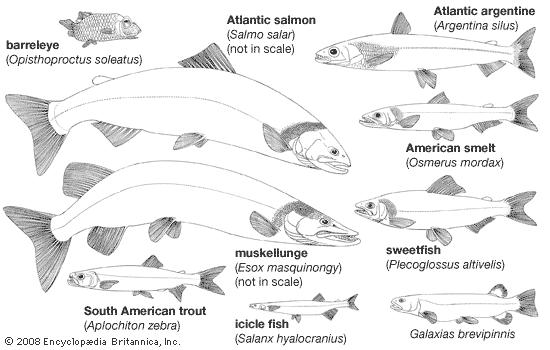
The superorder Protacanthopterygii is a diverse group of bony fishes currently organized into three primary orders. The following families are included within these orders:
Order Esociformes
- Family Esocidae: Includes pikes and pickerels.
- Family Umbridae: Includes mudminnows.
Order Osmeriformes
- Family Alepocephalidae: Slickheads.
- Family Bathylaconidae
- Family Leptochilichthyidae
- Family Platytroctidae
- Family Argentidae: Argentines.
- Family Bathylagidae
- Family Microstomatidae
- Family Opisthoproctidae
- Family Osmeridae: Smelts.
- Family Salangidae: Icefishes and noodlefishes.
- Family Galaxiidae: South American trouts.
- Family Retropinnidae: New Zealand trouts and southern graylings.
- Family Lepidogalaxiidae: Salamanderfishes.
Order Salmoniformes
- Family Salmonidae: Includes various species of salmons and trouts.
This classification reflects modern ichthyological consensus, which has refined the group by removing unrelated lineages that were historically misidentified as primitive relatives.258
Sources
- protacanthopterygian - Life cycle and reproduction — Encyclopædia Britannica
- protacanthopterygian — Encyclopædia Britannica
- protacanthopterygian - Evolutionarily important taxonomic characters — Encyclopædia Britannica
- protacanthopterygian - Critical appraisal — Encyclopædia Britannica
- protacanthopterygian - Evolutionary importance of the superorder — Encyclopædia Britannica
- fish - Actinopterygii: ray-finned fishes — Encyclopædia Britannica
- paracanthopterygian - Critical appraisal — Encyclopædia Britannica
- protacanthopterygian - Annotated classification — Encyclopædia Britannica
Published on · 3 min read