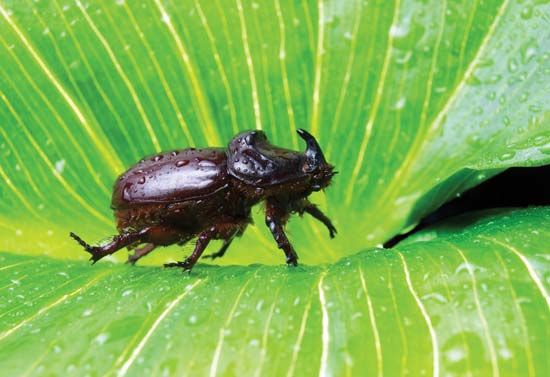
Rhinoceros Beetle
The rhinoceros beetle (subfamily Dynastinae) undergoes a process of complete metamorphosis, which consists of four distinct developmental stages: egg, larva…
What is the life cycle of a rhinoceros beetle?
The rhinoceros beetle (subfamily Dynastinae) undergoes a process of complete metamorphosis, which consists of four distinct developmental stages: egg, larva, pupa, and adult.1
- Egg: The life cycle begins when the female lays eggs, typically in environments rich in organic matter, such as rotting wood, decaying vegetation, or humus.21
- Larva: Upon hatching, the larvae feed on their surrounding environment, such as rotting logs or decaying plant material. As they grow, they must molt—shedding their skin (cuticle) and forming a new, larger one—usually three to five times before reaching maturity. Some species, such as those in the genus Megasoma, have a notably long larval stage, spending three to four years developing before transitioning to the next phase.321
- Pupa: After a nonfeeding prepupal period, the insect enters the pupal stage. The pupa forms beneath the final larval skin and resembles a soft, pale version of the adult with folded wings.1
- Adult: The adult emerges from the pupal skin, its skeleton hardens, and it develops its final coloration.1
How do rhinoceros beetles use their prominent horns?
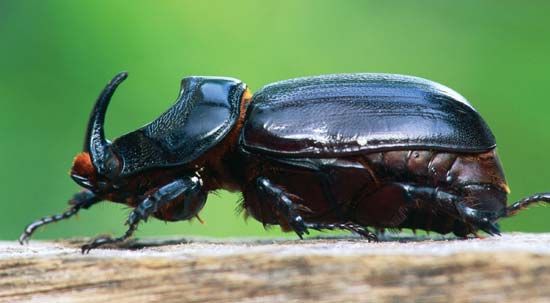
Male rhinoceros beetles use their prominent, hornlike structures primarily for combat. These displays are not intended to inflict physical injury on opponents; instead, the horns serve as tools to force rivals away from contested areas.1
Males engage in these conflicts to compete for access to females or to secure desirable feeding sites, such as specific trees, logs, or crops. While these beetles possess a fierce appearance, they are fundamentally harmless to humans and subsist entirely on plant material.1
It is important to note that while the function of horns in many rhinoceros beetle species is well-documented as a tool for territorial and reproductive competition, the specific evolutionary value or primary function of the horns in certain species, such as the eastern Hercules beetle, remains a subject of ongoing scientific study.4
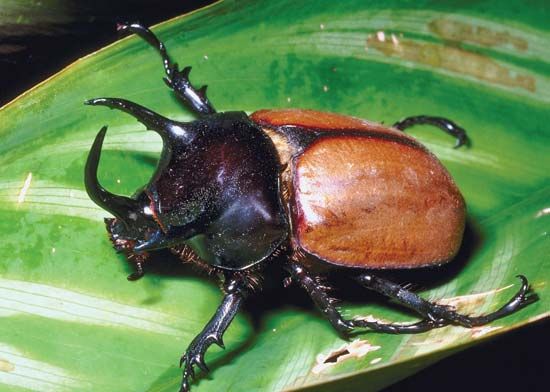
What are the distinctive physical characteristics of rhinoceros beetles?
Rhinoceros beetles, members of the subfamily Dynastinae, are characterized by several distinct physical features:
- Size: They are among the largest beetles on Earth, with some species, such as the Hercules beetle, reaching lengths exceeding 18 cm (7 inches).1
- Body Shape: These beetles possess rounded, convex backs.1
- Horns: The most iconic feature is the presence of impressive, hornlike structures on the frontal portions of males. These vary significantly by species:
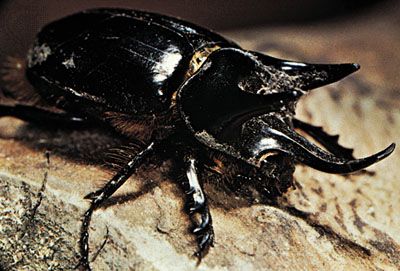
- Some, like the Hercules beetle and D. neptunus, feature double horns oriented vertically that resemble large pincers.1
- The elephant beetle (Megasoma elephas) displays a long, split central horn on the head, accompanied by shorter, conical horns on the thorax.1
- Other species may have a single upright horn or even rear-pointing horns.1
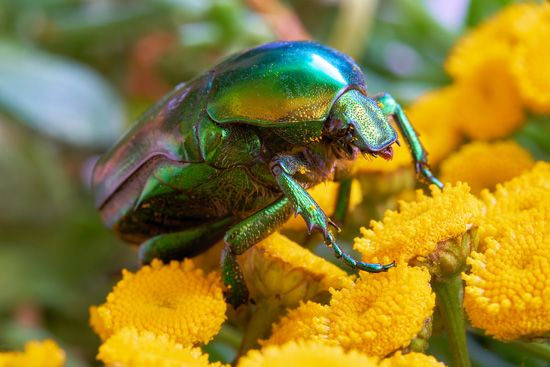
- Coloration and Texture: Their color ranges from black to mottled greenish gray. Their surfaces can be shiny and metallic, or covered in short, fine hairs that provide a velveteen appearance.1
What are some of the largest species of rhinoceros beetles?
Several species within the subfamily Dynastinae are recognized as some of the largest beetles on Earth. Notable examples include:
- Hercules beetle (Dynastes hercules): This species is among the most impressive, capable of growing to more than 18 cm (7 inches) in length, with its horn accounting for up to 10 cm (4 inches) of that measurement.1
- Neptune beetle (D. neptunus): Similar to the Hercules beetle, this species is found in American tropical forests and features a spectacular pair of vertical, pincer-like horns.1
- Elephant beetle (Megasoma elephas): Native to the lowland rainforests of Central and South America, this striking beetle reaches lengths of approximately 13 cm (5 inches). The male is distinguished by a long, split central horn and shorter, conical thoracic horns.1
- Megasoma actaeon: While known for its massive size, this species is particularly notable for its larvae, which can sometimes exceed 200 grams (0.44 pounds) in weight.5
Sources
- rhinoceros beetle — Encyclopædia Britannica
- Coleoptera - Feeding habits and habitats — Encyclopædia Britannica
- Coleoptera - General features — Encyclopædia Britannica
- eastern Hercules beetle — Encyclopædia Britannica
- arthropod - Size range — Encyclopædia Britannica
Published on · 3 min read