Scarab Beetle
Scarab beetles (family Scarabaeidae) comprise a diverse group of over 30,000 species. While your query mentions "jewel scarabs," this common name is not…
What are some notable examples of scarab beetles, such as the dung beetle or the jewel scarab?
Scarab beetles (family Scarabaeidae) comprise a diverse group of over 30,000 species. While your query mentions “jewel scarabs,” this common name is not explicitly categorized within the provided Britannica data; however, many scarabs are noted for their beautifully colored, highly polished forewings.1
Notable examples include:
- Dung Beetles (subfamily Scarabaeinae): These beetles are famous for forming manure into balls. The sacred scarab (Scarabaeus sacer) held significant cultural importance in ancient Egypt. Other species, such as the Australian Aulacopris maximus and the Indian Heliocopris, exhibit remarkable behaviors like creating large, clay-covered manure balls.21
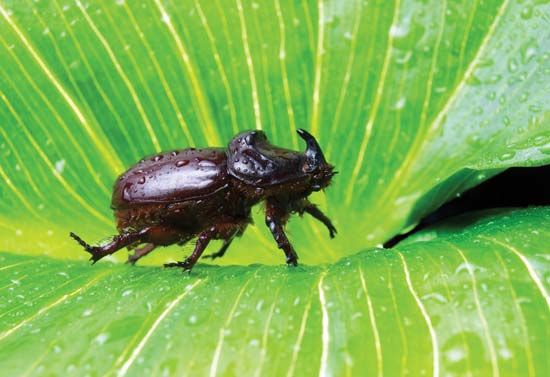
- Rhinoceros Beetles (subfamily Dynastinae): Known for their bizarre forms, males often possess one or more horns on the head or thorax. An example is the eastern Hercules beetle (Dynastes tityus).1
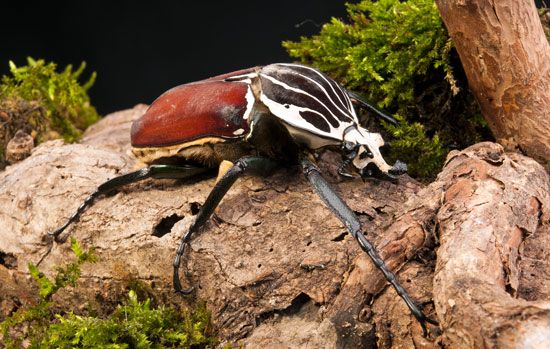
- Goliath Beetles (subfamily Cetoniinae): These include the African goliath beetle (Goliathus goliatus), one of the largest and heaviest scarabs.1
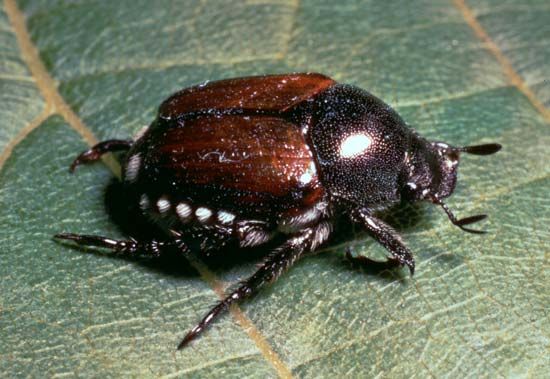
- Agricultural Pests: This group includes the Japanese beetle, June bugs, and cockchafers.1
What are the distinguishing characteristics of scarab beetles?
Scarab beetles (family Scarabaeidae) are characterized by several distinct physical and biological traits that set them apart within the order Coleoptera.
Physical Characteristics
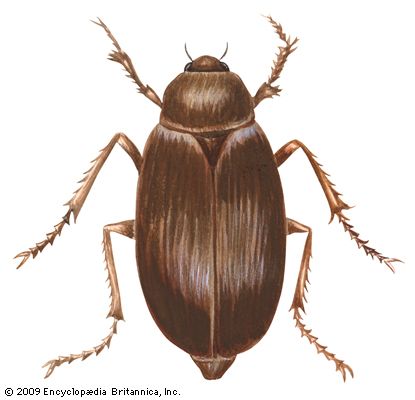
- Body Shape: Adults are typically compact and heavy-bodied with a robust, oval outline.1
- Antennae: They are most easily distinguished from other beetles by their unique antennae, which terminate in three flattened plates that fit together to form a club.1
- Legs: Like all insects, they have six legs; however, the outer edges of their front legs are often toothed or scalloped, an adaptation that facilitates digging.1
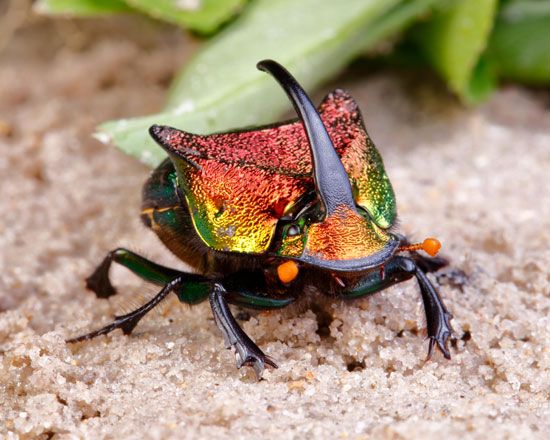
- Wings: Many species are prized by collectors for their large, hard, and highly polished forewings, known as elytra. These protective structures cover the delicate, often transparent wings used for flight.1
- Size and Ornamentation: They vary significantly in size, ranging from 5 mm to 12 cm in length. Many species, particularly males, exhibit bizarre forms such as horns on the head or thorax, which are common in groups like rhinoceros beetles and goliath beetles.14
Life Cycle and Habits
Scarab beetles undergo complete metamorphosis, progressing through egg, larva, pupa, and adult stages. Their larvae are typically soft-bodied, thick, and strongly C-shaped. Ecologically, they are highly diverse; while many feed on manure or decomposing plant materials, others consume roots, leaves, or fungi.1
How many species of scarab beetles exist, and where are they commonly found?
There are more than 30,000 species of scarab beetles (family Scarabaeidae), making them one of the largest and most diverse groups within the order Coleoptera6.6
Regarding their distribution, beetles as a whole are found in nearly all climates and latitudes, excluding extreme environments like Antarctica or the highest altitudes. While many species of beetles are concentrated in the tropics, they are present globally, ranging from the Arctic to subantarctic islands. Scarab beetles specifically are ecologically important and are particularly associated with flowering plants. Depending on the species, they may be found living beneath the ground, in soil, or in association with decaying organic matter, and some are known to occur in aggregations.1768
How have scarab beetles been used in art and jewelry throughout history?
Scarab beetles have held a significant place in art and jewelry for millennia, primarily due to their status as a sacred symbol in ancient Egyptian religion. The dung beetle (Scarabaeus sacer) was revered as a manifestation of the god Khepri, who represented the morning sun and the power of transformation and rebirth.910
Amulets and Seals
The most common artistic application of the scarab was in the form of amulets. These were frequently crafted from glazed steatite and served dual purposes as decorative jewelry and functional seals. During the Middle Kingdom, these objects were produced in vast numbers, often featuring spiral motifs, official titles, or inscriptions containing good omens.9
Funerary Art
In funerary contexts, scarabs were essential for the afterlife. Large “heart scarabs” made of basalt were placed within mummy bandages, symbolically replacing the heart of the deceased to ensure safe passage through the underworld. Winged scarabs were also placed on the breast of the deceased, and many bore inscriptions from the Book of the Dead.910
Cultural Legacy
The popularity of the scarab extended beyond Egypt, as trade carried these designs throughout the Mediterranean, leading to Greek and Etruscan imitations. Additionally, scarab rings were worn by Roman soldiers as protective charms.910
Sources
- scarab beetle — Encyclopædia Britannica
- dung beetle — Merriam-Webster
- dung beetle — Encyclopædia Britannica
- Scarabaeidae — Merriam-Webster
- Coleoptera - Size range and diversity of structure — Encyclopædia Britannica
- scarab beetle: Top Questions — Encyclopædia Britannica
- Coleoptera - Feeding habits and habitats — Encyclopædia Britannica
- Coleoptera - Distribution and abundance — Encyclopædia Britannica
- scarab — Encyclopædia Britannica
- Khepri — Encyclopædia Britannica
Published on · 4 min read