Rhinoceros Viper
The rhinoceros viper (Bitis nasicornis) is a fascinating, brightly colored snake native to the rainforests and swamps of West and Central Africa. Several…
Are there any interesting facts or behaviors unique to the rhinoceros viper?
The rhinoceros viper (Bitis nasicornis) is a fascinating, brightly colored snake native to the rainforests and swamps of West and Central Africa. Several unique characteristics define this species:
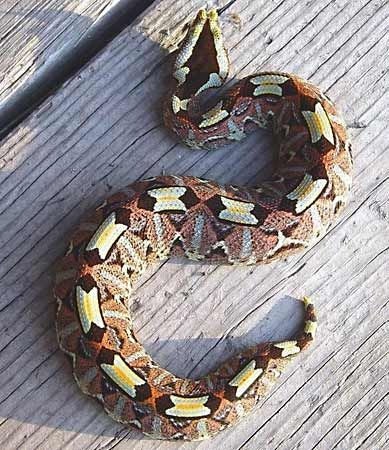
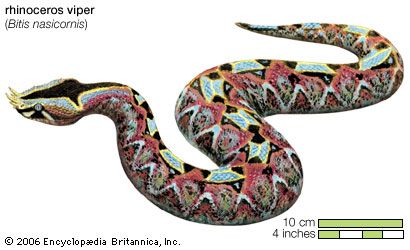
- Distinctive Appearance: It is named for the two or three pairs of hornlike scales on its snout. Its body features a striking, velvetlike pattern of triangles, rectangles, and diamonds in vibrant shades of red, yellow, blue, green, and black.1
- Behavioral Traits: While primarily nocturnal and terrestrial, it is known to venture into trees and aquatic environments. Despite being a sluggish mover, it can strike with surprising speed in both forward and sideways directions.1
- Reproduction: Unlike many snakes that lay eggs, the rhinoceros viper exhibits viviparity, giving birth to live young—often between 6 and 35 offspring at a time.1
- Temperament: Although it possesses a significant amount of venom, it is generally mild-mannered and rarely bites humans. When disturbed, it often emits a prolonged, audible warning hiss.1
What are the distinguishing physical characteristics of the rhinoceros viper?
The rhinoceros viper (Bitis nasicornis) is a heavy-bodied snake characterized by several distinct physical features:
- Snout Appendages: It is named for the two or three pairs of hornlike scales located on the tip of its snout.13
- Head Markings: The snake possesses a triangular head, typically colored green or blue, featuring a prominent black arrowhead mark on the top.1
- Body Pattern: Its body is covered in rough, strongly keeled scales arranged in a velvetlike pattern of triangles, rectangles, and diamond-shaped areas. This pattern is exceptionally colorful, displaying a vibrant mix of red, yellow, blue, green, and black.1
- Size: The species generally reaches an average length of 70–90 cm (28–35 inches), though some individuals have been recorded at lengths up to 1.3 metres (4.3 feet).1
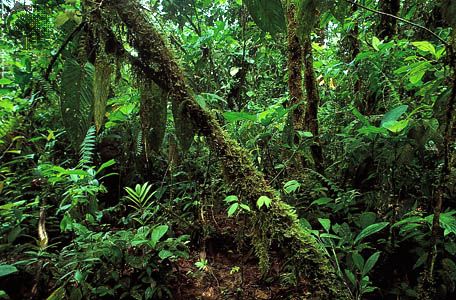
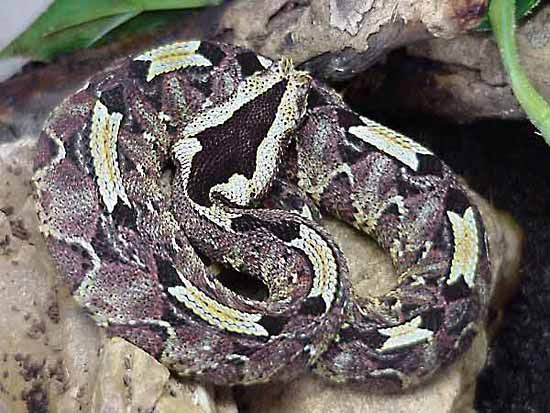
The rhinoceros viper’s coloration serves as effective camouflage, allowing it to blend into the leaf litter of its forest floor habitat.1
What is the typical diet and hunting behavior of the rhinoceros viper?
The rhinoceros viper is a nocturnal, primarily terrestrial predator that employs an ambush strategy to secure its food. By utilizing its complex, cryptic coloration, the snake remains hidden among the leaf litter of the forest floor, waiting patiently along rodent trails for unsuspecting prey to pass by.1
Although the rhinoceros viper is generally characterized as a sluggish and slow-moving animal, it is capable of striking with significant speed in both forward and sideways directions when attacking. Its diet consists primarily of rodents, though it is also known to consume frogs and fish when the opportunity arises.1
How venomous is the rhinoceros viper, and what effects does its venom have?
The rhinoceros viper (Bitis nasicornis) is a venomous snake that produces a significant amount of venom. Despite its capacity to produce this toxin, the snake is known for having a rather mild disposition. Consequently, it rarely bites humans, and fatalities resulting from its bite are uncommon.1
While the specific clinical effects of the rhinoceros viper’s venom are not detailed in the provided search results, it belongs to the family Viperidae, a group whose members often possess complex venoms. Generally, venomous snakes utilize mixtures of toxic enzymes and proteins that can act as hemotoxins, which affect the blood and circulatory system, or cytotoxins, which cause the destruction of cells and tissues.4
Sources
- rhinoceros viper — Encyclopædia Britannica
- Venom — Encyclopædia Britannica
- rhinoceros viper — Merriam-Webster
- Bitis — Encyclopædia Britannica
Published on · 3 min read