Sambar
The term "sambar" refers to a large, widely distributed deer species (Cervus unicolor) belonging to the family Cervidae. Found throughout India, Nepal, and…
What is sambar?
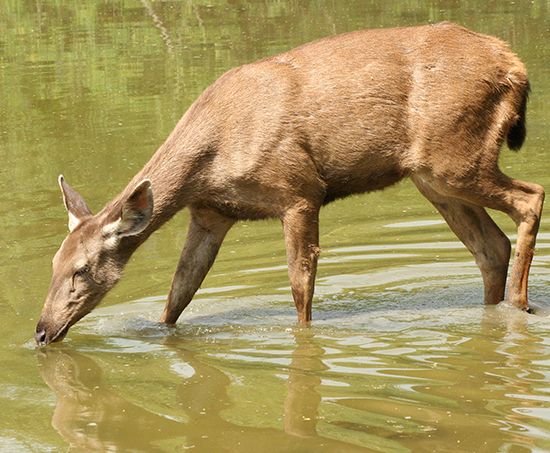
The term “sambar” refers to a large, widely distributed deer species (Cervus unicolor) belonging to the family Cervidae. Found throughout India, Nepal, and Southeast Asia, these animals typically inhabit forests either alone or in small groups.1
Physically, the sambar is a large deer standing approximately 1.2–1.4 meters (47–55 inches) at the shoulder. They are characterized by a dark brown, unspotted coat and a distinct ruff of hair around the neck. Males are notable for their long, three-tined antlers. Several subspecies exist, including the large Indian sambar (C. u. niger) and the smaller Malayan sambar (C. u. equinus).21
It is important to note that while the word “sambar” is also commonly used to describe a popular South Indian lentil-based vegetable stew, the provided search results specifically define the term as the Asian deer species.
What is the diet of a sambar deer?
The sambar deer (Cervus unicolor) is a herbivorous animal that primarily feeds by browsing on leaves and cropping coarse grasses within its forest habitat.2
As a ruminant, the sambar has evolved to efficiently process these plant-based food sources. Observations of their feeding habits in regions like Kanha Park in central India indicate that they occupy a specific ecological niche, allowing them to coexist with other herbivores by utilizing different food resources. While other deer species in the same area may seek out tender grass blades or specific fruits, the sambar is noted for its ability to consume coarser vegetation, including leaves and grasses found in forest environments.2
How do sambar deer protect themselves from predators?
Sorry, the Britannica knowledge base does not contain this information.
What are some other species of deer found in Asia?
Asia is home to a diverse array of deer species, ranging from primitive forms to large, specialized ruminants. These species occupy various ecological niches across the continent’s tropical, subtropical, and temperate zones.4
Notable Asian Deer Species
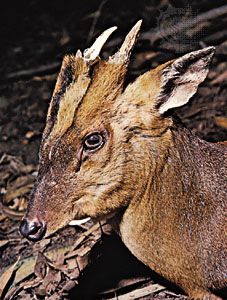
- Muntjacs: Often called “barking deer,” these are considered the most primitive deer. They are small- to medium-sized, solitary, and nocturnal, with males possessing tusklike upper canine teeth.45
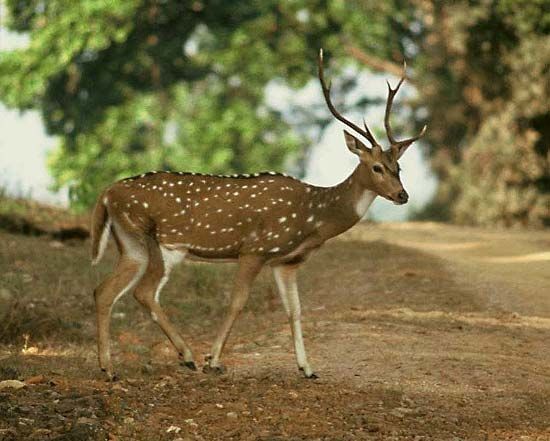
- Chital: A gregarious species found in India and Sri Lanka, known for its spotted coat and branching, three-tined antlers.46
- Barasingha: A large swamp deer native to India and Southeast Asia.4
- Sika: A temperate-zone deer native to Japan that features a basic four-pronged antler structure.4
- Père David’s deer: Historically found in the swamps along China’s major rivers.4
- Musk deer: Found in the pine zones of regions including Kashmir, Nepal, and Sikkim.7
- White-lipped deer: Native to the Tibetan Plateau.4
- Eld’s deer: Another large swamp deer species found in parts of India and Southeast Asia.4
Other notable species include the Timor deer, hog deer, and various island-specific deer such as the Bawean, Calamian, Visayan, and Philippine brown deer.4
Sources
- sambar — Merriam-Webster
- sambar — Encyclopædia Britannica
- artiodactyl - Food habits — Encyclopædia Britannica
- deer - Old World deer — Encyclopædia Britannica
- East Asia - Animal life — Encyclopædia Britannica
- Asia - Mammals — Encyclopædia Britannica
- muntjac — Encyclopædia Britannica
- chital — Encyclopædia Britannica
- List of deer — Encyclopædia Britannica
Published on · 2 min read