Sand Mountain
A sand mountain is an isolated, massive accumulation of sand found in open desert regions, formed by strong winds blowing from multiple directions. These…
What is sand mountain?
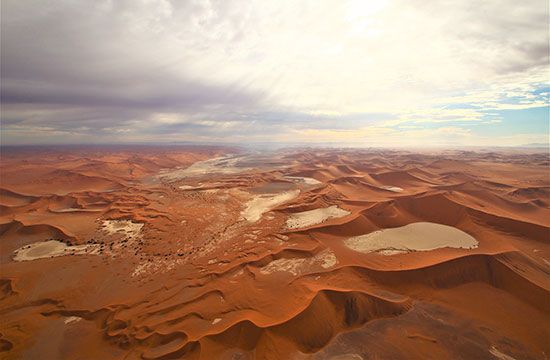
A sand mountain is an isolated, massive accumulation of sand found in open desert regions, formed by strong winds blowing from multiple directions. These formations can reach heights of up to 300 meters (1,000 feet), such as those found in the Namib Desert and Saudi Arabia.1
In plan view, they typically resemble a star with several points, featuring sharp-crested ridges that rise from the base to a central peak. Because they remain stable for centuries, they are often utilized as landmarks in desert environments. Smaller versions of these formations are known as pyramidal or star dunes.1
How do wind patterns create star dunes?
Star dunes, also known as pyramidal dunes, are formed by the action of strong winds blowing from multiple directions. Unlike dunes created by consistent, unidirectional winds—which typically result in crescent-shaped barchan dunes or straight ridges—star dunes develop where wind patterns are complex and variable.23
These formations are characterized by a central peak with several sharp-crested ridges radiating outward, resembling a star when viewed from above. Because they are built by winds shifting from various directions, they remain relatively stable over long periods, often serving as permanent landmarks in desert environments. While smaller dunes are frequently affected by lighter, multi-directional winds, these massive accumulations can reach heights of up to 300 meters (1,000 feet).21
What is the difference between a sand mountain and a barchan dune?
The primary differences between a sand mountain and a barchan dune lie in their formation, shape, and stability:
- Formation and Wind Patterns: A barchan dune is created by winds blowing consistently from one direction, whereas a sand mountain is formed by strong winds blowing from various directions.51
- Shape: Barchans are crescent-shaped, with horns pointing downwind and a distinct asymmetry featuring a gentle windward slope and a steep leeward slip face. In contrast, a sand mountain resembles a several-pointed star in plan view, characterized by sharp-crested ridges that rise from the base to a central peak.51
- Stability and Size: Barchans are migratory, moving with the wind at rates ranging from one to one hundred meters per year. Sand mountains are massive, stable formations that can remain in place for centuries, often serving as desert landmarks. While barchans are typically 9–30 meters high, sand mountains can reach heights of up to 300 meters.51
Which deserts are most famous for having large sand mountains?
Sand mountains, also known as pyramidal or star dunes, are massive, stable accumulations of sand that can reach heights of up to 300 meters (1,000 feet). These formations are most famously found in the following regions:1
- The Namib Desert: Located in Namibia, this coastal desert is home to the Namib Sand Sea, a World Heritage site featuring some of the world’s largest dunes, including those surrounding Sossusvlei.
- Saudi Arabia: This region is noted for its extensive sand mountains that serve as permanent desert landmarks due to their stability over centuries.1
- The Sahara: As the world’s largest hot desert, the Sahara contains massive, complex dune forms, including pyramidal dunes and mountainous sand ridges known as draa, which can reach heights of 1,000 feet.7
- The Takla Makan Desert: Located in China, this desert features complex eolian landscapes where pyramidal dunes frequently reach heights of 200 to 300 meters.8
Sources
- sand mountain — Encyclopædia Britannica
- sand dune - Dune and sheet patterns — Encyclopædia Britannica
- sand dune - Winds — Encyclopædia Britannica
- sand dune - Sands — Encyclopædia Britannica
- barchan — Encyclopædia Britannica
- barchan — Merriam-Webster
- Sossusvlei — Encyclopædia Britannica
- sand dune — Encyclopædia Britannica
- Sahara - Physiography — Encyclopædia Britannica
- Takla Makan Desert - Physiography — Encyclopædia Britannica
Published on · 2 min read