Sossusvlei
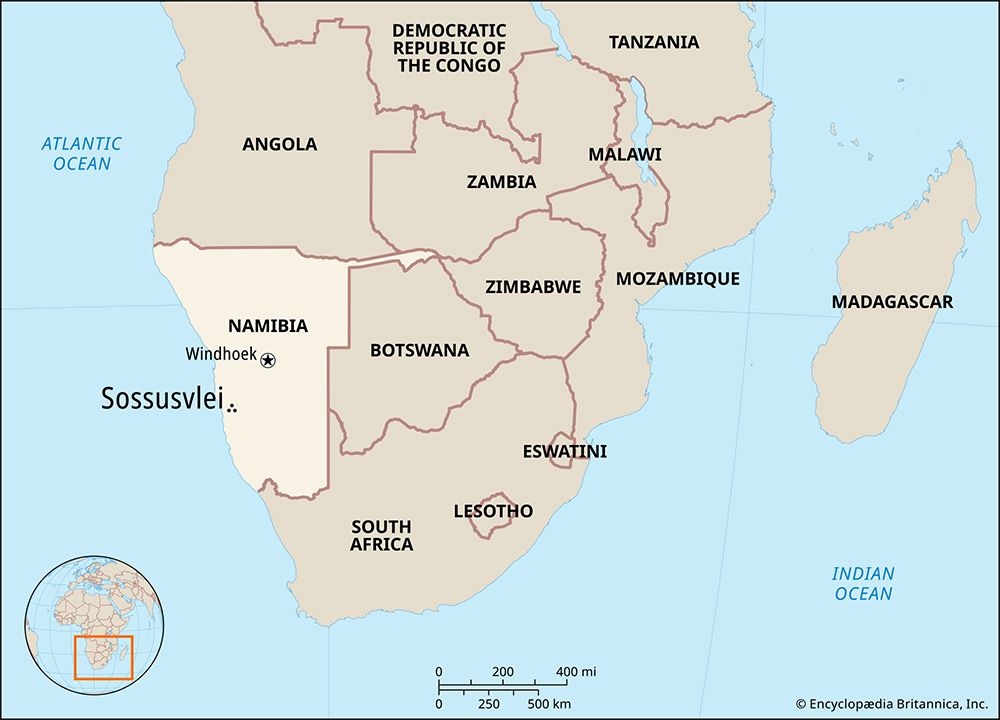
Sossusvlei is a striking salt and clay pan located in the southern region of the Namib Desert in Namibia. Situated within the Namib Sand Sea and the…
What is Sossusvlei?
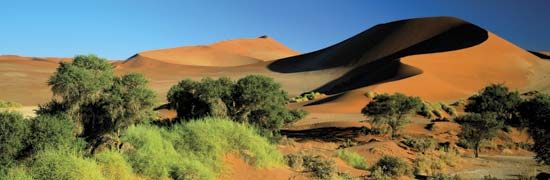
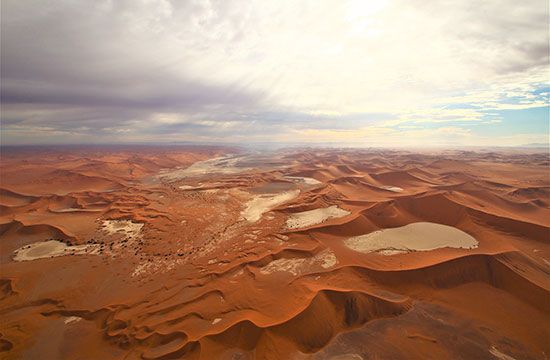
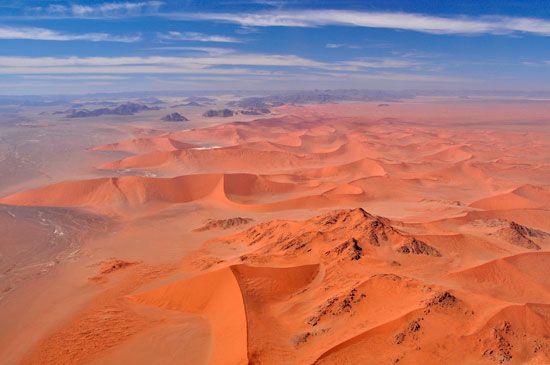
Sossusvlei is a striking salt and clay pan located in the southern region of the Namib Desert in Namibia. Situated within the Namib Sand Sea and the Namib-Naukluft National Park, it is famous for being surrounded by some of the world’s tallest sand dunes, which reach heights of up to 1,065 feet.12
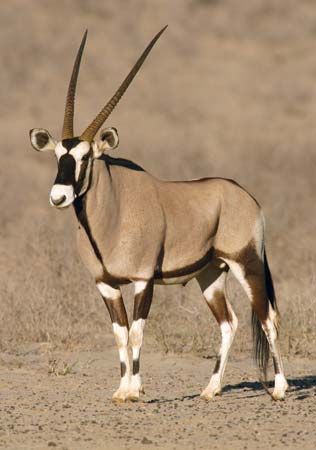
These iconic orange-red dunes, colored by iron oxide, were formed over millennia by wind-blown sediment. The area is shaped by the ephemeral Tsauchab River, which terminates at the pan. While typically a dry, white salt flat, the pan occasionally fills with water during rare heavy rains, attracting local wildlife such as gemsboks, ostriches, and springboks. Recognized as a World Heritage site, the region is unique for its reliance on fog as a primary moisture source for its endemic species.2
How do animals survive in the arid Namib Desert?
Animals in the arid Namib Desert have evolved specialized morphological and physiological mechanisms to survive in an environment where water is extremely scarce. Because the region is a fog desert, many endemic species—including invertebrates, reptiles, and mammals—rely on fog as their primary source of moisture.34
To minimize water loss, desert animals often possess skin that is relatively impervious to evaporation. For larger mammals like gazelles, cooling mechanisms help conserve internal water: as they inhale, warm air evaporates moisture in the nasal passages, cooling the nose and the blood within it. This process also cools the air before it reaches the lungs, allowing water to condense in the nose and be reabsorbed rather than exhaled.3
Reptiles, which are ectothermic, utilize behavioral strategies to manage heat and energy. By moving between sun and shade or adjusting their body orientation, they regulate their temperature without the high metabolic cost of internal heat production. This energy-efficient lifestyle allows them to survive with less food and water than warm-blooded animals.56
What are star dunes and how do they form?
Star dunes, also known as pyramidal dunes, are large, isolated accumulations of sand that resemble a several-pointed star when viewed from above. These structures feature sharp-crested ridges that rise from basal points to meet at a central peak.10
They form in open desert areas where winds blow from various directions rather than a single, constant path. While many dune types, such as barchan dunes, are shaped by consistent wind, star dunes develop in environments with complex, multi-directional wind patterns. These dunes are notably stable, often remaining in the same location for centuries, which allows them to serve as reliable landmarks for travelers in regions like the Namib Desert and Saudi Arabia. In their largest form, these accumulations can reach heights of up to 300 meters (1,000 feet).1011
Why are the sand dunes in Sossusvlei orange-red?
The iconic orange-red color of the sand dunes in Sossusvlei is the result of a thin coating of iron oxide on the individual grains of sand.2
Over tens of millions of years, wind has transported sediment from dry riverbeds, the coast, and the interior of Africa to form the massive dunes of the Namib Sand Sea. As these quartz-rich grains are exposed to the elements over vast periods, the iron oxide—essentially rust—accumulates on their surfaces, deepening the characteristic reddish hue that makes the landscape so visually striking.21
Sources
- Sossusvlei: Top Questions — Encyclopædia Britannica
- Sossusvlei — Encyclopædia Britannica
- Biosphere - Humidity — Encyclopædia Britannica
- Namib - Animal life — Encyclopædia Britannica
- reptile - Thermal relationships — Encyclopædia Britannica
- Why are reptiles cold-blooded? — Encyclopædia Britannica
- Namibia - Plant and animal life — Encyclopædia Britannica
- Namib — Encyclopædia Britannica
- Africa - Desert vegetation — Encyclopædia Britannica
- sand mountain — Encyclopædia Britannica
- sand dune - Dune and sheet patterns — Encyclopædia Britannica
- sand dune - Winds — Encyclopædia Britannica
- sand dune - Sands — Encyclopædia Britannica
- sand dune — Encyclopædia Britannica
Published on · 3 min read