Sanmiguelia
Sanmiguelia is a genus of fossil plants identified by impressions of palmlike leaves discovered in Triassic Period rock formations in Colorado.
What is Sanmiguelia?
Sanmiguelia is a genus of fossil plants identified by impressions of palmlike leaves discovered in Triassic Period rock formations in Colorado.1
These plants, which existed between 251 and 199.6 million years ago, are significant because they may represent some of the earliest known angiosperms, or flowering plants. The fossilized leaves are characterized by an elliptic shape with a pleated texture, measuring up to 40 cm (16 inches) in length and 25 cm (10 inches) in width, and were attached to the tip of a tapering stem.1
What are the main characteristics of angiosperms?
Angiosperms, commonly known as flowering plants, are a sharply defined group of seed plants characterized by several unique reproductive and structural features.2
Key Characteristics
- Enclosed Ovules: The most distinguishing feature of angiosperms is that their ovules are produced within enclosed containers called carpels, which typically mature into fruit. This contrasts with gymnosperms, whose ovules are exposed.23
- Double Fertilization: Perhaps the most characteristic feature of angiosperms is double fertilization. During this process, one sperm nucleus unites with an egg to form a zygote, while a second sperm nucleus fuses with two other nuclei in the embryo sac to form the endosperm, a nutrient-rich tissue that supports the developing seed.23
- Complex Conducting Tissues: Angiosperms possess more complex vascular systems than gymnosperms. Their water-conducting xylem typically includes specialized tubes called vessels, and their food-conducting phloem features companion cells that are ontogenetically related to the sieve tubes.2
- Flowers: While not all flowers are showy, the flower serves as the reproductive structure where pollination occurs. Pollen is received by a specialized structure called the stigma, which is often elevated on a style.23
Angiosperms are further categorized into groups such as monocotyledons, eudicots, and magnoliids, based on evolutionary lineages and structural traits like the number of embryonic seed leaves (cotyledons).4
How do scientists identify fossilized plants?
Scientists identify and study fossilized plants through the field of paleobotany, employing a variety of techniques depending on the nature and size of the remains.
Methods of Identification and Analysis
- Palynology: This discipline focuses on the study of pollen and spores. Because these microfossils are highly resistant to decay and are produced in vast quantities, they are invaluable for identifying plant groups in sedimentary rocks, even when larger fossils are absent.6
- Microscopic Analysis: Scientists use electron microscopes to analyze the morphology of pollen and spores. Additionally, they examine phytoliths—microscopic silica bodies that retain the shape of the plant cells in which they formed—and starch grains, which can be recovered from artifacts like stone tools.67
- Morphological Classification: For larger remains such as leaves, stems, and seeds, researchers assign names based on structural characteristics. Because it is often difficult to associate different parts of a single plant, scientists construct “form groups” to classify these fragments until they can be definitively linked to a specific organism.8
- Excavation and Documentation: Professional collection involves rigorous, painstaking excavation to ensure the context of the fossil within the rock strata is preserved. This documentation is essential for scientific accuracy, as opposed to nonscientific collecting, which often results in a loss of critical data.9
What other types of life existed during the Triassic Period?
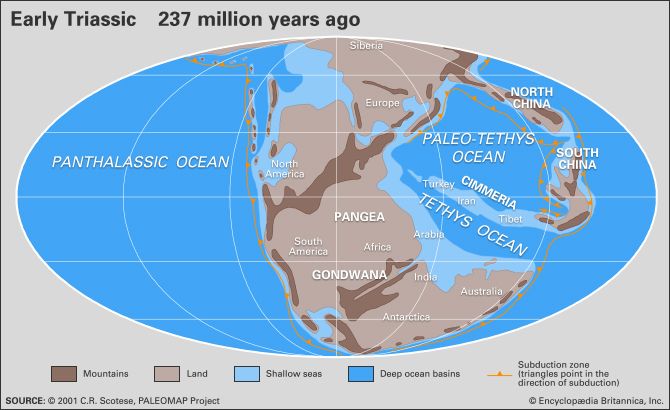
The Triassic Period (252.2 to 201.3 million years ago) was a time of significant biological recovery and diversification following the massive Permian extinction. Life during this era included a wide array of organisms across land and sea.
Terrestrial Life
- Plants: The landscape was dominated by gymnosperms, including cycads, ginkgoes, and conifers, while ferns served as the primary understory plants.12
- Reptiles and Dinosaurs: Reptiles increased in diversity, including the emergence of the first dinosaurs in the Late Triassic. Other groups included thecodonts, therapsids (mammal-like reptiles), and the ancestors of modern lizards, turtles, and crocodilians.131415
- Mammals: The very first mammals—tiny, shrewlike creatures—appeared toward the end of the period.1315
Marine Life
- Marine Reptiles: Large predators such as ichthyosaurs and nothosaurs inhabited the seas.1316
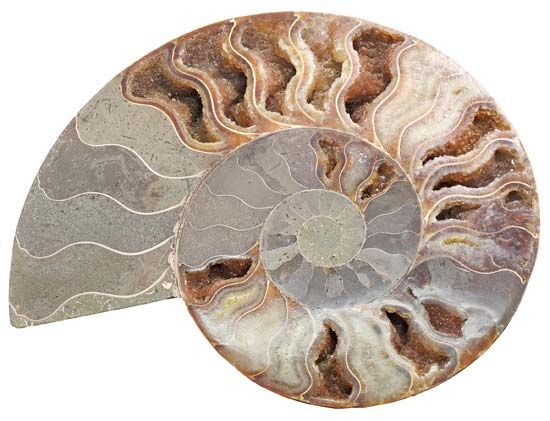
- Invertebrates and Algae: The oceans featured reef-building corals, ammonoids, and cephalopods like belemnites. Microscopic life also flourished, with the first appearance of coccolithophores and the diversification of dinoflagellates.131216
Sources
- Sanmiguelia — Encyclopædia Britannica
- angiosperm - General characteristics — Encyclopædia Britannica
- angiosperm - Paleobotany and evolution — Encyclopædia Britannica
- plant reproductive system - Angiosperms — Encyclopædia Britannica
- plant - Classification of angiosperms — Encyclopædia Britannica
- palynology — Encyclopædia Britannica
- taxonomy - Making a classification — Encyclopædia Britannica
- geology - Paleobotany — Encyclopædia Britannica
- paleobotany — Merriam-Webster
- Origins of agriculture - Research techniques — Encyclopædia Britannica
- fossil — Encyclopædia Britannica
- A Journey Through Time Since the Precambrian - Triassic Period: 252.2 million to 201.3 million years ago — Encyclopædia Britannica
- Triassic Period - Plants — Encyclopædia Britannica
- Triassic Period - The first dinosaurs — Encyclopædia Britannica
- Triassic Period - Fishes and marine reptiles — Encyclopædia Britannica
- Triassic Period - Terrestrial reptiles and the first mammals — Encyclopædia Britannica
Published on · 3 min read