King Snake
King snakes (genus Lampropeltis) are a group of terrestrial snakes native to the Americas, with a geographic range extending from southeastern Canada down to…
What is the geographical distribution of king snakes, and in what habitats can they be found?
King snakes (genus Lampropeltis) are a group of terrestrial snakes native to the Americas, with a geographic range extending from southeastern Canada down to Ecuador.1
While the provided search results do not detail specific habitat types beyond their classification as terrestrial, they are widely distributed across this vast range, with the common king snake found throughout the United States and northern Mexico. Other species, such as the milk snake, exhibit an even broader distribution, occurring across a wide range of latitudes.1
It is important to note that king snakes are distinct from king cobras (genus Ophiophagus), which are venomous snakes found in the forests of India, Southeast Asia, the Philippines, and Indonesiacom/place/Philippines), and Indonesia.2
What are the different species of king snakes, and how do they vary?
King snakes belong to the genus Lampropeltis and are generally divided into six or seven species, though some classifications recognize as many as 20–30 species. These nonvenomous constrictors vary significantly in their patterns and distributions.1
Key variations among species include:
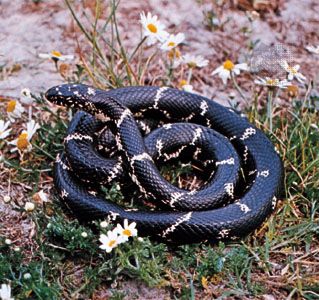
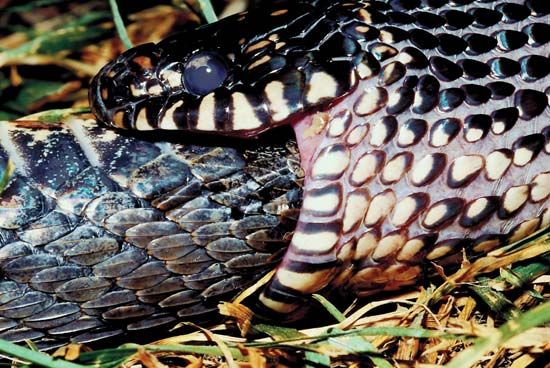
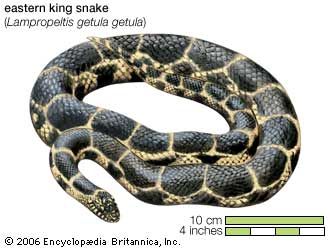
- Common king snake (L. getula): Found throughout the United States and northern Mexico, this species is highly variable in pattern, appearing in black or dark brown with yellow or white stripes, rings, crossbars, or spots. The California king snake is a notable variant that can exhibit either a ringed or a striped pattern, even within the same clutch of eggs.1
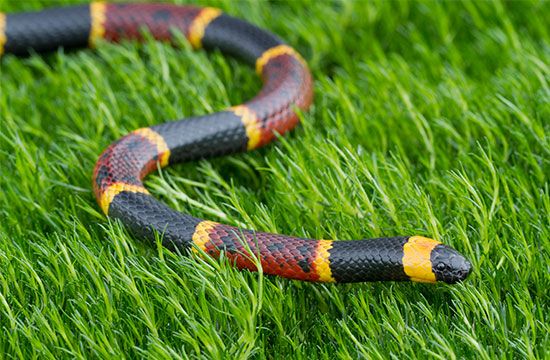
- Milk snake (L. triangulatum): Known for having one of the largest distributions of any snake, it features a tricoloured pattern of red, black, and yellow rings.1
- Scarlet king snake (L. elapsoides): A smaller species from the southeastern United States that feeds primarily on lizards.1
Both the milk snake and the scarlet king snake are often called false coral snakes because their coloration mimics that of venomous coral snakes.1
How do king snakes reproduce, and what is unique about their mating and breeding habits?
King snakes reproduce through internal fertilization, a process typical of most snakes. During the breeding season, males often engage in competitive “combat dances” to establish dominance and secure access to females, which involves entwining their bodies and attempting to press their opponent to the ground.51
Courtship involves tactile stimulation, where the male crawls over the female and taps his chin on her back to exchange pheromones, which helps ensure mating occurs between members of the same species. Copulation is achieved when the male inserts one of his two hemipenes—intromittent organs located at the base of the tail—into the female’s cloaca.51
A unique aspect of snake reproduction is the ability of females to store sperm within their oviducts, allowing them to fertilize eggs long after the initial mating event. Once fertilized, king snakes lay clutches of 5–24 eggs in protected, damp, and warm environments. Like many other snakes, they typically abandon their eggs after deposition, leaving them to incubate until they hatch.1567
How are king snakes different from other types of snakes in terms of their diet and hunting behavior?
King snakes (Lampropeltis) are distinguished from many other snakes primarily by their specialized diet and unique physiological resistance to toxins. While they are nonvenomous constrictors that consume a cosmopolitan diet of mammals, birds, lizards, and amphibians, they are most famous for their ophiophagous (snake-eating) behavior.91
Their hunting behavior is particularly notable because they actively prey upon other snakes, including highly venomous species such as rattlesnakes and copperheads. King snakes possess a natural immunity to the venom of these species, allowing them to hunt and consume them safely. Furthermore, king snakes are known to engage in cannibalism, occasionally consuming members of their own species. This predatory versatility sets them apart from many other snake species that have more restricted or specialized diets.91
Sources
- king snake — Encyclopædia Britannica
- cobra — Encyclopædia Britannica
- Lampropeltis — Merriam-Webster
- king cobra — Encyclopædia Britannica
- snake - Mating — Encyclopædia Britannica
- snake - Egg formation and laying — Encyclopædia Britannica
- reptile - Courtship and fertilization — Encyclopædia Britannica
- lizard - Parental care — Encyclopædia Britannica
- What eats snakes? — Encyclopædia Britannica
Published on · 3 min read