Sea Cucumber
Sea cucumbers (holothurians) reproduce through both sexual and asexual means, with life cycles that vary based on their developmental strategy.
How do sea cucumbers reproduce and what is their life cycle like?
Sea cucumbers (holothurians) reproduce through both sexual and asexual means, with life cycles that vary based on their developmental strategy.12
Sexual Reproduction
Most sea cucumbers have separate sexes and reproduce sexually by spawning, where males and females release spermatozoa and eggs into the water column for external fertilization for external fertilization. To improve fertilization success, they may aggregate and raise the front end of their bodies to wave them about, preventing gametes from becoming trapped in sediment.3
Life Cycle and Development
Development typically follows one of two paths:
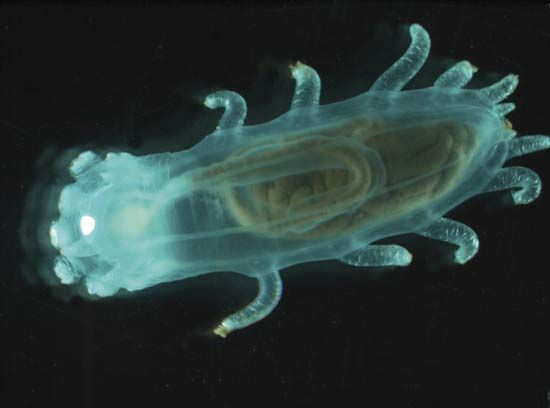
- Indirect Development: Fertilized eggs develop into free-swimming, planktonic larvae. In holothurians, this is often an auricularia larva, which may later transition into a barrel-shaped doliolaria larva before undergoing metamorphosis into a juvenile4.
- Direct Development: Some species bypass the larval stage, with females often providing parental care by brooding young on their body surface or within special pouches.4
Asexual Reproduction
Some sea cucumber species reproduce asexually through fragmentation, where the body divides transversely, followed by the regeneration of missing tissues.1
What are the main characteristics that define sea cucumbers as echinoderms?
Sea cucumbers (class Holothuroidea) are classified as echinoderms based on several fundamental biological characteristics shared with other members of the phylum Echinodermata:
- Water-Vascular System: Like all echinoderms, sea cucumbers possess a water-vascular system, a network of fluid-filled canals derived from the coelom that is essential for various physiological functions, including locomotion and respiration.78
- Pentamerous Symmetry: A hallmark of the phylum is radial pentamerous (five-part) symmetry. While sea cucumbers are elongated and exhibit bilateral symmetry on the outside, they maintain internal radial symmetry, with their tube feet and major organ systems typically arranged in five rows or radii.9
- Calcareous Skeleton: Echinoderms are characterized by a skeleton composed of calcium carbonate. In sea cucumbers, this skeleton is uniquely reduced to microscopic, bone-like structures known as ossicles or spicules embedded within the body wall.79
- Marine Habitat: Their inability to regulate the osmotic pressure of their coelomic fluid restricts them, like all other echinoderms, to strictly marine environments.8
How do sea cucumbers contribute to the health of coral reefs?
Sea cucumbers play a vital role in maintaining the health and structure of coral reefs through their feeding habits and physical contributions to the environment.
As deposit feeders, many species of the genus Holothuria ingest large quantities of sediment to extract organic nutrients. By processing this material and ejecting the remainder, they turn over vast amounts of surface sediment, which significantly alters the physical and chemical composition of the seafloor. This process helps cycle nutrients within the reef ecosystem.1213
Additionally, sea cucumbers contribute to the physical structure of the reef. Like other organisms with calcareous spicules, they provide skeletal fragments that fall or wash into the gaps between corals, helping to fill and stabilize the reef framework.14
Despite their ecological importance, many sea cucumber populations have been decimated by overfishing to meet the global demand for bêche-de-mer, raising significant concerns among ecologists regarding the potential loss of these essential reef-dwelling organisms.12
What are the different species of sea cucumbers and how do they vary?
There are approximately 1,200 species of sea cucumbers (class Holothuroidea), which are categorized into six living orders: Dendrochirotida, Dactylochirotida, Aspidochirotida, Elasipodida, Molpadiida, and Apodida.127
These species exhibit significant variation in their physical characteristics, behaviors, and habitats:
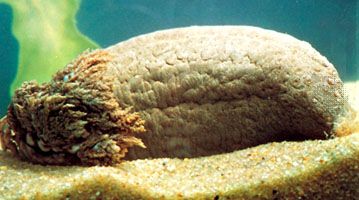
- Size and Shape: While most are cylindrical and range from 2 to 200 cm in length, they vary in texture, often appearing warty or dull-colored.12
- Locomotion: Most species move in a sluglike fashion using tube feet, though some deepwater species are capable of swimming. While many are free-moving (eleutherozoan), some have adopted a sedentary (pelmatozoan) habit, attaching themselves to the seafloor to feed on plankton.127
- Feeding Habits: Most are deposit feeders that ingest sediment to extract organic nutrients, similar to earthworms. However, others are specialized to capture plankton.127
- Defense Mechanisms: Species vary in their defensive strategies; many can expel their internal organs or sticky filaments to deter predators, and some exude toxins lethal to small animals.12
Due to high commercial demand for bêche-de-mer, many species—such as H. fuscogilva, H. whitmaei, H. scabra, and Isostichopus fuscus—have faced significant population declines.12
Sources
- sea anemone: Top Questions — Encyclopædia Britannica
- echinoderm - Asexual reproduction — Encyclopædia Britannica
- echinoderm - Reproduction and life cycle — Encyclopædia Britannica
- echinoderm - Development — Encyclopædia Britannica
- echinoderm - Sexual reproduction — Encyclopædia Britannica
- Reproduction - Life cycles of animals — Encyclopædia Britannica
- echinoderm - Annotated classification — Encyclopædia Britannica
- echinoderm - Symmetry and body form — Encyclopædia Britannica
- echinoderm — Encyclopædia Britannica
- Locomotion - Bottom locomotion — Encyclopædia Britannica
- Circulatory system - Echinodermata — Encyclopædia Britannica
- sea cucumber — Encyclopædia Britannica
- echinoderm - Role in nature — Encyclopædia Britannica
- coral reef - Corals and other reef-building organisms — Encyclopædia Britannica
- mollusk - Size range and diversity of structure — Encyclopædia Britannica
Published on · 4 min read